The 50% saving hiding in the CRAC row
Most legacy data halls still cool with belt-driven AC fans inside their CRAC units, running at fixed speed all day. Replacing those fans with speed-controlled EC fans is one of the few retrofits that pays for itself without touching chillers, pipework or the building — and the measured savings are large enough to plan a project around.
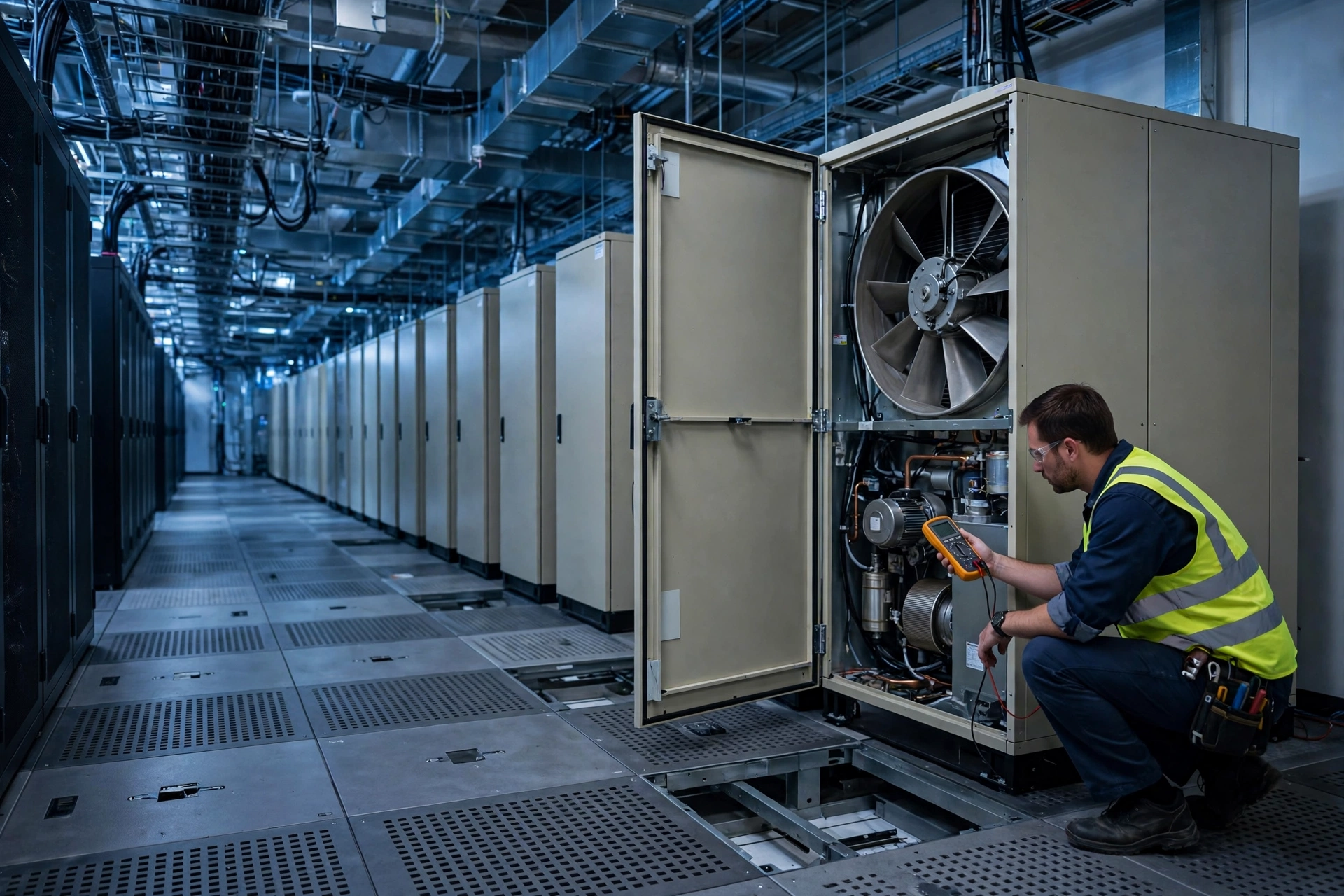
A legacy CRAC unit usually moves air with a belt-driven, forward-curved fan on an AC induction motor, running at one fixed speed. It was sized for the worst day the room was ever expected to see, and it runs at that speed through nights, weekends and winter, when the IT load is far lower. Cooling already takes roughly half of a data center's electricity, so a fan that cannot slow down is a permanent tax on the whole facility.
The measured prize for fixing it is well documented. DCD's CRAC fan analysis reports that upgrade projects replacing AC fans in CRAC units with high-efficiency EC backward-curved fans have achieved energy savings of around 50 percent on the fan itself, with a further 10 to 20 percent available from reducing fan speed, and a typical payback period of less than two years. Those are third-party project figures, not a manufacturer's brochure claim, which is exactly why they are usable in a business case.
The physics behind the number is the fan cube law: fan power rises with the cube of speed, while airflow rises only linearly. Cut speed by 20 percent and airflow falls 20 percent, but power falls by roughly half. A fixed-speed AC fan can never use that relationship. A speed-controlled EC fan lives on it, which is why the saving concentrates exactly where a data hall spends most of its hours: at part load.
What actually changes when AC becomes EC
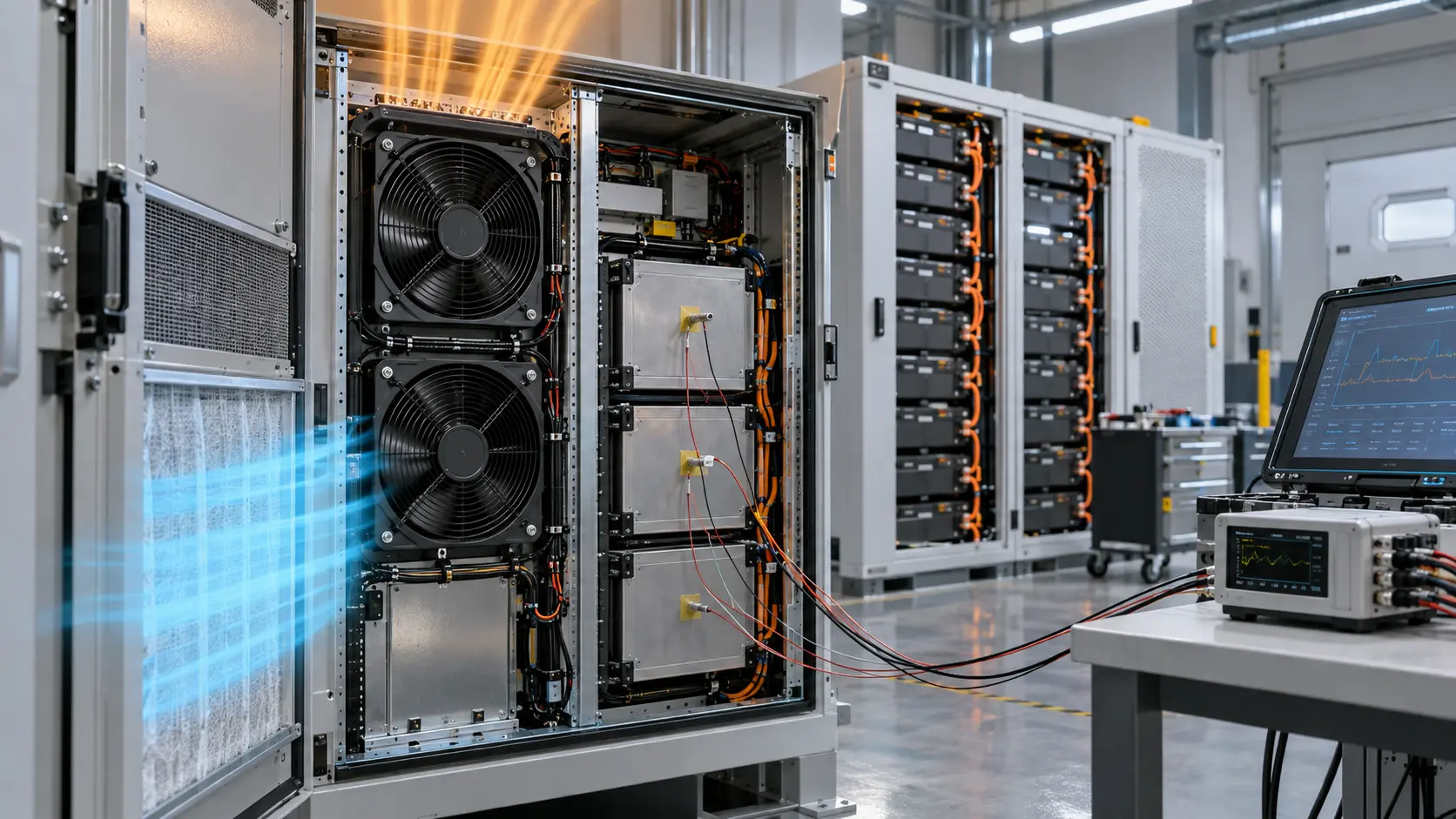
Three things change at once, and it is worth separating them because each one carries its own risk. First, the motor changes: an AC induction motor with a belt and pulleys becomes a direct-drive EC motor with integrated electronics. The belt, the pulleys, the belt tensioning and the belt dust in the airstream all disappear, and with them a routine maintenance task and a known failure mode. Second, the impeller changes: the forward-curved fan sized for one duty point becomes a backward-curved fan selected for the real operating point. Third, and most valuable, control changes: the fan gains continuous speed control, so airflow can follow the actual thermal load instead of being throttled or bypassed.
EC here is an industry facility-cooling concept, described with third-party figures throughout this guide. It is not a MEGA Tech product claim: MEGA Tech's published fan dataset covers DC axial fans, and the EC equipment in a CRAC retrofit comes from the facility-fan makers named in the sources. Keeping that attribution straight matters, because the retrofit business case rests on the third-party numbers, not on any fan vendor's promise.
The practical consequence is a different commissioning job. A fixed-speed swap is verified once, at full speed. A speed-controlled retrofit must be verified across its whole operating range: minimum speed, normal part-load speed, full-load speed, and the one-fan-out case if the room has redundancy. If the controls are not commissioned across that range, the project keeps the new hardware and loses much of the saving.

Size the replacement at the measured duty, not the nameplate
The most common retrofit failure is sizing the new fan from the old fan's nameplate. Nameplate airflow and motor size describe what the unit was sold to do, not what the room needs today. IT load, containment, blanking panels and filter condition have all changed since installation. Size from measurements taken at the unit, in its normal running state, and the project starts from truth.
Take the baseline before any vendor is asked to quote. Measure total airflow by duct traverse or calibrated grille readings with dampers in their normal state, total static pressure with a manometer across the CRAC unit and then across each section in turn, filter pressure drop across each filter bank at the measured flow, and true motor input power with a true-power meter averaged over 15 minutes at duty. Repeat the airflow run twice: if the two runs disagree by more than 5 percent, the traverse is wrong, not the room.
Never accept same outline dimensions as equivalent. A replacement fan earns its place by matching the measured duty — airflow at the measured static pressure, on the maker's curve, with a stated speed margin — not by fitting the same hole. That selection-by-operating-point rule is also how MEGA Tech treats every replacement position it is asked about, including the DC axial positions inside a CRAC retrofit project.
| Measurement | How to take it | What a usable result looks like |
|---|---|---|
| Total airflow | Duct traverse or calibrated grille readings, dampers in normal running state | Design value in m³/h, within ±5% between two repeat runs |
| Total static pressure | Manometer across the CRAC unit, then across each section in turn | A section-by-section budget in Pa that sums to the fan duty |
| Filter pressure drop | Across each filter bank at the measured flow | Actual Pa today, read against the maker's final pressure drop for change-out |
| Motor input power | True-power meter on the motor supply, 15-minute average at duty | Measured kW at duty, the baseline every saving claim is judged against |
| Supply and return air temperature | Calibrated sensors at the unit, logged over a full load cycle | A temperature profile that shows where part load actually sits |
The compliance clock: 2027 ratings, 2030 minimums
Energy saving alone would justify this retrofit. The compliance calendar makes delay expensive. DCD reports that the European Commission plans an A–G efficiency rating for data centers starting in 2027, followed by minimum standards in 2030, with asset quality judged on calculated or measured performance rather than on consumption alone. An old CRAC row running fixed-speed AC fans is exactly the kind of asset that scores badly under that kind of scheme, because its inefficiency is built into the equipment, not into how the site is operated.
The practical reading is simple: a fan retrofit completed now is a compliance measure as well as an energy measure, and it is one of the few compliance measures that pays for itself. DCD's compliance analysis lists EC fan retrofits with dynamic controls among the measures that recover efficiency in legacy facilities without replacing major cooling equipment such as chillers, CRAC units or air handlers. The same logic applies wherever an efficiency disclosure or customer audit is coming: documented fan power, before and after, is evidence a report can cite.
Treat the calendar as a planning constraint, not a reason to rush. A rushed fleet-wide swap sized from nameplates creates a second problem to fix. The sequence that survives both the energy case and the compliance case is: measure, pilot one unit, prove the saving, then roll out on the proven selection.
Controls are the second saving
The fan swap alone is worth about 50 percent. The controls add the next 10 to 20 percent, and they decide whether the first 50 percent survives contact with real operation. Dynamic control means the fan tracks real thermal load: supply air temperature, return air temperature, or rack inlet temperature drives speed, instead of a fixed setpoint chosen for the worst day. Without it, the new EC fan runs at a fixed speed just like the old AC fan, and the project keeps the hardware saving while giving back the part-load saving.
Set the control band from a standard, not from habit. The ASHRAE recommended envelope for air-cooled IT equipment is 18 °C to 27 °C at the server inlet, and many legacy rooms still deliver air below the bottom of that range, wasting cooling energy the hardware does not need. DCD cites an ENERGY STAR estimate that data centers can save four to five percent in energy costs for every 1 °F increase in server inlet temperature — but that saving is only safe once containment and airflow repairs make it possible to raise setpoints without creating hot spots.
Two control defects undo retrofits more often than any hardware fault. The first is hunting: a tight control loop with no deadband or hysteresis drives the fan up and down all day, wearing the drive and annoying everyone near the unit. The second is a sensor in the wrong place: a single return-air sensor above a hot aisle reads a different room from the one the racks experience. Put the control sensor where the protected load actually breathes, give the loop a deadband, and log speed against load for the first month so the curve can be tuned once, on evidence.
| Fan speed | Airflow | Fan power, approximate |
|---|---|---|
| 100% | 100% | 100% |
| 90% | 90% | 73% |
| 80% | 80% | 51% |
| 70% | 70% | 34% |
| 60% | 60% | 22% |
Cutover without downtime: one unit at a time
A CRAC retrofit must never take a whole room down at once. The safe sequence is one unit at a time, inside the room's redundancy. If the room runs N+1, one unit can be off while the rest carry the load; if it runs with no redundancy, the cutover needs a planned window with agreed load shedding or temporary cooling, and that window belongs in the project plan, not in a surprise.
Before the first unit is touched, agree the rollback rule in writing: if the replacement unit cannot hold airflow and static pressure at the proven duty within its first four hours, the old fan goes back in and the project stops for diagnosis. A retrofit without a rollback rule becomes a forced march, and forced marches produce the second failure mode of this kind of project — a fleet of new fans commissioned in a hurry, with no baseline, no pilot and no evidence.
The per-unit window itself is short, and that is the point. A fan swap inside one CRAC unit is a half-day to one-day job for a prepared team, including recommissioning. The expensive part is not the swap, it is the measurement before and the proving after. Budget the project that way, and the downtime conversation with operations becomes easy.
- Confirm N+1 cover for the unit being changed, in writing, before isolation.
- Isolate, lock out and prove dead: electrical, and any shared chilled-water or condensate path the work touches.
- Record the as-left duty — airflow, static pressure, motor input kW — before the unit returns to service.
- Run the unit for four hours at the proven duty before the next unit is touched.
- Keep the removed fan and belt set on site until the pilot unit passes its acceptance week.
Prove it on one pilot CRAC first
No fleet order should be placed on a vendor's saving claim. The pilot is where the claim meets the room. Pick the most representative unit — not the easiest one — fit the replacement fan and controls, sub-meter it, and run it for at least two full weeks covering a real load cycle. Sub-metering matters: a dedicated meter on the pilot unit produces clean before-and-after data that ends every internal argument, and it makes the finance reviewer an ally instead of an obstacle.
Set the pass conditions before the pilot starts, and write them into the order. Flow within ±5% of the proven duty, static pressure held at the section budget, motor input power showing the claimed reduction at matched duty, server inlet temperatures inside the ASHRAE 18 °C to 27 °C envelope, and noise no worse than the unit it replaced at the same duty. If any condition fails, the selection is wrong or the controls are wrong — either way, the fleet order waits.
The pilot also answers the question the business case cannot: what the saving is worth in this room, at this load, on this tariff. Multiply the metered kW reduction by the site's actual running hours and tariff, not by a brochure's assumed hours. That number, from the site's own meter, is the only saving figure that should appear in the rollout case.
| Check | Pass condition | Evidence |
|---|---|---|
| Airflow at duty | Within ±5% of the proven duty | Duct traverse, two repeat runs |
| Static pressure | Section budget held at the proven duty | Manometer readings across the unit |
| Motor input power | Reduction shown at matched duty, on the meter | Sub-metered kW before and after |
| Server inlet temperature | Inside the ASHRAE 18 °C to 27 °C envelope | Logged inlet sensors over two weeks |
| Noise at duty | No worse than the unit replaced, at the same duty | Sound reading at 1 m, same position |
| One-fan-out behaviour | Remaining capacity holds the protected load | N+1 test with one unit isolated |
What the vendors' guarantees do and do not cover
A new kind of vendor offer is entering this market, and it is worth understanding exactly what it promises. ebm-papst's NEXAIRA.Fit announcement of 20 October 2026 adds an energy efficiency guarantee to its retrofit solution: simply replacing the fan technology can generate energy savings of up to 50 percent, and with additional digital optimization features, savings of up to 70 percent are possible, depending on the application and operating conditions. The guarantee itself is issued by ebm-papst to the customer, and the guarantee model is financially backed by Great Lakes Insurance SE, a subsidiary of Munich Re.
Read that sentence the way a contract reader would. Up to 50 percent is a fan-only figure; up to 70 percent needs the digital optimization layer, with its gateways, monitoring and service contract. Both figures depend on the application and operating conditions, which means the guarantee is only as good as the baseline measurement and the operating profile it is written against. A guarantee written against a nameplate, or against a load profile the room never sees, is not a guarantee worth paying for.
The useful response is to ask any vendor offering a saving guarantee for three things: the baseline protocol the guarantee is measured against, the operating conditions the figure assumes, and what happens when the room's load changes after the retrofit. If those three answers are in writing, the guarantee is a genuine risk transfer. If they are not, it is marketing, and the pilot meter remains the only promise that counts.
A real retrofit, measured
Vendor guarantees are one thing; a metered project in a live facility is another. Vertiv's Singapore telecom CRAC retrofit case describes a telecommunications provider that upgraded aging CRAC units with EC fans across two data centers, without a major infrastructure overhaul. Cooling load fell by over 70 percent across the two sites: from 24 kW to 7.5 kW at the six-unit CRAC retrofit site, and from 18 kW to 5 kW at the four-unit site, with return on investment in three months.
Treat that case the way its numbers deserve: as proof that the top end of the range is real, and as a warning against quoting it as typical. Three-month payback on a cooling-load reduction of that size implies a room that was badly oversized or badly controlled before the retrofit — exactly the rooms where this project class shines, and exactly why the baseline measurement matters. A room that is already well controlled will land nearer the 50 percent fan saving, not the 70 percent cooling-load figure, and a business case built on the wrong end of the range will disappoint.
The transferable lesson is the method, not the headline number: retrofit the fans, add variable-speed control, measure before and after on the meter, and let the site's own data set the rollout pace. That method works whether the room lands at 40 percent or 70 percent, and it is the method this guide's checklist follows.
Where MEGA Tech fits — and where it does not
MEGA Tech is a custom cooling-fan manufacturer. What the company does, in the form its customers actually buy, is five things: custom cooling-fan development and manufacturing, fan selection, airflow-path review, sample validation, and batch production. A CRAC retrofit project touches that capability at a specific point: the replacement positions inside the project that are DC axial fans, where the customer needs a fan selected for a measured operating point and proven by a sample on the customer's own unit.
That boundary is deliberate. MEGA Tech does not supply coils, liquid loops, controllers, cabinet safety design or emergency ventilation, and it does not supply complete fan-wall cabinets or rear-door heat exchanger systems. The EC facility fans in a CRAC retrofit come from the facility-fan makers, with their figures attributed to them as this guide does. What MEGA Tech supplies is the DC axial fan, selected by operating condition rather than by part number, and validated the same way every MEGA Tech sample is validated: on the customer's unit, at the customer's duty.
To ask about a replacement position, send the information a selection actually needs: the airflow and static pressure at that airflow, the temperature basis, the voltage and its tolerance, the control interface, the connector, the mounting envelope, the noise target, and the life assumption. With those values, a sample can be built and proven. Without them, any vendor — including MEGA Tech — is guessing, and a retrofit built on guesses is how a fleet ends up with the wrong fan in every unit.
Engineer FAQ
Q: How much can a CRAC AC-to-EC fan swap really save? A: Third-party project figures report around 50 percent on fan energy from the swap alone, plus a further 10 to 20 percent from speed reduction, with typical payback under two years. Your room's figure comes from the pilot meter, not from any vendor's brochure.
Q: Do I need to replace the whole CRAC unit? A: No. The retrofit replaces the fan and adds speed control inside the existing unit. DCD lists EC fan retrofits with dynamic controls among the measures that recover efficiency without replacing major cooling equipment such as chillers, CRAC units or air handlers.
Q: What if the room has no N+1 redundancy? A: Then the cutover needs a planned window with agreed load shedding or temporary cooling. Never take a whole room down for a fan swap, and never gamble a live room that cannot lose one unit.
Q: Does the EC fan need a new control system? A: It needs a speed signal and a control sensor in the right place — supply or return air temperature, or rack inlet temperature — with a deadband so the loop does not hunt. The sensor position matters more than the controller brand.
Q: How do I know the saving is real? A: Sub-meter the pilot unit and compare metered kW before and after at matched duty, over at least two weeks covering a real load cycle. That metered figure is the only one the rollout case should use.
Q: What should I send MEGA Tech for a DC axial replacement position? A: Airflow and static pressure at that airflow, temperature basis, voltage and tolerance, control interface, connector, mounting envelope, noise target, and life assumption. A sample is then built and validated on your unit at your duty.
Questions for a Design Review
Bring these answers, with measured values attached, before a CRAC fan retrofit is released beyond the pilot unit.
- What is the measured duty today — total airflow, the section-by-section pressure budget, and motor input kW at that duty?
- Which replacement fan holds the duty point at or below 90% of maximum speed on the maker's curve, with the section budget included?
- What is the cutover window per unit, and does the room hold its thermal margin with one unit isolated?
- Which control signal drives fan speed, where is the sensor, and what deadband stops the loop hunting?
- What are the pilot pass conditions — flow, pressure, power, inlet temperature, noise, one-fan-out — and who signs them before the fleet order?
- What does any saving guarantee assume — baseline protocol, operating conditions, and what happens when load changes — and is it in writing?
- For every DC axial position the project touches: what are the airflow, static pressure, voltage, control interface and mounting envelope for the replacement sample?