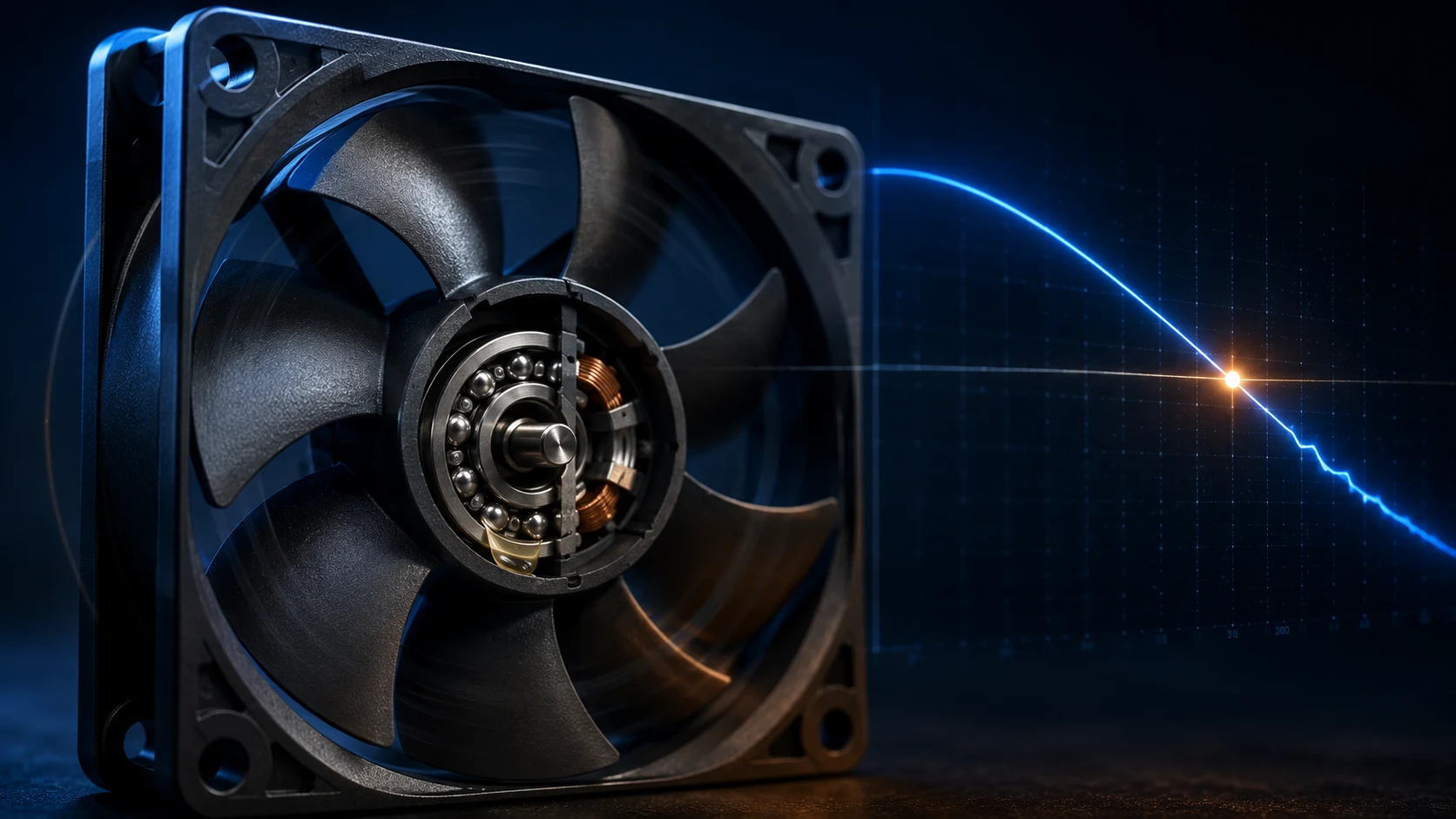
The bearing system is the lifetime decision
Frame size, airflow and interface can all be changed later in a project. The bearing system cannot be changed without changing the fan — and it decides how long the fan survives in your machine's temperature, orientation and dust.
Every cooling fan conversation eventually reaches the same arithmetic: the electronics are specified for a service life, the machine runs hotter than the datasheet room, and the fan is the component most likely to end that service life early. What sits between the motor and that failure is the bearing system — and electronics fans offer four families: oil-impregnated sleeve bearings, ball bearings, fluid dynamic bearings, and magnetic levitation as a manufacturer-documented fourth.
The selection is a duty problem, not a quality ranking. Each family earns its place: sleeve bearings where cost and initial quietness dominate and the duty is gentle; ball bearings where temperature, orientation and load are severe; fluid dynamic bearings where long life and low noise must coexist; magnetic levitation where the manufacturer's documented approach to contact-free operation matches the environment. A bearing system that is the wrong answer in a vertical, 70 C telecom cabinet is the right answer in a horizontal, 35 C office device — the duty decides.
This guide defines the four systems, works the temperature and orientation arithmetic that compares them honestly, and ends with the validation step that turns a datasheet life claim into evidence. The life arithmetic is shared with the fan lifetime and bearings guide; here the question is narrower: which system does your duty call for?
What the four systems actually are
The mechanics differ in how the shaft is supported, and that difference drives everything: temperature sensitivity, orientation tolerance, noise behaviour and cost.
A sleeve bearing supports the shaft on a plain, oil-impregnated bronze journal. There is no rolling element — the shaft rides on a thin oil film. The system is inexpensive and quiet when new, but its life depends on retaining that oil: high temperature evaporates the lubricant, and the shaft's own weight loads one side of the journal. Sleeve bearings are at their best in gentle duties: horizontal or near-horizontal mounting, moderate ambient, modest life targets.
A ball bearing system replaces the film with rolling elements — hardened balls in a race. Contact loads are carried by steel instead of oil, so the system tolerates higher temperatures, any mounting orientation and shock or tilt, with published life curves at elevated temperatures. The costs are acoustic (rolling contact has a signature) and component precision. This is the system of telecom, industrial and high-temperature duties.
A fluid dynamic bearing (FDB) also supports the shaft on oil, but on a self-pressurising wedge generated by rotation — the geometry keeps the shaft centred without metal contact at speed. Well-designed FDBs combine long documented life with very low noise, which is why they dominate quiet consumer and office equipment; their temperature and orientation tolerance depends on the specific design and must be read from the datasheet rather than assumed.
Magnetic levitation — documented in the market by SUNON's MagLev platform — suspends the rotor magnetically and removes mechanical contact from the equation entirely. It is a real engineering approach with documented claims, and it reads like every other system in this guide: the manufacturer's life and environmental data, converted to your duty, decides.

| System | How the shaft is supported | Characteristic strength | Characteristic limit |
|---|---|---|---|
| Sleeve | Oil film in a plain journal | Cost and initial quietness | Oil loss at temperature; orientation loads one side |
| Ball | Rolling elements in a race | Temperature, any orientation, shock tolerance | Rolling-contact noise signature; precision cost |
| Fluid dynamic | Self-pressurising oil wedge | Long life with very low noise | Design-dependent temperature and orientation limits |
| Magnetic levitation | Magnetic suspension, no contact | Contact-free operation, documented platform claims | Availability within specific product families |
Temperature: the arithmetic that compares the four
Life claims are quoted at reference temperatures chosen by each manufacturer. Converted to the machine's real inlet temperature, the rankings sometimes reverse — which is why the conversion comes before any comparison.
The rule of thumb shared across bearing and capacitor practice is Arrhenius-based: every 10 C rise in lubricant temperature roughly halves the life. A sleeve bearing quoted at 30,000 hours in a 35 C reference and a ball bearing quoted at 50,000 hours in a 60 C reference are not comparable as printed. Put both in a cabinet whose fan inlet reaches 60 C at worst case: the sleeve's lubricant runs far above its comfort zone and its real life collapses; the ball bearing's published 60 C curve applies nearly as printed.
The conversion direction matters as much as the arithmetic. A fluid dynamic bearing quoted at 40 C may outlast a ball bearing in a 40 C machine and lose to it in a 70 C machine, because each system's curve bends differently as the oil film thins. The datasheet life curve — not the single headline number — is the source, and where a manufacturer publishes life only at one temperature, that is a question for the supplier, not a detail to ignore.
Dust and lubricant loss complete the temperature story. Sleeve and fluid dynamic systems both live on retained oil; a dusty, hot path accelerates lubricant degradation, and a horizontally mounted sleeve in a hot path loses oil to gravity at the same time. Where the environment is severe, sealed ball bearings or a documented MagLev platform change from premium options to the durable ones.
Orientation, noise and the end of life
Two duty properties that never appear in the life number — mounting orientation and end-of-life behaviour — separate the systems as sharply as temperature does.
Orientation: a horizontal shaft loads a sleeve journal unevenly, and a vertical shaft loads it worse still, because gravity works on the oil distribution as well as the shaft. Ball bearings carry radial and axial loads by construction and are indifferent to orientation; fluid dynamic designs vary, with some documented for vertical operation and others not. A fan specified horizontally but mounted vertically has already left its selection envelope — this is a checkpoint, not a preference.
Noise at start of life: sleeve and fluid dynamic systems are quieter than ball bearings when new, because there is no rolling contact. In a quiet office device this decides the selection toward FDB or a well-made sleeve; in a rack with forty fans, the bearing signature disappears under airflow noise and the decision returns to life and temperature.
Noise at end of life is the more useful signal. A sleeve bearing that has lost its lubricant gets louder as the film breaks down — the noise is the failure warning. A ball bearing's signature is more stable across its life, then degrades as the race wears. Fluid dynamic and magnetic levitation systems tend to stay quiet until near the end. Knowing which warning your system gives changes the service interval design: a machine built on sleeve bearings needs its acoustic check scheduled, not left to the operator's ears.
How life is documented — and what to ask a supplier for
L10 is a statistical statement, not a promise about your unit: at the quoted hours, ten percent of a population is expected to have failed. Reading the claim correctly is part of the selection.
A life claim has three parts: the L10 hours, the reference temperature, and the failure definition — usually a speed drop below a threshold or a noise limit. A claim that states only the hours is incomplete, and the questions that complete it are cheap: at what temperature, against what failure criterion, and from what population size. A manufacturer who answers all three with a published curve is offering comparable data; a manufacturer who answers with a rounded headline number is offering marketing.
The population context matters for service planning. L10 means ten percent of fans are expected to fail by those hours — which is a fleet statistic, not a per-unit guarantee. Designs that need higher confidence read the same curve at L1 or L5 where the manufacturer publishes it, or specify a service interval from the L10 number with a stated margin. The replacement selection method applies the same margin discipline to fan curves; here it applies to life curves.
What to ask for, concretely: the life-versus-temperature chart across the full ambient range, the failure criterion behind it, the mounting orientations it was measured in, and any endurance test report behind the endurance re-check you will run. Suppliers with their own manufacturing answer these from test data; suppliers without it answer from someone else's brochure — and the difference shows up in the sample's endurance re-check, not in the quotation.
| Part | What it states | Why it matters |
|---|---|---|
| L10 hours | Hours by which 10% of a population is expected to fail | A fleet statistic — plan service intervals with margin |
| Reference temperature | The inlet or winding temperature the claim was measured at | The conversion to your real inlet temperature starts here |
| Failure criterion | Speed drop, noise limit or functional stop that counts as failure | Defines what actually ends the fan's service in your machine |
| Orientation basis | How the test population was mounted | A claim measured horizontally may not survive a vertical mount |
Matching the system to the duty
Four duty parameters — worst-case temperature, mounting orientation, dust load and noise limit — select the bearing system. The table is the short version of everything above.
The selection is rarely close once the four parameters are written down. Gentle duty — horizontal, 35 C, clean, cost-sensitive — is sleeve territory. Hot, vertical, dusty, long-service duty is ball bearing territory, with magnetic levitation as the documented alternative where the platform exists. Quiet duty with a long service target and a controlled environment is fluid dynamic territory. The judgment calls live at the boundaries, and the boundaries are exactly where the temperature conversion and the orientation checkpoint earn their keep.
One more duty parameter is frequently forgotten: service strategy. A fan that will be replaced on a fixed interval in an accessible cabinet can carry a shorter-lived, quieter, cheaper system; a fan sealed into a distributed product that must outlive its warranty has no such option. The bearing selection is a lifecycle decision, and the sample validation in the real enclosure protocol — including the endurance re-check — is how the choice is proven before the product ships.
| Duty | Recommended system | Watch out for |
|---|---|---|
| Horizontal, ≤ 40 C, clean, cost-sensitive | Sleeve | Oil loss rises fast with temperature; keep the duty gentle |
| Hot (≥ 60 C), vertical, dusty, long service | Ball (or documented MagLev) | Rolling noise signature; verify the life curve at the real temperature |
| Quiet office device, controlled environment, long life | Fluid dynamic | Orientation and temperature limits are design-specific — read the datasheet |
| Coastal or corrosive exposure, any temperature | Sealed ball or MagLev with coated board | Salt fog severity per IEC 60068-2-52; coating variant in the option code |
| Sealed product, inaccessible after assembly | Ball or FDB with endurance-validated sample | No second chance — the endurance re-check is the gate |
What MEGA Tech does with bearing system selection
We manufacture fans across the bearing families — ball, fluid dynamic and sleeve — and the bearing question is one of the first we settle with a customer, because it decides the fan long before the connector is chosen.
What we do: tell us the duty — worst-case inlet temperature, orientation, dust and noise limit, service strategy — and we propose the bearing system that matches it, with the life curve converted to your real temperature and samples for the validation protocol, including the endurance re-check. Where the duty sits at a boundary between systems we will say so, and where a quieter, cheaper system genuinely covers the duty we will not sell you the premium one.
What we need from you: the worst-case environment (temperature at the fan inlet, orientation, dust, corrosive exposure), the acoustic limit at the operator position, the service life the product promises, and whether the fan is serviceable after assembly. Those five facts select the system; the rest of the fan follows from them.
Where our boundary is: we do not supply liquid cooling loops, heat pipes, cabinet safety design or fan controllers. Our scope is the fan — and the measured data that lets your team verify the bearing decision in the machine, not in the catalogue.
Engineer FAQ
The questions engineers actually ask about bearing selection, with the short engineering answers.
Q: Is a ball bearing fan always better than a sleeve bearing fan? A: No. Ball bearings win on temperature, orientation and shock; sleeve bearings win on cost and initial quietness. A sleeve in a gentle duty is the correct engineering answer, not a compromise.
Q: The datasheet says 50,000 hours. Is that the life in my machine? A: Only at the reference temperature and orientation the datasheet states. Convert the claim to your worst-case inlet temperature with the 10 C halving rule, and check the mounting orientation against the datasheet's envelope.
Q: Do fluid dynamic bearings work mounted vertically? A: Design-specific. Some FDB platforms document vertical operation; others do not. Read the manufacturer's mounting envelope — assuming it is the most common way an FDB selection goes wrong.
Q: What actually kills a sleeve bearing? A: Lubricant loss — accelerated by temperature, gravity and dust. The audible signature rises as the film breaks down, which is why acoustic checks are part of service design for sleeve-based machines.
Q: Is magnetic levitation worth the premium? A: It is worth evaluating where the environment is hot, dusty or orientation-critical and the platform's documented claims cover your duty. It is evaluated the same way as every other system: converted life curve, environmental data, validated sample.
Q: Can I verify the bearing decision before mass production? A: That is exactly what the endurance re-check in the validation protocol is for: run the agreed hours at the real temperature and re-verify noise, speed behaviour and thermal margins before the product ships.
Questions for a design review
Take these to the review with the duty specification and the candidate life curves on the table.
The bearing decision is the lifetime decision. These questions close the gaps that produce early field failures, and every one can be answered before samples are ordered.
- What is the worst-case air temperature at the fan inlet, and has every candidate's life claim been converted to it?
- What orientation will the fan actually run in, and does each candidate's datasheet envelope cover it?
- What dust and corrosive exposure does the path impose, and which coating or sealing variants answer them?
- What is the acoustic limit at the operator position, and which systems meet it at both start and end of life?
- What service strategy does the product assume — replaceable fan or sealed assembly — and does the bearing system match it?
- Has the endurance re-check been scheduled with hours that reveal bearing behaviour at the real temperature?
- Who owns the decision if the life converted at the real temperature falls short of the product's warranty promise?