Why a loose-fan test is not enough
A fan can pass a catalogue test and still miss the product target once the real enclosure, filter, grille and heat sources are installed.
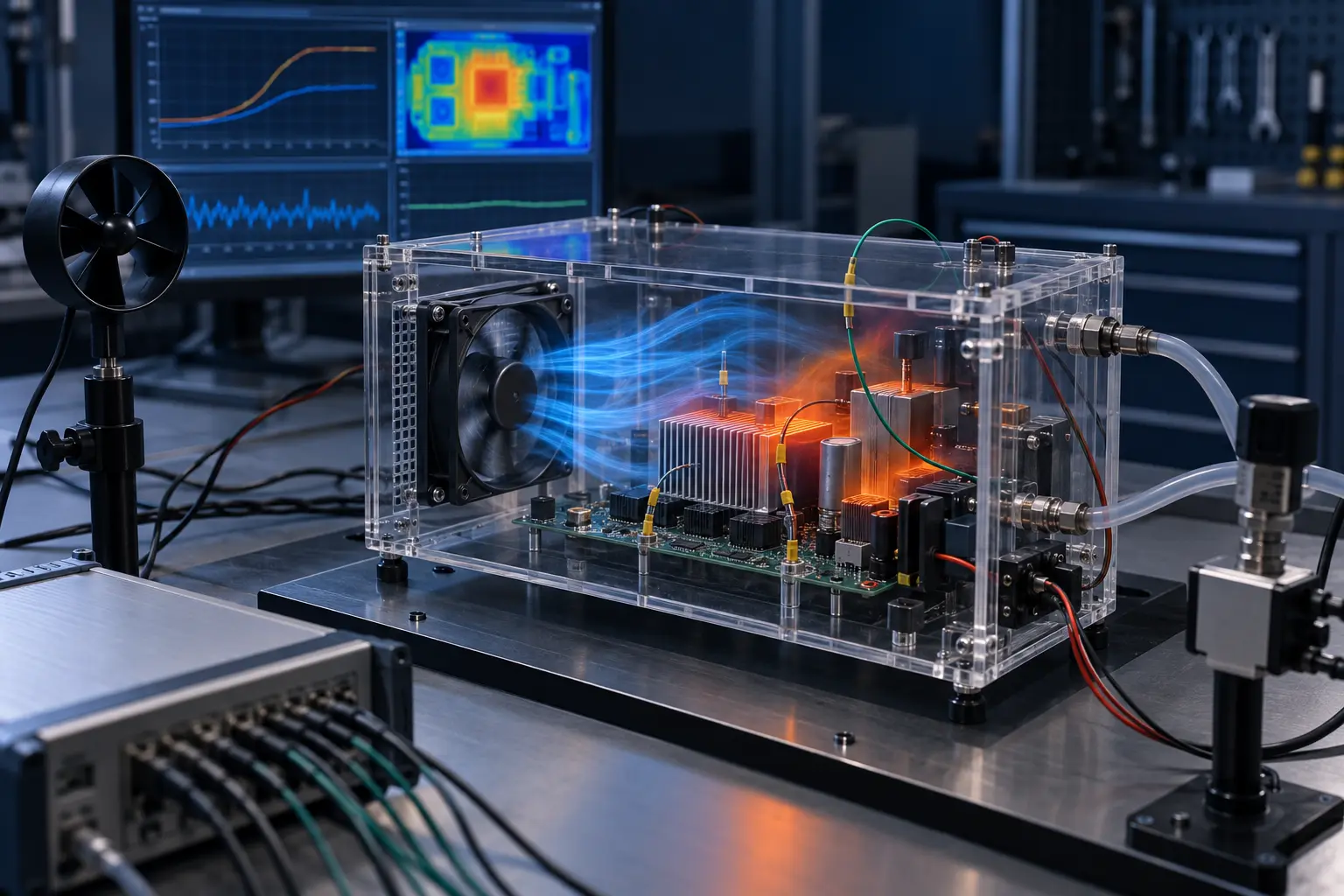
Free-air airflow is useful for comparing a fan family, but it does not answer what the fan delivers through the customer's restrictions. The product test must preserve the final mounting, inlet and outlet geometry, cable routing, heat sink, filter, controller and expected operating orientation.
The purpose of a sample is not only to prove that the fan spins. It is to confirm the operating point, temperature margin, noise, power, control behaviour and reliability risks before the configuration becomes difficult to change.
- Use the final or representative mechanical path.
- Measure the fan inlet condition and component temperatures.
- Keep voltage, speed and control settings recorded.
- Treat a sample as an engineering decision, not a sales demonstration.
Build a test matrix around the real duty
A single point can show that the design works. A small matrix shows where it stops working.
At minimum, test the normal design point and the credible worst case: peak heat load, highest fan-inlet temperature, minimum supply voltage, maximum intended speed, loaded filter and the real control profile. If the product has different modes, record each mode's airflow and thermal result.
For high-temperature equipment, wait for thermal steady state and record the time, sensor locations and ambient conditions. For variable-speed fans, capture commanded duty, actual RPM, current, power and tachometer signal. This creates evidence that can be compared between samples and production lots.
- Normal load and peak load.
- Clean and loaded filter.
- Minimum voltage and intended maximum speed.
- Cold start, hot restart and required start-stop cycling.
- Normal mode and fault response where applicable.
Measure what the customer will approve
The acceptance record should connect fan data to product performance, not list isolated catalogue numbers.
Measure airflow or local velocity with a defined method, and measure static pressure at locations that describe the installed path. Measure noise with the background level, distance, operating point and enclosure state recorded. A sound number without the test setup is difficult to compare.
Use thermocouples or other sensors at the critical components and at the fan inlet. Add vibration, current and tachometer trend data when bearing, mounting or service life is important. The aim is not to collect every possible number; it is to collect the numbers that decide the release.
- Airflow or velocity at the required location.
- Static pressure across the real restriction.
- Fan inlet and critical component temperatures.
- RPM, current, power and alarm signals.
- Noise and vibration with test conditions.
Write the acceptance record before the test
A sample should be approved against a written decision rule, not against a moving interpretation of the results.
For each required operating state, put the target and the measured result in the same record: airflow or local velocity, pressure definition and location, fan-terminal voltage, current or power, commanded duty, actual RPM, inlet temperature, critical component temperature, noise and fault feedback. This keeps a fan that meets airflow but violates noise, power or temperature limits from being approved accidentally.
Set the acceptance limits from the customer's product requirements, measurement capability and risk analysis. A practical record can classify each item as pass, conditional review or fail, while preserving the raw readings and test conditions. Do not replace a missing measurement with a catalogue maximum, and do not turn one prototype result into a production tolerance without checking sample-to-sample variation.
When the sample passes, attach the approved drawing, controller settings, fixture or enclosure configuration, sensor map, test method, sample identification and change-control rule. This is the evidence package that lets the next engineer reproduce the decision and lets production detect drift.
- Define pass/fail limits before the sample run.
- Record target, measured result, condition and uncertainty together.
- Separate catalogue data, engineering estimates and application measurements.
- Keep raw data and configuration identifiers with the approval record.
- Repeat affected tests after a fan, controller, filter, mounting or enclosure change.
Turn sample results into a production baseline
A successful sample is only useful when the approved configuration can be repeated.
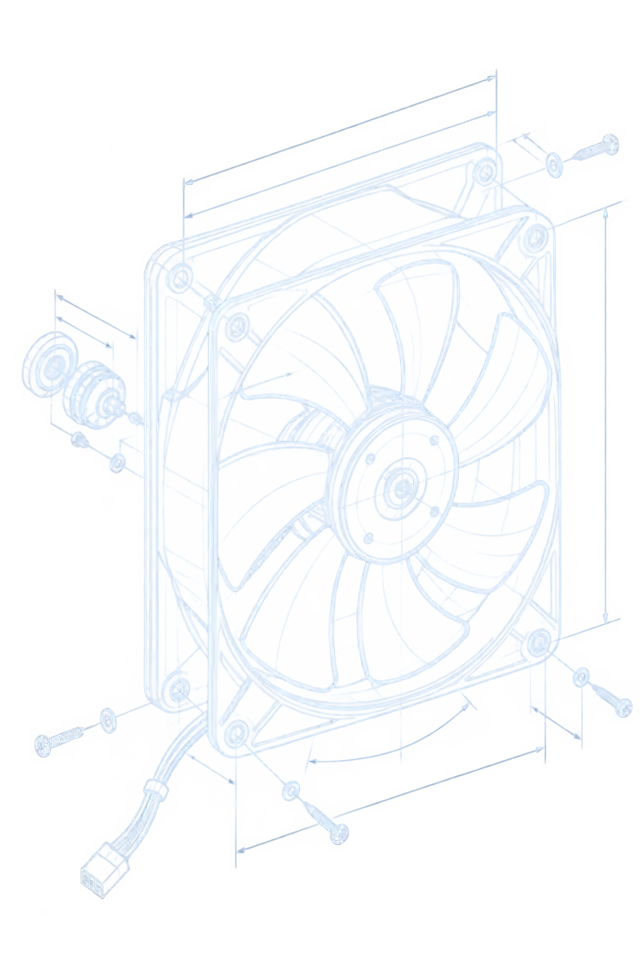
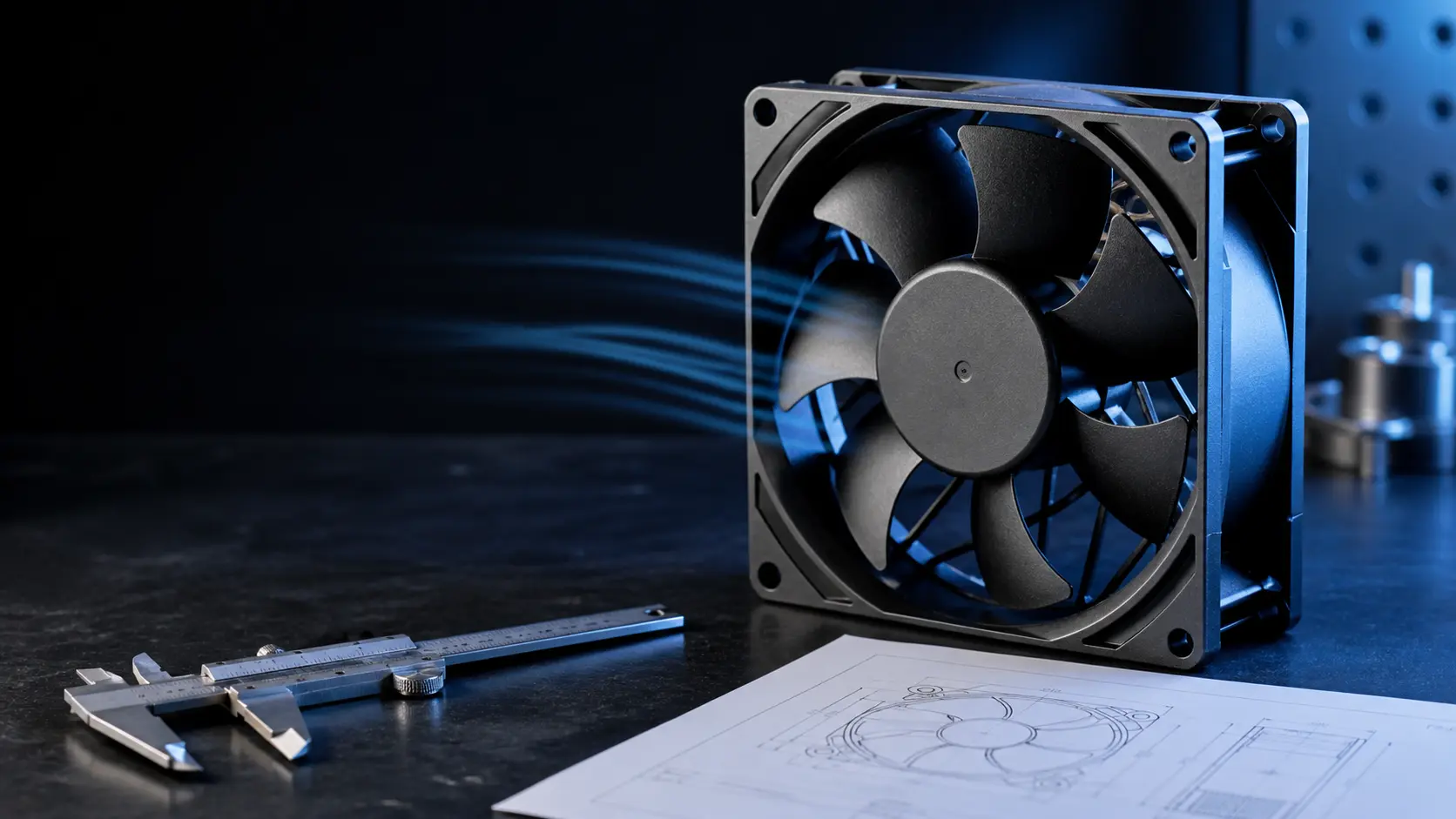
Record the exact frame size and thickness, motor, bearing, voltage, speed, airflow-pressure point, connector, cable length, rotation, mounting and control interface. Record the environmental and acoustic limits used for approval. If a design change is made later, repeat the checks that the change could affect.
MEGA Tech's customization path is requirement, sample, customer evaluation and controlled volume production. The production baseline should preserve the agreed performance window and clearly identify which values are catalogue data, bench measurements, project results or engineering estimates.
- Freeze the approved drawing and interface definition.
- Keep the test setup and acceptance limits with the configuration.
- Recheck changes to fan, filter, mounting or controller.
- Use lot or sample data to protect repeatability.
Engineer FAQ: validating a custom fan sample
These questions keep sample approval focused and repeatable.
Q: Can we approve a fan from its Max CFM value? A: No. Confirm the airflow at the product's pressure and temperature conditions.
Q: How long should we run the test? A: Long enough to reach a defined thermal steady state, plus any required startup, cycling or environmental test duration.
Q: Should the filter be installed? A: Yes, if it is part of the product. Test clean and specified loaded conditions when maintenance affects performance.
Q: What if the fan meets airflow but is too noisy? A: Revisit the operating point, fan size, speed, inlet/outlet geometry, vibration isolation and control profile; do not solve noise by hiding the thermal shortfall.
Q: What should be frozen before volume production? A: Drawing, bearing and motor configuration, voltage, RPM, P-Q point, interface, mounting, environmental limits, acceptance method and change-control rules.
- Validate the installed point, not free air only.
- Use a defined worst-case matrix.
- Record the full configuration and test method.
- Carry the approved sample into repeatable production.
Make the Validation Repeatable
A test result is only useful for a production decision when another engineer can reproduce the measurement and understand its uncertainty.
Define the instrument, calibration status, sampling interval, sensor position and calculation method for each acceptance value. Airflow and pressure are especially sensitive to measurement planes, straight lengths, swirl and leakage. A thermocouple moved a few millimetres or a pressure tap placed in a recirculation zone can change the apparent result without changing the fan.
Run repeated measurements at the same duty point and record the spread. Separate repeatability from the allowed product tolerance and from instrument uncertainty; do not hide all three inside one unexplained percentage. If the sample result is close to the acceptance limit, improve the measurement setup or use a more appropriate method before making a release decision.
Agree the sample quantity and acceptance rule before testing. One prototype can identify a design direction, while repeated samples or a defined production check are needed to understand variation in the approved configuration. The result should identify whether it is a screening test, an engineering validation, a contractual acceptance test or a production-control check.
- Document instrument type, calibration, sensor location and data-reduction method.
- Repeat the same duty point and record measurement spread.
- Separate repeatability, product tolerance and instrument uncertainty.
- Define sample count, acceptance rule and test purpose before the run.