Why normal RPM does not prove normal cooling at altitude
An EV fast charger installed in a high-temperature or high-altitude site can report the expected fan RPM and still lose thermal margin. The fan is rotating, but the air is less dense, the pressure capability changes and each cubic metre carries less heat away.
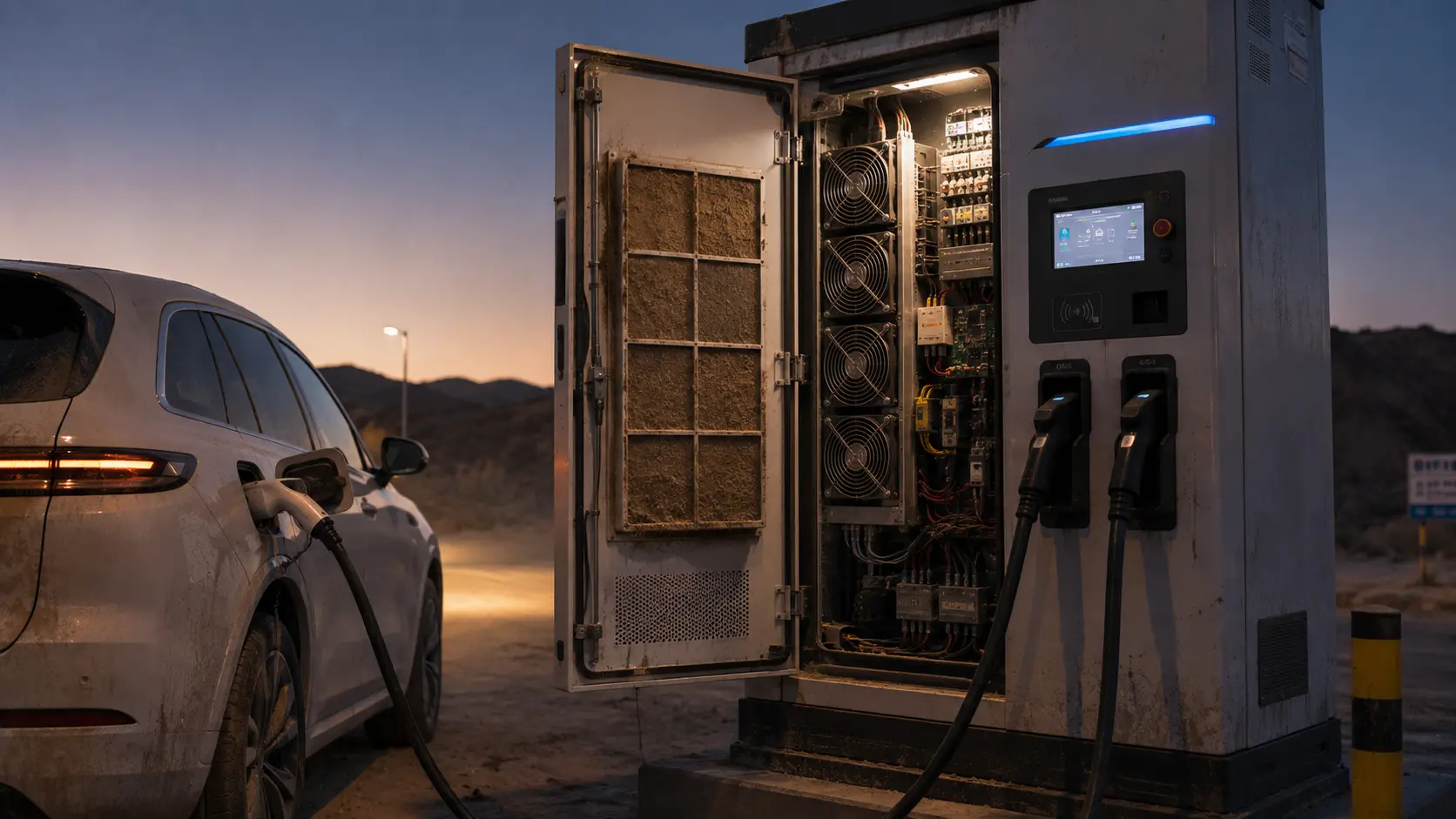
This matters in mountain depots, plateau charging sites, desert locations and installations where a hot cabinet inlet combines with reduced barometric pressure. A design validated at sea level and 25 C may therefore derate earlier than expected, even when the controller sees a healthy fan signal.
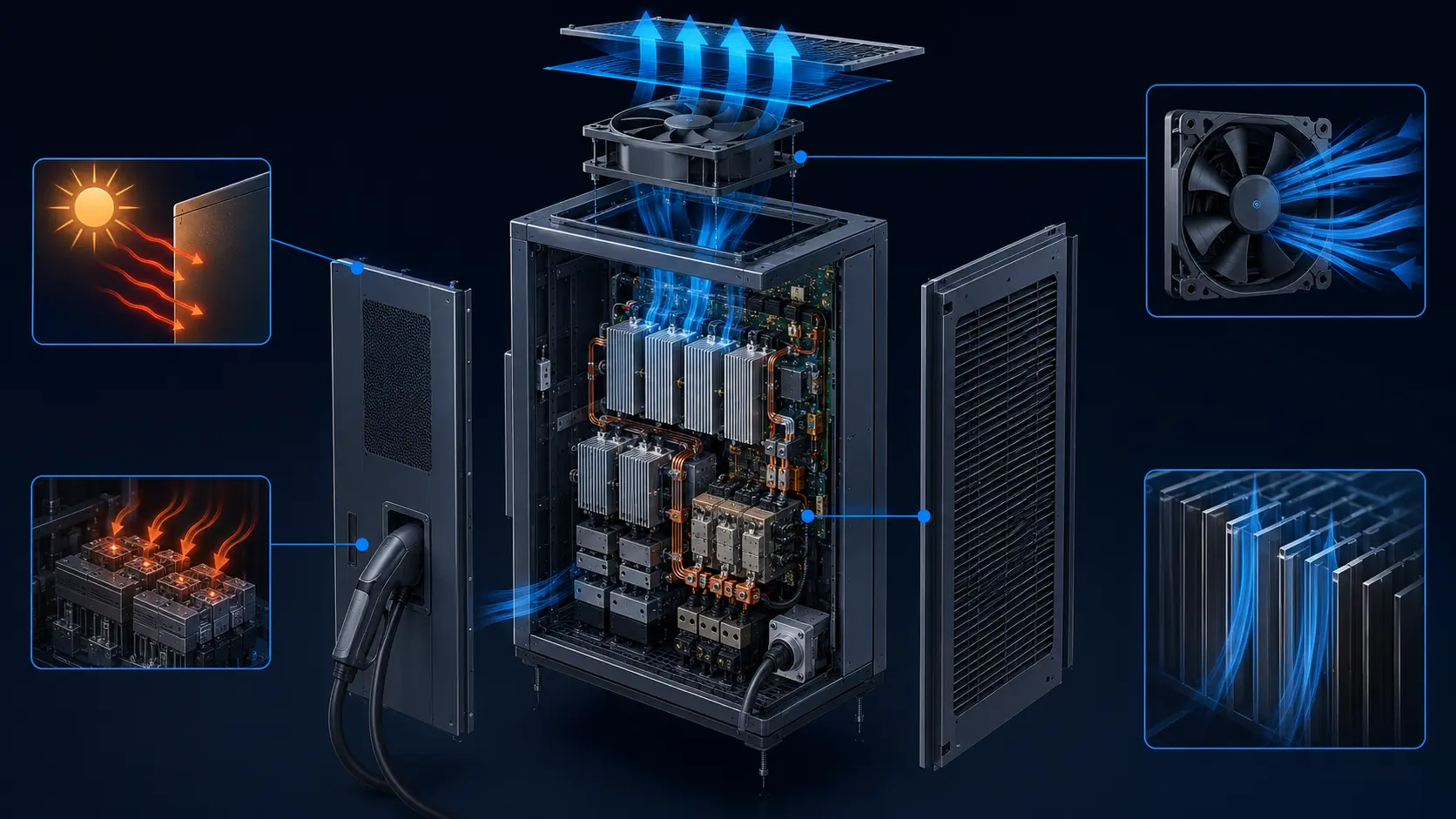
The engineering correction is to work with mass flow and actual air density, not volume flow alone. Air density changes with altitude, temperature and humidity. The fan curve and the cabinet resistance curve must be evaluated at the same condition, then checked against the power-electronics temperature limit and charging duty.
ASHRAE notes that fan application data must account for the density of the actual air, while power-electronics cooling references emphasize that mass flow, rather than volume flow by itself, governs heat removal. These principles are simple, but omitting them creates an expensive field surprise.
Separate volume flow from cooling mass flow
Fan catalogues commonly quote volumetric flow in m3/h or CFM. The heat balance depends on the mass of air and its specific heat crossing the heat source.
For sensible air cooling, Q = m-dot times cp times delta-T, and m-dot equals rho times V-dot. If the same volumetric flow passes through a cabinet at a lower density, the mass flow is lower. The cabinet may therefore need a larger volume flow, a lower permitted temperature rise, or a different cooling architecture to reject the same heat.
As a practical example, assume a charger rejects 4.0 kW and permits a 15 K average air rise. At 1.20 kg/m3, the estimate is approximately 795 m3/h. If site density falls to 1.00 kg/m3 while the fan still delivers 795 m3/h by volume, mass flow falls from 0.265 kg/s to 0.221 kg/s. The same heat then produces a larger air temperature rise, about 18 K before other losses.
This is not a universal altitude correction because the actual fan operating point also changes. Use the calculation to identify the direction of the risk, then apply the candidate fan curve, cabinet resistance and thermal model at the site condition.
| Condition | Air density | Volume flow | Mass flow | 4.0 kW air rise |
|---|---|---|---|---|
| Reference | 1.20 kg/m3 | 795 m3/h | 0.265 kg/s | 15 K |
| Lower-density site | 1.00 kg/m3 | 795 m3/h | 0.221 kg/s | about 18 K |
| Correction target | 1.00 kg/m3 | 954 m3/h | 0.265 kg/s | about 15 K |
Altitude changes both the fan and the cabinet curve
Density does not only reduce the heat carried by a given volume of air. It also changes fan pressure, system pressure loss and the operating point where the two curves intersect.
For a geometrically similar fan at the same speed, the pressure rise and aerodynamic power scale with density. A low-density site can therefore reduce the pressure margin available to push through filters, louvers and heat sinks. At the same time, many friction losses also change with density and velocity, so the full system curve should be recalculated rather than corrected with one universal percentage.
The result can move in either a confusing or misleading direction. A fan may appear to deliver similar volume flow in a low-resistance path while its pressure reserve disappears at the filter or heat sink. Another fan may move to a different point and deliver less volume flow. Only the installed curve and the heat balance reveal which case applies.
Use the manufacturer's test reference condition explicitly. If a fan curve was measured at standard air but the charger operates at high ambient and altitude, document the density correction and the acceptance condition. An unlabelled curve invites a comparison that looks precise but is not physically equivalent.

Three site states engineers should model
A charger should not be validated at a generic altitude label alone. Define the actual operating states that consume the thermal margin.
The first state is the reference condition: clean filter, design inlet temperature and nominal pressure. The second is the hot site condition: maximum expected inlet temperature combined with the local barometric pressure. The third is the service or degraded condition: loaded filter, partial louver blockage, fan speed limit or one branch operating outside normal control.
The worst state may not be the highest altitude. A warm site at moderate elevation can be more severe than a cool high-altitude site because heat-sink-to-air temperature difference and air density are both working against the design. Treat altitude and ambient temperature as coupled inputs rather than separate checkboxes.
If the charger is installed beside other cabinets, include discharge-air recirculation. The local inlet temperature may be several degrees above the weather-station value, and the density calculation should use the air actually entering the fan. A site survey or commissioning measurement is more useful than a climate average when the thermal margin is small.
Worked example: a 12% density loss consumes the margin
The following is an illustrative calculation, not MEGA Tech test data. It shows why a charger can pass a sea-level test and derate at a remote site.
Assume the reference design rejects 3.0 kW with 600 m3/h through the critical air path at 1.20 kg/m3 and a 14 K air rise. The mass flow is about 0.200 kg/s. At a site where the effective density is 1.06 kg/m3, the same 600 m3/h produces about 0.177 kg/s, a reduction of roughly 11.7%.
If the heat load stays at 3.0 kW, the ideal air rise increases from about 14 K to approximately 15.8 K before the fan pressure shift, leakage and heat-transfer changes are included. If the power module has only 4 K of temperature margin in the reference test, the site can consume most of that margin without a fan fault.
A correction might target 680 m3/h at the site density to recover roughly the original mass flow. That is only a starting point. The candidate fan must still produce the required pressure through the final filter and heat sink, and the motor, noise, current and bearing duty at the corrected point must be accepted.
| State | Density | Volume flow | Mass flow | Design implication |
|---|---|---|---|---|
| Reference test | 1.20 kg/m3 | 600 m3/h | 0.200 kg/s | 14 K air rise target |
| Site at same RPM | 1.06 kg/m3 | 600 m3/h | 0.177 kg/s | About 11.7% less mass flow |
| Illustrative correction | 1.06 kg/m3 | 680 m3/h | 0.200 kg/s | Recheck pressure, noise and power |
How to validate a high-altitude charger without guessing
A strong validation plan separates density correction from fan-control behavior and records the final cabinet state.
Record barometric pressure or site altitude, inlet temperature, humidity where relevant, supply voltage, fan command, FG, fan current, pressure across the filter and heat-sink path, and temperatures at the critical device. Use the same load profile and stabilization time for the reference and site-condition tests.
If a climate chamber is used, verify that the chamber pressure and the fan test model represent the intended site. A hot chamber at sea-level pressure is not identical to a hot high-altitude installation. If pressure cannot be reproduced, use a density-corrected model and label the result as an engineering correlation that still needs field confirmation.
Measure the fan at the installed point, not only in free air. A high-altitude test can reveal a pressure-margin problem at the filter or heat sink even when the volume-flow meter shows a plausible number. Pair flow with pressure and temperature so the result can be interpreted physically.
| Evidence | What it answers | Common mistake |
|---|---|---|
| Site density | How much mass does each m3 carry? | Using sea-level standard air without marking it |
| Fan curve | What pressure and flow are available? | Comparing only maximum CFM |
| System curve | What does the final cabinet require? | Ignoring filter and louver pressure |
| Device temperature | Does the power module keep margin? | Using only average exhaust air |
| Current and noise | Is the correction sustainable? | Accepting higher RPM without life review |
Control strategy: temperature feedback is not a density correction
PWM control can respond to rising temperature, but it should not be used to hide an undefined site condition or an inadequate pressure margin.
A controller may increase duty when the heat sink warms, yet the remaining fan capacity may be limited by maximum speed, current, noise or pressure. If the system reaches a limit only after the device temperature has risen, the control loop is reacting to lost margin rather than preventing it.
Use site-aware setpoints where the product supports them, or establish a validated derating curve for altitude and ambient temperature. The control logic should define what happens when the fan reaches its permitted duty: reduce charger power, issue an alarm, or shut down safely. The correct response depends on the semiconductor limit, thermal time constant and field-service requirement.
Avoid aggressive temperature-only control that hunts around a restriction. A stable pressure or fan-current signal can help identify a filter problem, while a heat-sink temperature signal confirms the thermal result. Combine signals rather than expecting PWM alone to solve an air-path problem.
Fan selection at altitude: pressure, motor and bearing checks
A high-altitude fan choice is a system decision. The fan must meet the corrected operating point and remain reliable at the electrical, acoustic and environmental duty.
Compare candidate fans at the required volume flow and pressure after density correction. Check startup at the lowest supply voltage, PWM range, FG or alarm behavior, input current and the maximum permitted speed. If the design uses a larger or faster fan to recover mass flow, verify the enclosure noise and vibration response.
Bearing life should be reviewed against the real duty cycle, not a single nominal ambient. A charger that spends every afternoon at high fan duty has a different service profile from one that reaches high duty only during short peaks. Outdoor dust, salt, condensation and filter maintenance can be more important than the altitude label itself.
MEGA Tech's current scope is custom DC axial cooling-fan sampling. For an EV charger, the useful inputs are the fan envelope, voltage, target flow and pressure, site altitude, inlet temperature, PWM/FG/RD requirements, filter state, noise limit and acceptance temperatures. The sample should be tested in the assembled cabinet at the site-representative condition.
Noise, derating and service decisions belong together
The correction that preserves full power at altitude may consume acoustic or maintenance margin. Decide whether the charger should run continuously at the corrected duty or derate before the fan reaches its limit.
A larger fan at lower speed can be quieter than a small fan at high speed, but only if the frame fits and the installed pressure curve supports the target. A speed increase can create tonal noise and higher bearing duty even when electrical power is lower because the air is less dense. Measure sound at the same site-representative operating point.
Define the service response for a loaded filter. If the charger is expected to continue at reduced power until a technician arrives, validate that degraded state at the high-temperature density. If the correct action is a shutdown, make the alarm threshold early enough to prevent a thermal trip that is difficult to diagnose.
A production change should document the site envelope, density basis, fan curve reference, derating rule, filter interval and acceptance test. This information helps service teams understand why a normal RPM number can coexist with a reduced power limit.
For field acceptance, let the charger reach the defined steady load instead of judging the first temperature peak. Record the pressure and temperature at the fan inlet, heat-sink base and exhaust, then repeat after the fan command has stabilized. If the site cannot reproduce the laboratory pressure, record the local barometric pressure and use it in the report so later service comparisons do not mix standard air with site air. Keep the same filter, panel and cable-routing condition in every comparison. Record the software version and power-limit state too.
Where MEGA Tech fits in a site-specific fan review
MEGA Tech helps evaluate custom DC axial fan samples against the real charger duty instead of treating a sea-level catalogue point as a universal result.
Send the installation altitude, maximum and minimum inlet temperature, pressure or barometric data, heat load, airflow path, filter and louver details, available space, voltage, PWM/FG/RD requirements, noise target and temperature acceptance points. If the charger already has a fan, include its part number and the measured site behavior.
We can help compare the fan requirement at the corrected working point, prepare a practical sample and identify which measurements should be repeated in the assembled cabinet. This is particularly useful for development programs that need a small first build before production, or for replacement work where a branded fan has become too expensive.
The final decision remains application-specific. A DC axial fan may be suitable for the air path, while a dense high-pressure branch, liquid-cooling heat exchanger or facility-side system may require another architecture. A clear scope and site-representative validation are part of a credible quotation.
Engineer FAQ: EV charger cooling at high altitude
These answers keep altitude and temperature discussions tied to measurable design inputs.
Q: If the fan RPM is unchanged, is the airflow unchanged? A: Not necessarily. Volume flow, pressure capability and mass flow can change with density and the installed operating point.
Q: Should I multiply the sea-level CFM by one correction factor? A: Use a first estimate to identify risk, then recalculate the fan and system curves at the actual density, temperature and pressure. One universal factor is not a substitute for the installed model.
Q: Does lower density always reduce fan power? A: Aerodynamic power can fall with density, but that does not mean cooling capacity is preserved. The heat removed depends on mass flow and temperature rise, while motor, control and system effects still need checking.
Q: What is the worst condition: high altitude or high ambient? A: It depends on the site. A combined hot, low-density inlet often consumes more margin than either input alone. Include recirculated exhaust air where it is credible.
Q: What should I ask a fan supplier to provide? A: Ask for the test reference condition, pressure-flow data, electrical limits, control-signal behavior, environmental range and a validation plan using the actual site density and cabinet resistance.
Questions for a design review
Use these questions before approving a charger for a mountain, desert or other density-sensitive site.
1. What barometric pressure and inlet temperature define the site envelope? 2. Is the heat balance based on mass flow or only volume flow? 3. Has the fan curve been corrected to the actual air density? 4. Has the filter, louver and heat-sink pressure drop been measured in the final cabinet? 5. Which device temperature defines pass or derating? 6. What happens when the fan reaches its maximum validated duty? 7. Are noise, current, bearing life and maintenance intervals acceptable at the corrected condition? 8. Is the field acceptance test repeatable and time-aligned?
A sound approval record should include the density basis, fan operating point, pressure margin, heat-load calculation, sensor locations, derating rule and service state. That record lets engineering and procurement compare suppliers on the same physical problem.
Validate the site condition before the fan number
A charger fan selection is credible when it survives the actual combination of heat load, inlet density, cabinet resistance and service state.
If you are evaluating a DC axial-fan sample for a high-altitude or hot-site EV charger, share the heat load, site pressure or altitude, inlet temperature, cabinet layout, filter condition, target flow and pressure, voltage, control signals and acceptance temperatures. MEGA Tech can help structure a practical sample and validation plan around the real operating point.
Continue with the EV and automotive cooling applications or read the EV charger airflow distribution guide.