The Cooling Decision Started Before the Fan Catalogue
An anonymized European BESS developer compared air-cooled and liquid-cooled cabinet concepts before freezing the fan and auxiliary-power budget.
The project had moderate energy density in one cabinet and a higher sustained discharge profile in another. The team initially asked which cooling technology was better. The more useful engineering question was which architecture could hold the cell temperature spread, service condition, noise limit and auxiliary-energy budget across the actual operating modes.
MEGA Tech reviewed both air paths and the air-side boundary of the liquid system. The review covered heat load, cabinet density, filter and coil pressure drop, fan control, fan-fault behavior, ambient temperature, maintenance access and the information required for a sample. It did not treat the fan as a substitute for a pump, cold plate, HVAC system or battery safety design.
The customer identity and final acceptance values remain confidential. This case presents the decision method and labels illustrative calculations rather than claiming customer test results.
The Engineering Hook: Cooling Labels Hide Different Failure Modes
Air cooling and liquid cooling move heat differently, but neither removes the need for an installed duty point and a fault plan.
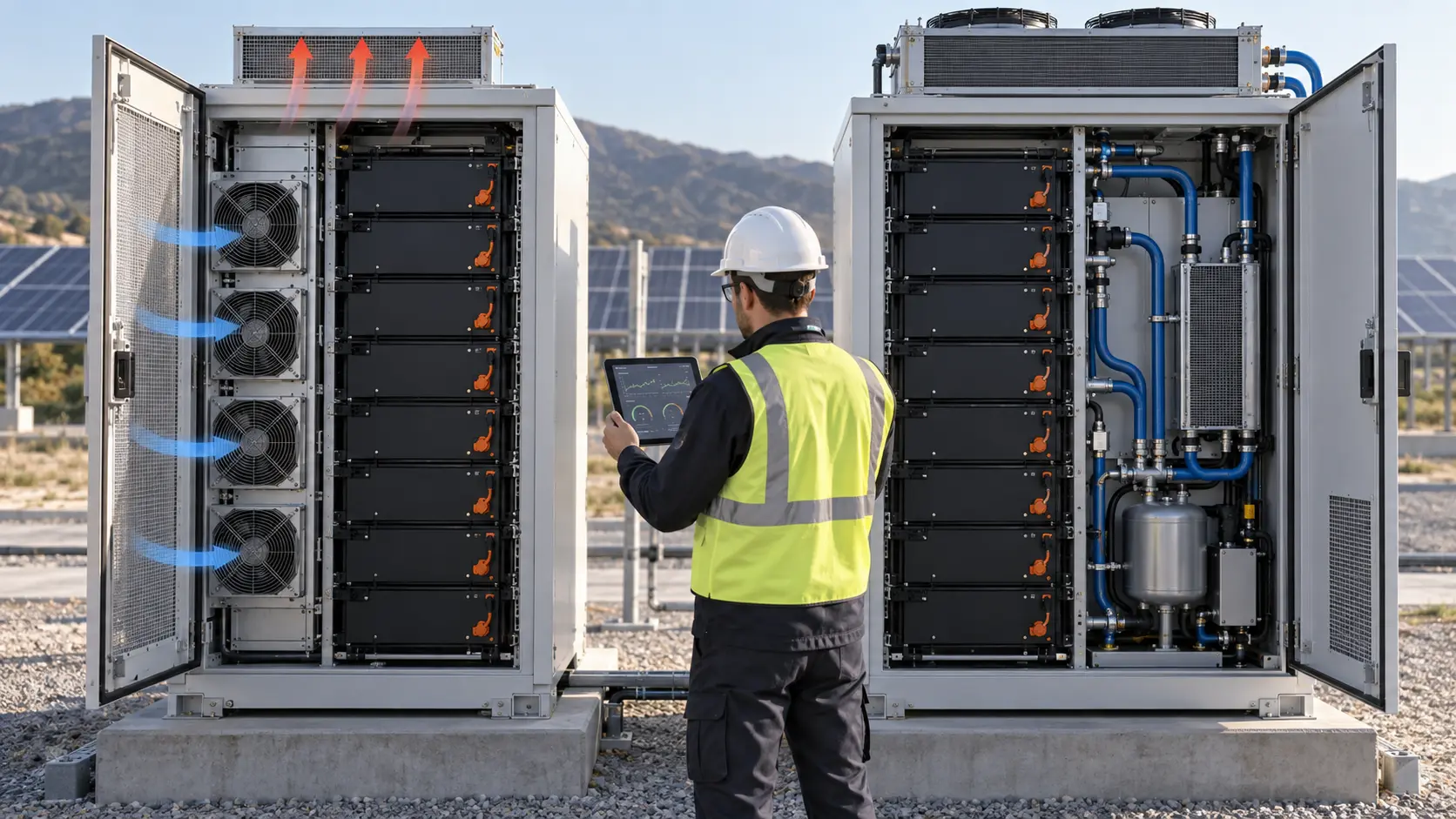
Air cooling relies on fans, filters, ducts, grilles and conditioned air reaching the relevant heat sources. It can be simpler to service, but uneven airflow, filter loading, recirculation and fan failure can create local hot zones. Liquid cooling moves heat through plates and a coolant loop, which can support higher density and tighter temperature control, but adds pumps, hoses, seals, sensors, leak detection and a liquid-to-air heat-rejection boundary.
The final boundary matters for fan selection. A liquid system may reduce the air volume needed around the cells, yet its dry cooler or radiator still needs air at a defined flow and pressure. The fan operating point, entering-air temperature and coil pressure drop remain real design inputs.
A recent review of practical ESS architectures identifies the same tradeoff: air cooling tends to favor simplicity and moderate loads, while liquid cooling can support higher density but requires more specialised maintenance. These are tendencies, not universal product guarantees. The correct choice is the one that passes the project's thermal, acoustic, service and auxiliary-power tests.
The Problem in Operation: A Headline Efficiency Number Was Not Enough
The developer needed to compare complete operating states, not just the nominal efficiency of a cooling technology.
The air-cooled option was checked for inlet filter pressure, internal distribution, fan current, noise and service intervals. The liquid-cooled option was checked for pump power, coolant temperature, dry-cooler fan power, coil pressure and leak or sensor fault response. Both options were evaluated at the same battery heat-load cases and ambient conditions.
The team also separated cell cooling from PCS and control-electronics cooling. A liquid loop sized for the battery modules does not automatically cool every electrical compartment. Conversely, a cabinet fan that protects the PCS does not prove that the battery cell temperature spread is acceptable.
The comparison avoided a common procurement trap: treating lower fan power as lower system auxiliary power. Pumps, chillers, HVAC controls, heaters, sensors, dehumidification and standby loads must be included in the same system boundary before the two architectures are compared.
Interactive: Watch the Two Architectures Move Heat Differently
The animated schematic shows where the fan duty sits in an air-cooled cabinet and at the dry-cooler boundary of a liquid-cooled cabinet.
The figure is qualitative, not CFD and not a selection curve. In the air-cooled panel, useful fan flow must reach the battery and power electronics through the enclosure resistance. In the liquid panel, the pump moves heat inside the cabinet, while the dry-cooler fan still rejects heat across the outdoor coil.
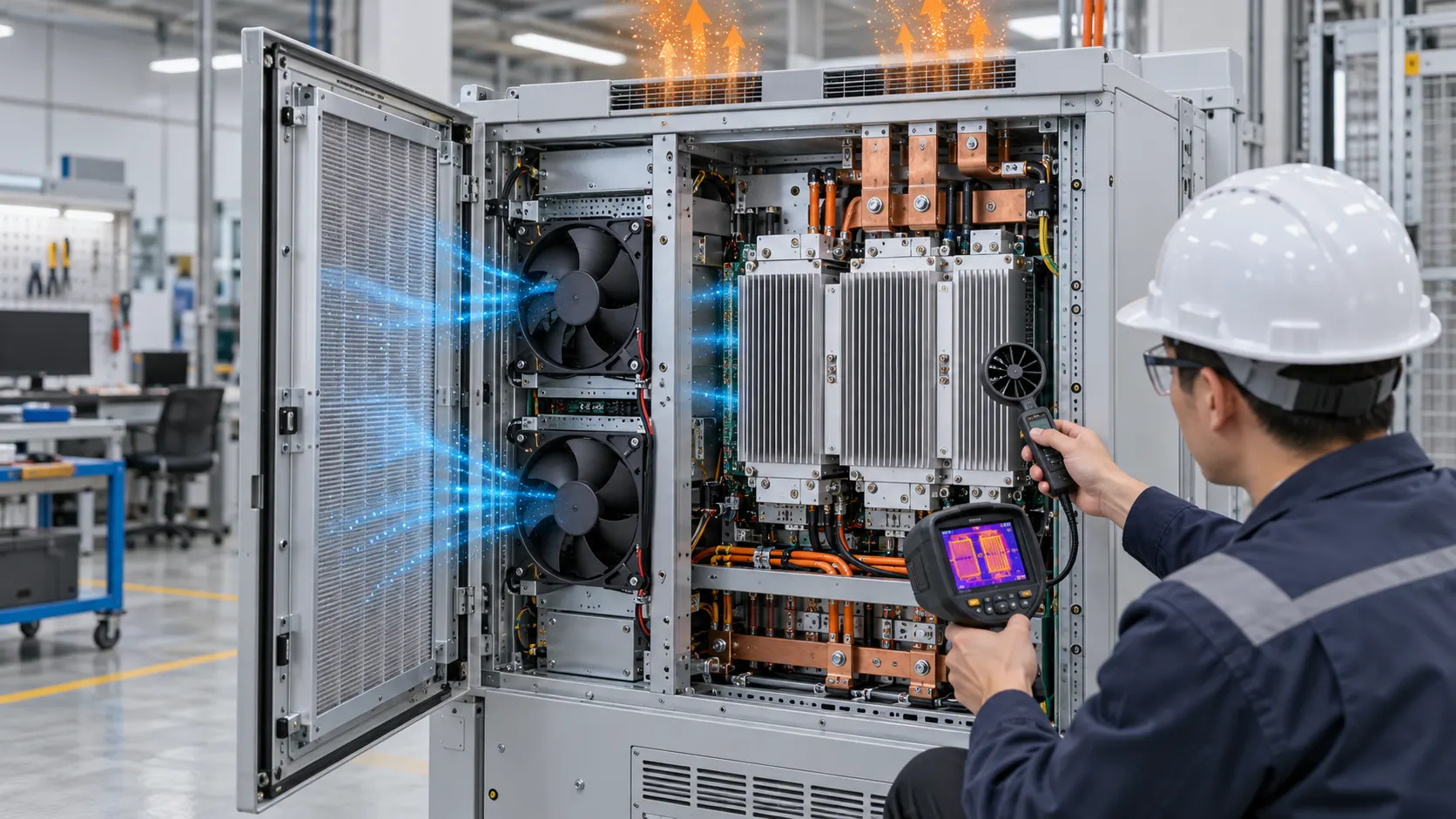
The review sequence measured the fan voltage, current, PWM, FG or RD feedback, pressure, air temperatures and relevant battery or coolant temperatures. A system state was not marked successful just because a fan reached its command or a pump reported running.

Sample 01: Define the Heat Load and Temperature-Spread Requirement
The first decision input was the allowed thermal result, not the preferred cooling technology.
The developer supplied heat generation over charge and discharge, cell and module arrangement, allowable cell temperature, allowable cell-to-cell spread, PCS heat, ambient range, solar load, altitude, noise limit, service strategy and available envelope. The team identified whether the most difficult case was a short peak, a long sustained discharge or a hot standby condition.
As an illustrative air-side estimate, a 3 kW sensible load with an 8 K average air rise gives Qv = P/(rho x cp x deltaT), or about 0.31 m3/s and 650 CFM at the assumed density. That is not a fan specification. The installed grille, filter, rack channels and outlet may require substantially more pressure than a free-air test suggests.
For a liquid-side estimate, 3 kW carried by a coolant with an effective heat capacity near 3.6 kJ/(kg K) at a 6 K rise requires approximately 0.139 kg/s. That value still does not select the pump or fan because the plate, manifold, coolant and dry-cooler data remain separate design inputs.
Sample 02: Compare Thermal Margin and Auxiliary Power at the Same Duty
The two architectures were compared at equal heat load, ambient condition and service state rather than by marketing labels.
The air-cooled sample was tested with clean and loaded filters, representative cabinet panels, the actual grille and a realistic outlet. The liquid-cooled sample was tested with the selected coolant flow, radiator, shroud and dry-cooler fans. Both tests recorded useful heat transfer, component temperatures, fan or pump power and noise.
An illustrative auxiliary comparison makes the boundary clear. Four 24 V fans at 0.4 A each use about 38.4 W before controller losses. A liquid system might use two 48 V dry-cooler fans at 1.0 A each, or about 96 W, plus a pump and controls. These numbers are examples only; they do not establish that one architecture is more efficient. The complete measured duty cycle decides that result.
The candidate fan was judged at its operating point. A replacement with the same outline and voltage was not accepted until its airflow and pressure at the real filter, coil or shroud condition were measured.
Sample 03: Validate Maintenance and Failure Recovery
The selected cooling architecture had to remain understandable and recoverable when a filter, fan, pump or sensor was no longer ideal.
For air cooling, the review included filter replacement access, differential-pressure monitoring, fan-fault detection, reverse flow through an idle fan and the temperature response after a blocked intake. For liquid cooling, it included coolant level or pressure, leak detection, pump fault, dry-cooler fan fault, sensor plausibility and cold-start or hot-start behavior.
The project defined the response to each fault: alarm, controlled derating, redundant duty, shutdown or service request. MEGA Tech supplied fan-side feedback and sample data; the BESS integrator remained responsible for BMS logic, battery protection, emergency ventilation and the final safety case.
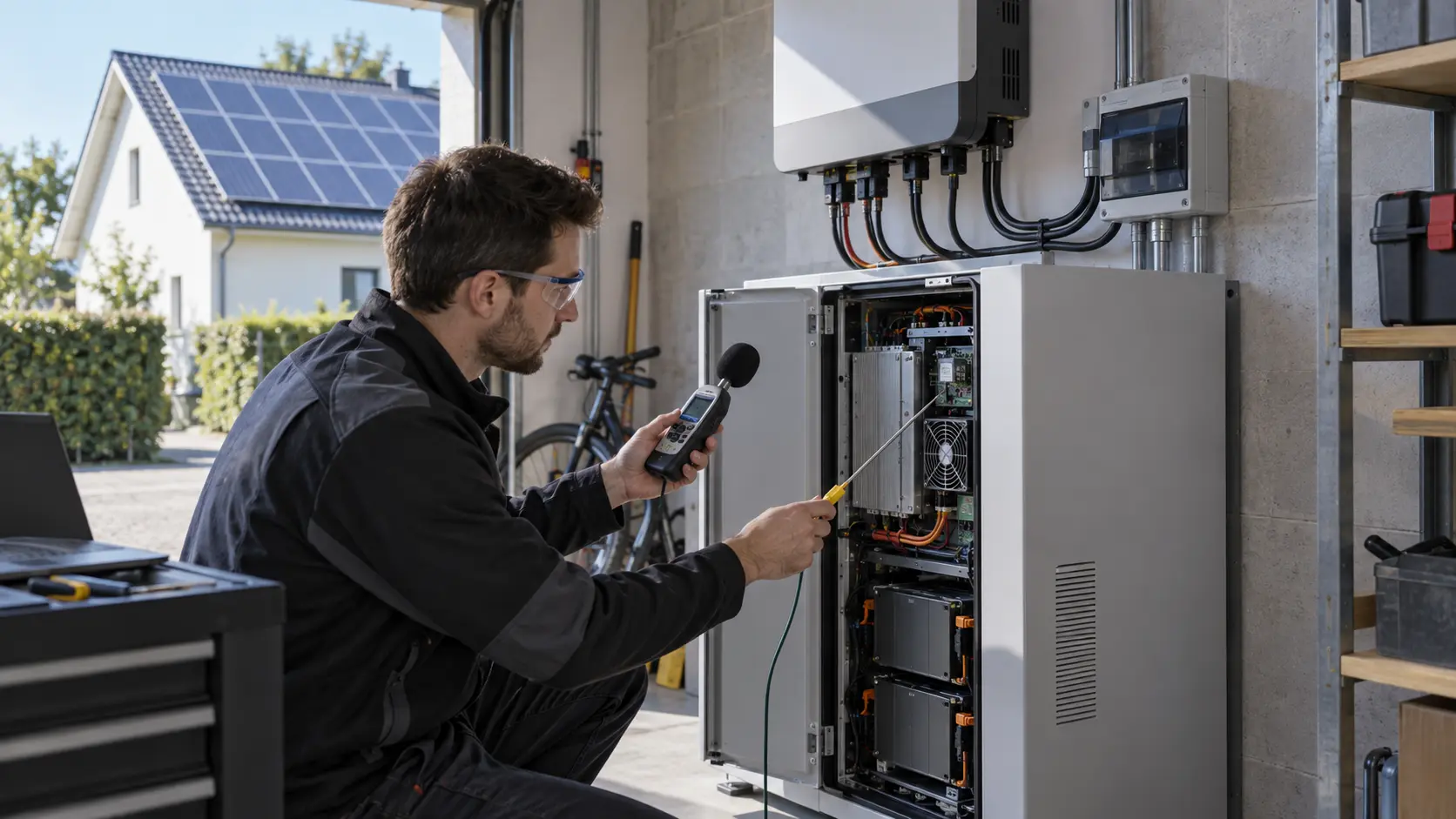
Noise and service access were evaluated together. A larger fan at lower speed can reduce tonal noise in some installations, but only if the shroud and pressure path support it. A quiet fan that cannot maintain the required operating point is not a valid solution.
Validation Result: Choose the Architecture, Then Freeze the Fan Duty
The comparison produced a decision matrix instead of a universal claim that air or liquid cooling is always better.
Air cooling remained attractive where the heat load, enclosure density, ambient condition and service plan could be satisfied with a controlled air path and realistic filter maintenance. Liquid cooling became more attractive where density, sustained heat and temperature uniformity dominated, provided the project accepted the additional coolant, pump, leak and dry-cooler boundaries.
The release record documented the chosen architecture, heat-load cases, temperature limits, auxiliary-power boundary, fan or pump controls, pressure points, maintenance state, fault response and sample conditions. It also recorded what the selected fan did not prove: cell safety, coolant integrity, HVAC capacity, fire protection or regulatory compliance.
For procurement, the transferable lesson is simple: ask for the installed P-Q duty, not just the fan technology label. A custom DC fan supplier can help with the air-side boundary, but the customer must retain ownership of the complete thermal architecture.
How MEGA Tech Supports BESS Fan Customization
MEGA Tech helps integrators select and validate the fan-side duty in air-cooled cabinets and liquid-cooled dry-cooler assemblies.
We can review high-ambient DC axial fans and compact centrifugal blowers, filter or coil pressure drop, shroud losses, airflow direction, PWM and FG/RD signals, connector and lead-wire details, bearing and life targets, IP and environmental requirements, voltage tolerance and small first-build quantities. We can also evaluate alternatives to Sanyo Denki, SUNON, Delta, NMB, ebm-papst and other installed brands when the operating point is defined.
Please provide heat load over the operating modes, airflow and static pressure at that airflow, temperature and altitude basis, fan size, voltage, quantity, control interface, connector, noise, filter or coil condition, environment and life assumption. For liquid systems, also provide coolant targets, radiator data and the dry-cooler boundary. If data is incomplete, send the current fan part number, drawings, cabinet photos and measured temperature or pressure points.
Our scope is fan and air-path engineering, sample customization and comparative validation. We do not supply cold plates, pumps, coolant, chillers, BMS, cabinet safety design, emergency ventilation or battery protection systems.
Engineer Questions About This Cooling-Architecture Case
Use these questions before freezing a BESS cooling concept or fan BOM.
Q: Is liquid cooling always more efficient? A: No. Compare measured system auxiliary energy, heat load, ambient condition, control sequence and maintenance boundary.
Q: When is air cooling still practical? A: When the heat load, density, airflow distribution, filter service and ambient envelope can be validated with adequate installed margin.
Q: Does liquid cooling eliminate fans? A: No. A liquid-to-air system still needs air movement through its radiator or dry cooler unless another heat-rejection method is used.
Q: What should I compare between fan candidates? A: Compare P-Q data at the same density, voltage, pressure definition, control state and installed air path. Include current, noise, feedback, life and environment.
Q: What should I send for a review? A: Send heat load, airflow and static pressure, temperature and altitude, size, voltage, quantity, control, noise, environment, life target and any coil or filter data.
Q: Can MEGA Tech provide a custom sample? A: Yes. We can review the installed duty and support a sample comparison before production release.
Need Help Comparing Air and Liquid Cooling?
Send the heat-load profile, temperature limits, ambient conditions, candidate air path or radiator data, fan size, voltage, control interface and service constraints. MEGA Tech will review the fan-side operating point before recommending a sample.
Include the current fan model, cabinet or radiator drawings, filter or coil pressure data, altitude, noise target and any thermal or auxiliary-power measurements available. This helps separate an architecture decision from a fan-selection problem before the production BOM is locked.