A North American Server Integrator Brought the Full Fan Tray
The customer was not looking for a generic high-CFM fan. It needed a replacement that behaved correctly inside a dense AI server chassis.
An anonymized North American server integrator was preparing a high-density compute platform for AI inference and storage workloads. The server used a removable fan tray in front of dense heat sinks and power electronics. The original tray met the platform's initial thermal requirement, but the customer wanted a lower-cost supply option and a more flexible source for future revisions. The replacement had to fit the existing tray and connector interface without assuming that identical dimensions meant identical performance.
The first customer sample included the chassis, fan tray, heat sinks, grilles, cable routing and the normal control behavior. That was important because the fan did not operate in free air. The system resistance was set by the server inlet, filter or grille, heat-sink fin density, outlet openings and the neighboring fans. The team also needed to understand what happened when one fan stopped and how the remaining fans compensated.
MEGA Tech treated the full tray as the reference fixture. The development loop compared the original and candidate fan at the same installed condition, then adjusted the fan duty, control curve, connector, mounting and acoustic behavior around the measured result. The customer name and released product values are confidential; this case describes the sample-to-validation process.
What the Server Engineers Needed to Match
The replacement requirement included airflow, pressure, control, acoustic and service constraints at the same time.
The first requirement was the server thermal envelope. The customer defined the inlet temperature range, compute mode, power state and protected component temperatures. AI workloads can change the power distribution between CPU, GPU, memory, storage and voltage-regulator zones. A fan tray that looks adequate during a balanced benchmark can leave a local heat sink short of airflow when the workload moves to another zone.
The second requirement was the installed operating point. A fan's maximum CFM is the zero-pressure endpoint. In a server tray, the useful point is where the fan P-Q curve intersects the chassis resistance curve. The team measured or bounded the pressure across the tray and heat sinks, then compared airflow and temperature at that condition. A planning example used 38 CFM at 7 mmH2O as a test target; this is an illustrative value, not a customer specification.
The third requirement was service behavior. The tray had to support fan feedback, alarm logic and a controlled response when one fan stopped. The customer also needed a connector and cable arrangement that allowed hot-swap service without changing the tray geometry. Current, noise, startup, minimum speed, PWM response and bearing life were included because a fan that meets airflow but consumes too much power or fails early is not a successful replacement.
| Requirement | Evidence | Why it matters |
|---|---|---|
| Thermal duty | inlet temperature, workload and local component temperatures | protects the hottest zone, not only average exhaust |
| Air path | tray pressure, heat-sink restriction and outlet condition | finds the installed operating point |
| Control | PWM, voltage range, FG/RD and alarm behavior | keeps the candidate compatible with the server controller |
| Acoustics | dBA, tonal peaks, command and measurement position | avoids a replacement that is thermally correct but unacceptable |
| Service | fan-stop, reverse flow, hot-swap and restart | proves N+1 behavior instead of assuming it |
Sample 01: The Free-Air Comparison Was Misleading
The first candidate looked strong on a catalogue sheet but did not reproduce the tray's pressure and noise behavior.
The initial comparison used the same outline dimensions as the original fan and showed a high free-air airflow value. Once installed behind the tray grille and heat sink, the candidate operated at a different point. The pressure requirement reduced delivered airflow, while a narrow tonal peak appeared at the controller's normal command. The issue was not that the fan could not spin; it was that the fan and system curve were not matched.
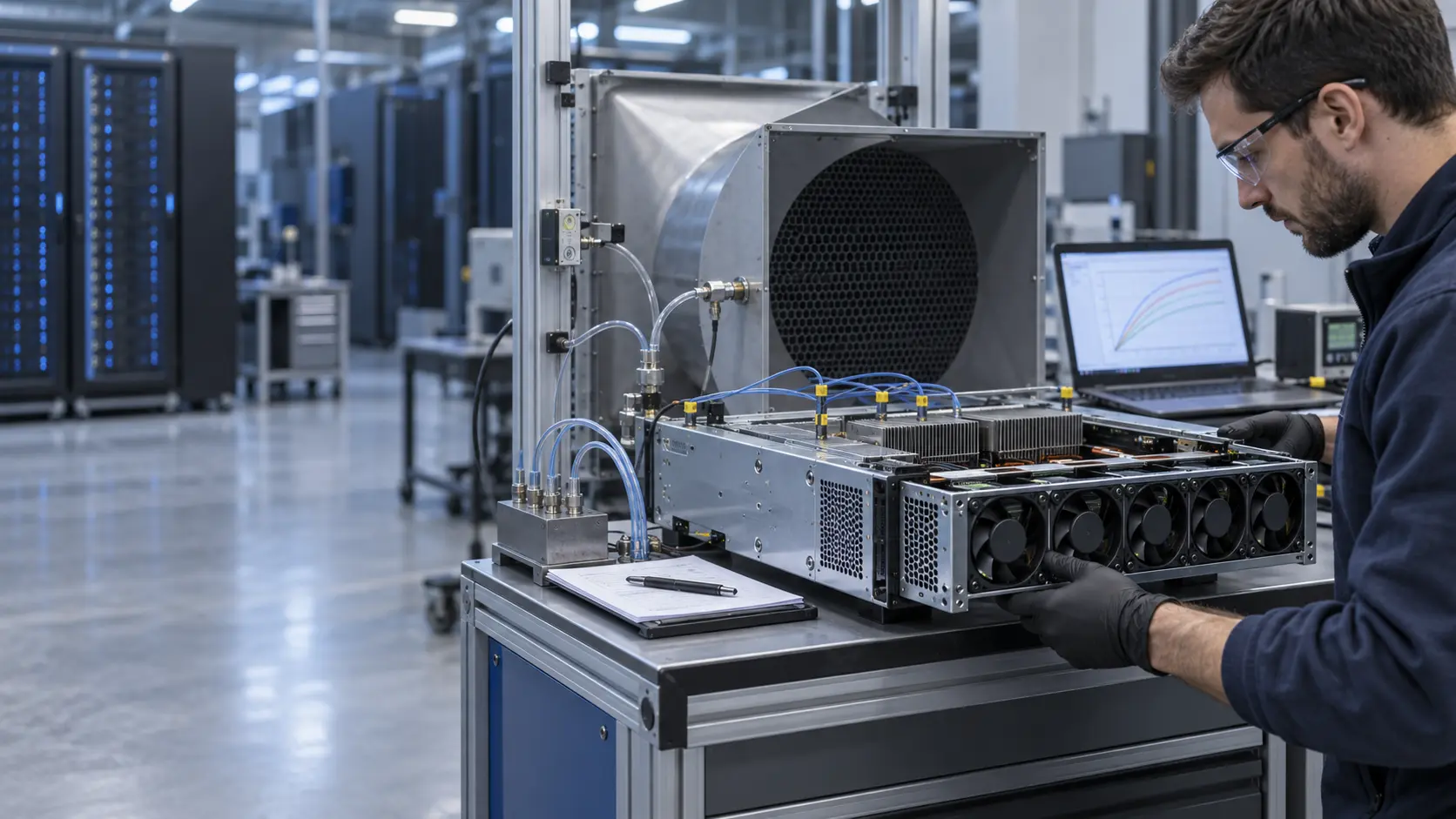
The team established a baseline using the original tray. It recorded fan voltage, PWM command, RPM, current, pressure or airflow proxy, local heat-sink temperatures, inlet temperature, exhaust temperature and acoustic spectrum. The same measurements were repeated with the candidate. A planning calculation showed why the headline was insufficient: if a 50 CFM fan reaches that number only at zero pressure, the server may receive far less at 7 mmH2O. The installed curve, not the maximum number, decides the result.
This baseline also found a small bypass around the tray seal. Air moved around part of the intended heat sink rather than through it. The next revision therefore included both fan tuning and a review of the tray interface. The customer could see which improvement came from the fan and which came from sealing or airflow guidance.
Sample 02: Tune Pressure, PWM and Acoustic Behavior
The second sample was developed around the workload and controller, not only around the fan frame.
MEGA Tech reviewed the fan blade and motor behavior at the pressure duty, the minimum stable speed, the PWM frequency or voltage command, the connector pinout, the cable exit and the mounting support. The sample had to deliver the required airflow without entering an unstable or unnecessarily loud region. A higher-pressure design can be useful behind dense fins, but it still needs to be checked for power, acoustics and heat generation.
The control curve was compared in three states: low-load idle, normal compute and peak compute. The customer wanted enough headroom for peak zones without running every fan at full speed during idle. The sample was tested for startup at the lowest declared voltage, command step response, RPM feedback, current and acoustic change. This made the control interface part of the fan selection rather than an afterthought.
The tray's mechanical interface was also checked. The candidate had to preserve mounting, clearance, connector access and airflow direction. If a replacement requires a different cable exit or changes the seal around the fan, its performance must be revalidated. ‘Drop-in’ is useful only after the real interface and operating point are proved.

Sample 03: Prove One-Fan Failure and Reverse Flow
N+1 is not a label on a datasheet. It is a tray-level behavior that must be measured with one fan stopped.
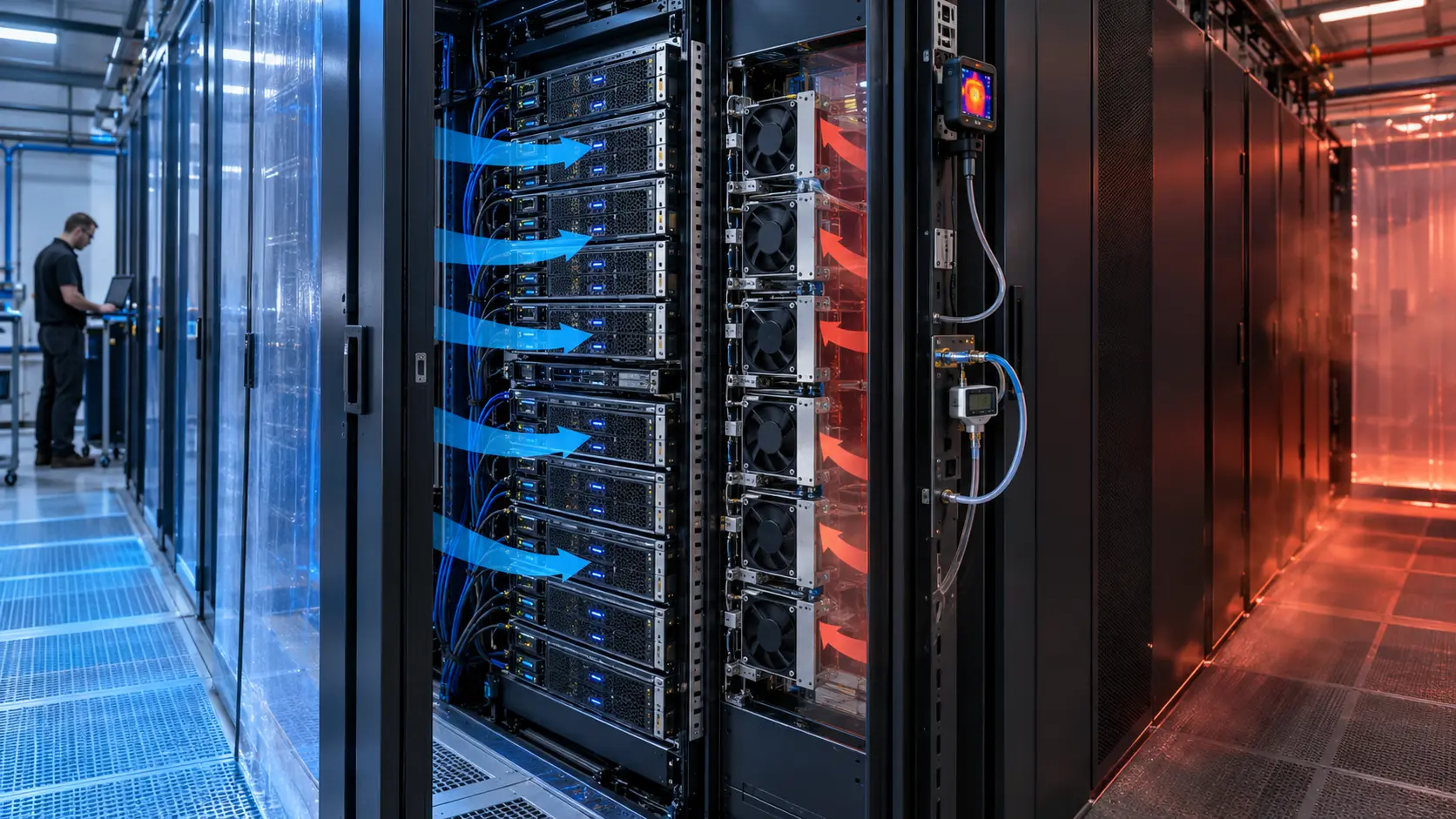
The customer then stopped one fan at a time and measured the remaining fan duty. The stopped fan could become a restriction, a bypass route or a path for reverse flow depending on the tray geometry and pressure distribution. The remaining fans might need to increase speed, which changes noise, current and bearing duty. The controller's alarm and compensation behavior also had to be observed.
The validation sequence included normal operation, one fan power loss, one fan feedback-line fault, one fan locked-rotor condition, a hot-swap removal and a restart. At each step, the report recorded the fault timestamp, alarm state, fan commands, RPM, current, local temperatures and recovery time. The objective was to prove that the hottest protected component stayed within the declared response envelope long enough for the service or control action.
A planning example used a 30-second hot-swap window and a 10 °C local temperature margin for the test fixture. These values are illustrative and must be replaced by the server maker's actual risk analysis. The important lesson is that the surviving fan curve and the idle-fan reverse-flow behavior belong in the same test, not in separate assumptions.
Sample 04: Validate Power and Noise at the AI Workload
A replacement that cools the server but consumes more power or creates a strong tonal peak can still fail the platform requirement.
The customer repeated the comparison under representative compute states. The fan tray was not judged only at one steady benchmark. It was checked during idle, normal inference, peak compute and a workload transition that moved heat between zones. The measurement record correlated inlet temperature, local heat-sink temperature, fan command, RPM, current, pressure or airflow and noise spectrum.
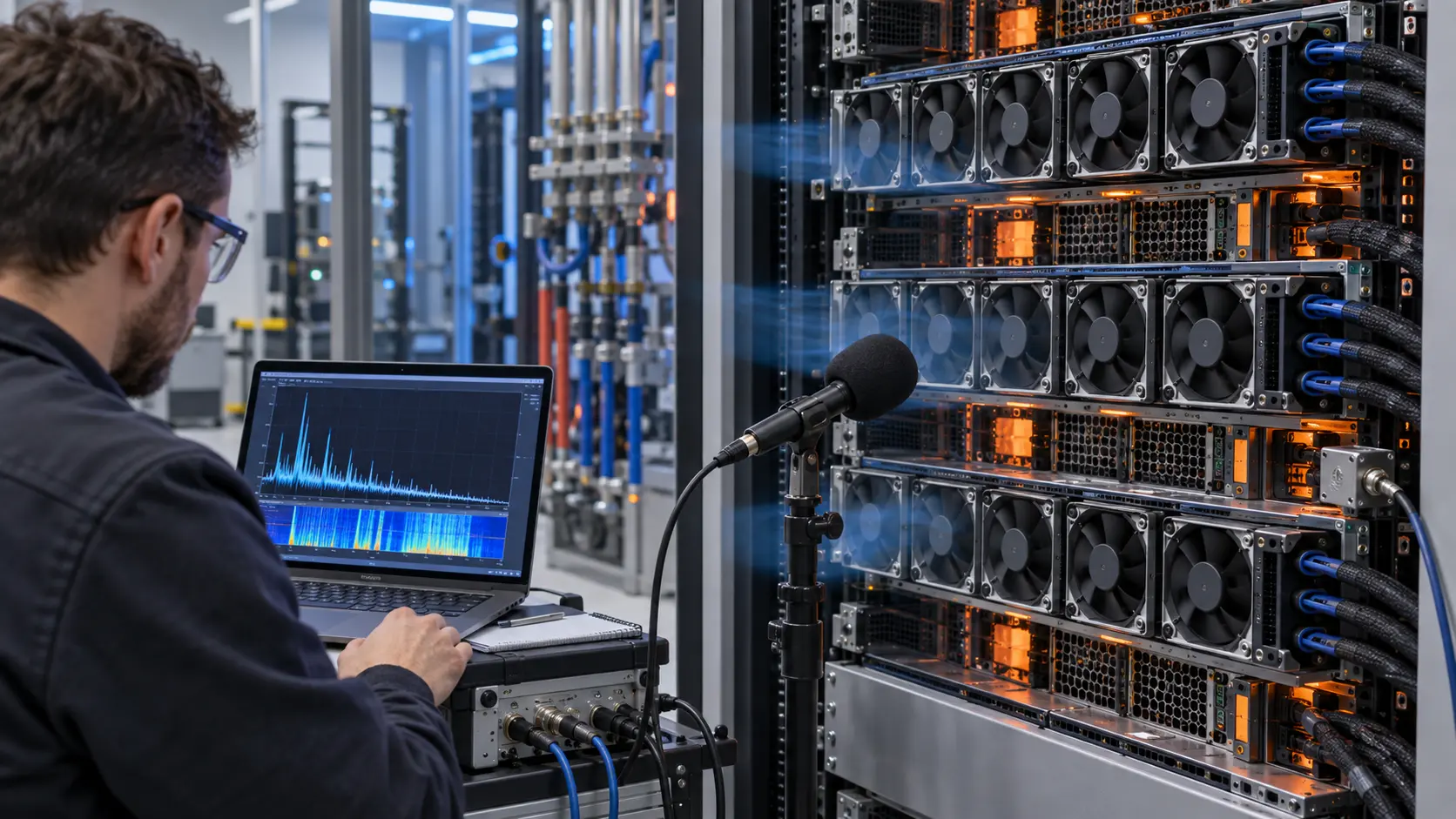
The acoustic check mattered because high-density servers can place many fans close together. Several similar fans can create a noticeable tonal pattern even when the overall sound-pressure number appears reasonable. The installation, receiver position and command were kept constant so the customer could compare the original and candidate fairly.
The power check included the fan electrical input and the controller response. A higher command may recover temperature margin after a failure, but the server maker must know the resulting power and thermal load. The production sample therefore needed a defined nominal command, peak command, fault command and recovery behavior, not only a maximum RPM.
The Result Was a Controlled Replacement Path
The customer gained a candidate fan configuration that could be evaluated against its own server, rather than a promise based on a frame number.
After the sample iterations, the customer had a matched fan interface, an installed operating-point record and an N+1 validation sequence. The exact released airflow, pressure, noise and power values remain project-specific. The transferable result is the process: start with the full tray, measure the actual system curve, tune the candidate fan and controller, test the failure state, and freeze the interface only after the thermal and service evidence agrees.
This process also gives procurement a defensible comparison. A replacement fan is not equivalent because its outline dimensions match. Blade geometry, pressure curve, control response, connector, cable exit, bearing, vibration and reverse-flow behavior can change the server. The buyer should request the operating point and sample evidence, not only maximum CFM and static-pressure endpoints.
For a new AI server platform or a startup integrator, MEGA Tech can support a small first build. The customer can provide the original fan, tray and thermal target, then review sample revisions before committing to a larger production quantity. Once approved, the critical dimensions and tests can be transferred into the production specification.
How MEGA Tech Supports AI Server Fan Customization
MEGA Tech helps customers develop DC fan samples around the real server tray while keeping capability statements precise.
MEGA Tech develops custom DC axial fans and compact centrifugal blowers for server trays, networking equipment, industrial compute and power electronics. We can review frame and thickness, pressure/airflow duty, airflow direction, connector and cable, PWM or voltage control, FG or RD feedback, bearing configuration, startup, mounting, acoustic target and the real heat-sink or grille restriction.
For the first review, provide the full fan tray or chassis sample, required airflow and static pressure at that airflow, inlet temperature and altitude basis, voltage range, control interface, connector, envelope, noise target, life assumption, workload states, filter or grille details and the single-fan failure requirement. If the current fan is a Sanyo Denki, SUNON, Delta, NMB or ebm-papst part, include the installed working point rather than relying only on the part number.
We can build a small first sample, tune the fan around the customer's tray and provide fan-side measurements for the declared states. We do not supply server CPUs, GPUs, heat sinks, liquid loops, controllers, data-center facility fan walls or DCIM software. The server maker owns the complete system thermal, reliability, service and regulatory validation. When EC or facility cooling is involved, it must be evaluated as a separate verified capability, not inferred from a DC fan sample.
Engineer Questions About This AI Server Case
Use these questions when a customer asks for a lower-cost replacement or a new fan tray.
Q: Why is maximum CFM not enough? A: The server tray, grille and heat sink create static pressure. The real airflow is the intersection of the fan curve and the chassis resistance curve.
Q: Can the same frame-size fan be called drop-in? A: Only after connector, cable, airflow direction, mounting, pressure, control, noise and thermal behavior are validated in the actual tray.
Q: What did MEGA Tech customize? A: The pressure/airflow duty, motor and blade behavior, PWM or voltage response, connector, cable, mounting and sample configuration can be reviewed around the server.
Q: Why test reverse flow after one fan stops? A: A stopped fan can become a restriction or a leak path. It can reduce the remaining fan airflow and change the local server temperature.
Q: Is this a certified AI server product case? A: No. It is an anonymized engineering case pattern. The server maker owns the final thermal, reliability, service and platform approval.
Questions for an AI Server Fan-Tray Review
A short checklist helps convert a replacement request into a testable engineering requirement.
- What airflow and static pressure are required at the actual heat-sink and grille condition?
- Which workload state creates the hottest local component?
- What are the voltage range, PWM/voltage command, minimum startup and FG/RD requirements?
- What are the fan envelope, connector, cable exit, mounting and hot-swap limits?
- What noise and tonal behavior are acceptable at the normal and peak commands?
- What happens when one fan stops, loses feedback or is removed from the tray?
- Does the idle fan create reverse flow or additional resistance?
- What power and temperature margin remains during N+1 compensation?
- Which values are fan-side evidence and which require complete server validation?
- Which sample dimensions, control settings and failure tests will be frozen for production?