A Fan IP Rating Is Not an Outdoor BESS Cooling Plan
A fan ingress rating describes one product under one test. The outdoor cabinet is judged on the assembled air path, and the two documents are not interchangeable.
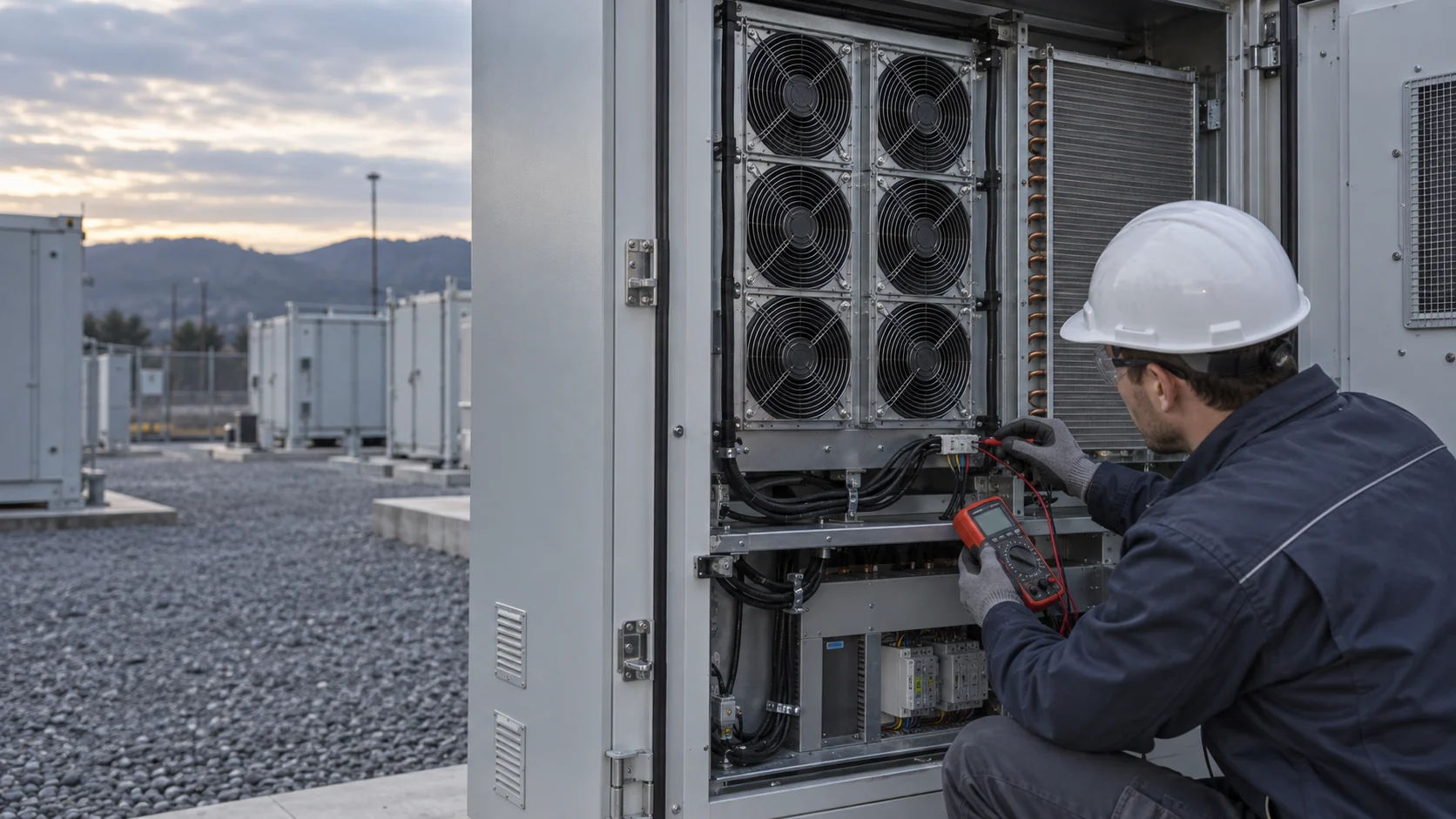
A fan-level ingress rating describes a defined test configuration for that fan. It does not automatically establish the protection level of the enclosure the fan is installed in, and it says nothing about what dust, salt and moisture do to the components between the intake and the fan. An outdoor BESS air path is an assembly: intake louver, filter, coil or heat exchanger face, shroud, fan array, cabinet seams, drains, cable entries and exhaust. Each stage has its own exposure, and the weakest stage decides the installed result.
The site exposure should drive the requirement. A sheltered inland cabinet with intermittent dust is not the same as a coastal installation with salt mist, or a desert site with fine mineral dust and high solar load. Standards help most when they are named precisely: which test method, which severity, which specimen, and which acceptance rule. A statement such as salt resistant has little engineering value without those four items.
This article walks the air path from louver to exhaust, separates what each environmental test actually proves, and gives a sample and acceptance plan you can put in front of a fan supplier or an enclosure integrator.
What the IP Code Says, and What It Does Not
IEC 60529 defines precise tests. Read the digits as a test result, not as a promise about your cabinet.
In the IP code, the first digit covers solids and the second covers water. Digit 5 is dust protected: limited ingress of dust is permitted, as long as it does not interfere with operation or safety; digit 6 is dust tight, and the test holds the enclosure at reduced pressure so the dust chamber works harder at finding a path in. On the water side, digit 5 is a jet test with a 6.3 mm nozzle at 12.5 liters per minute for about 3 minutes per surface; digit 6 raises that to a 12.5 mm nozzle at 100 liters per minute. A rating is earned by the test, in the mounting the manufacturer declares, on the specimen submitted.
That is why a fan with an IP68 rating does not make the cabinet IP55, and a cabinet marked IP55 does not prove anything about the fan mounted behind a service door. Cabinet builders commonly target IP55 for outdoor BESS enclosures and then protect the air path separately: the ventilation openings get a louver and a filter, and the cable entries are sealed after installation. One vendor installation guide for an outdoor cabinet states the IP55 enclosure class, an anti corrosion grade of C3H, an operating range from minus 20 to plus 60 degrees Celsius, and instructs that lower inlet and outlet openings be sealed with fire resistant compound after cabling. Those are assembly level decisions, not fan level ones.
When you collect documents for a design review, keep the fan test report and the cabinet test report as separate evidence, and add a third item neither of them covers: the assembled air path, tested at rated flow with the cabinet closed.
| Code element | What the test does | What it does not tell you |
|---|---|---|
| First digit 5 (dust protected) | Talcum dust chamber with reduced internal pressure; limited ingress allowed if harmless | How fast your filter loads at your site, or what dust does to the coil face |
| First digit 6 (dust tight) | No dust ingress at all, under reduced internal pressure | That a fan inside a gasketed plenum inherits the rating |
| Second digit 5 (water jets) | 6.3 mm nozzle, 12.5 L/min, about 3 minutes per surface | How the intake behaves during wind driven rain with the fans running |
| Second digit 6 (powerful jets) | 12.5 mm nozzle, 100 L/min | Salt corrosion resistance; that is a different standard entirely |
Salt Mist: Name the Method, Severity and Specimen
Salt exposure is a corrosion question with an electrical ending, and the proof is a named cyclic test, not an adjective.
The reference method for salt mist exposure is IEC 60068-2-52, which defines cyclic testing: a salt spray period followed by a humid storage period, repeated, with severity stated as a number of cycles. The value of the cyclic form is realism; the wet dry cycling is what drives corrosion on assemblies, because the salt film stays behind after each dry period. A report is only useful if it names the severity level, the specimen that was tested, and the acceptance rule applied afterward.
At the system level, UL 9540 evaluates the complete energy storage system, and its construction requirements include water exposure and salt fog exposure: the unit must not develop a shock or overheating hazard from that exposure. Again, the specimen is the system. A fan datasheet line saying salt mist tested, with no method and no severity, does not discharge that requirement for the cabinet, and the cabinet certificate does not describe what a year of salt film does to a fan bearing or a connector contact.
Coastal BESS projects commonly classify the site by corrosivity category practice such as C3, C4 or C5, and one outdoor cabinet vendor states an anti corrosion grade of C3H for its standard product, which puts the burden on the buyer to escalate for marine sites. For the fan itself, escalation means visible choices: conformal coated circuit boards, sealed cable entries, plastic or coated hardware at the exposed surfaces, and drain paths so condensed or sprayed water leaves the shroud instead of pooling over the electronics.
Dust: From Filter Loading to Airflow Loss
Dust rarely kills a fan first. It loads the filter and the coil, the air path resistance climbs, and the fan slides down its curve.
Dust does not need to damage a motor electrically before it becomes a thermal problem. As a filter, coil face or louver loads, the system pressure requirement rises at the same commanded flow, and the fan moves down its curve toward less delivered airflow. The battery section then runs warmer at the same fan command, which is the failure that shows up in a thermal report weeks or months after the dust event that caused it.
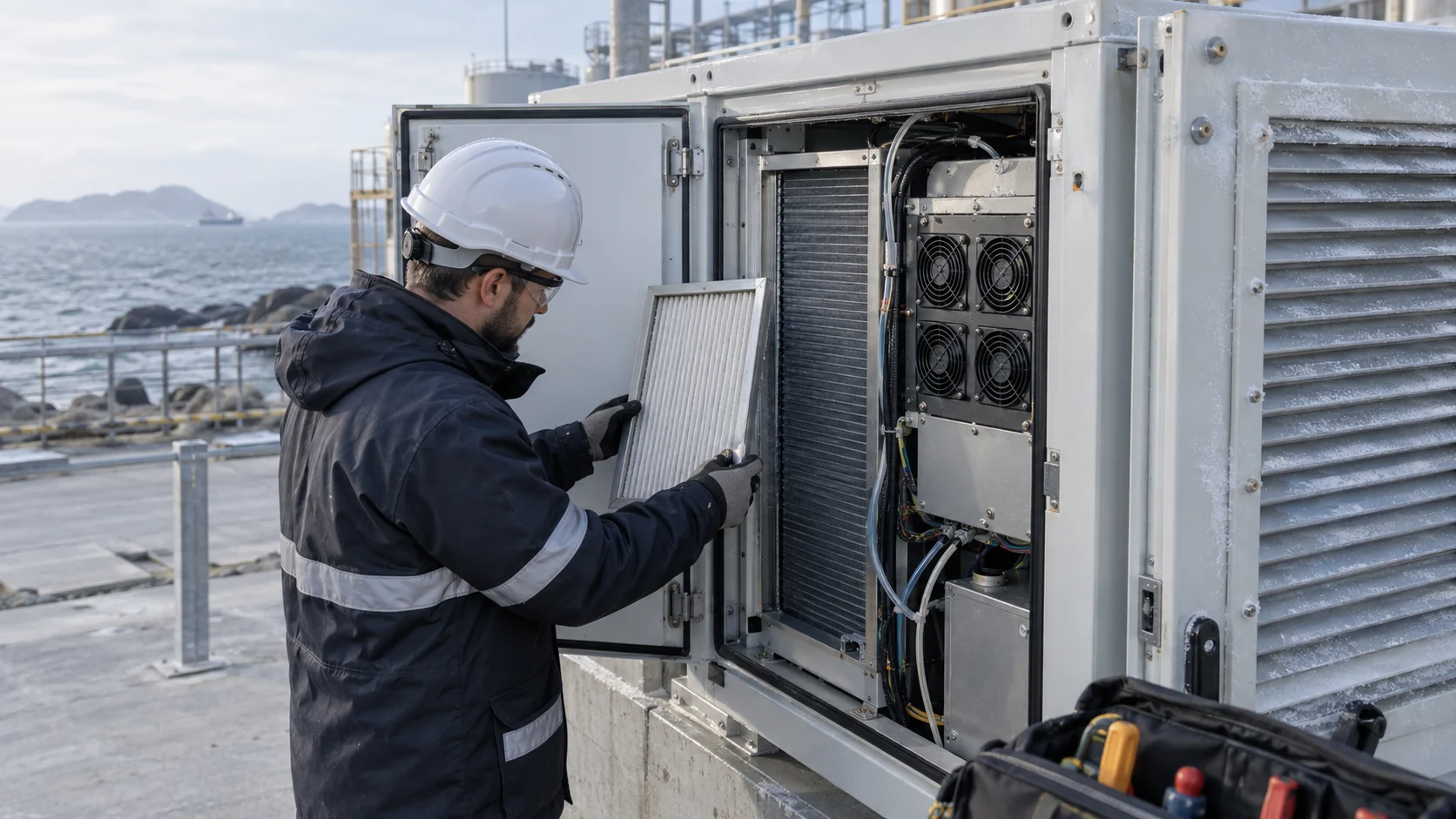
Filter practice gives you the numbers to size this margin. Under ASHRAE 52.2, a filter class is evaluated to a stated final resistance, and the minimum final resistance is at least twice the initial resistance; for a MERV 8 class media, the minimum final resistance in the standard table is 150 pascals at rated test flow. Your installed fan must hold the required airflow not at the clean filter pressure but near the changeout pressure, and the filter differential pressure alarm should sit below that changeout point with room for the operator to act. The site's filter differential pressure guide covers the alarm limit in detail, and the high ambient margin article shows how to reserve speed for exactly this kind of drift.
The louver is the other dust gate. Its free area and blade geometry set the entry velocity, and a high entry velocity pulls rain and dust past the blade line and onto the filter face. A low entry velocity costs opening area but buys a longer filter service interval and cleaner coil faces. Both belong in the air path drawing you hand to suppliers, next to the filter class and the fan curve.
One Fan Command, Two Air Path States
The same fan, the same command, and the difference is what months of site exposure did to the stages in front of it.
Read the two panels as a service interval in one image. At commissioning, the stages add about 100 pascals of static and the fan delivers the commanded airflow with margin. After seasons of dust and salt without service, the filter alone approaches its alarm limit, the total static nearly quadruples, and the delivered airflow falls by roughly a quarter at the same command. Nothing is wrong with the fan. The air path is the asset that needs the specification, the alarm and the maintenance plan.

Humidity and Contamination Reach the Fan Before the Filter Does
Fine dust mixed with humid air corrodes fan electronics directly, and the field evidence is specific about the chemistry.
A Sanyo Denki America field failure report documents two production designs that ran for roughly 10 to 13 years without returns, then began failing within a few years after customers installed systems in a humid Asian location and a Southeast Asian location. Failure analysis found corrosion at the points where lead wires solder to the fan circuit board, and one case where the corrosion opened a circuit board trace completely. The accumulated dust on the returned units was chemically analyzed: 48 percent chlorine, 25 percent potassium and 21 percent calcium. Chlorine plus high humidity is the combination that eats copper traces.
The fix in that report is instructive for how narrow it can be: a silicone based conformal coating on the fan circuit board, applied as a customization, with no change to fan performance and therefore no thermal requalification of the host system. The drawing and lot codes carried the change. This is exactly the kind of fan level decision an outdoor BESS specification should make explicitly, because the fan sits at the pressure boundary where humid, contaminated air concentrates.
Component vendors offer graded answers: some industrial DC fans seal the whole motor, winding and electronics in coated construction with ingress ratings up to IP68, and others offer a humidity protected variant of a standard series. The selection question is not which label sounds stronger; it is which construction matches the air your air path actually delivers to the fan face, in your corrosivity category, with your filter service discipline. The condensation and dew point guide handles the inside surface side of the same humidity budget.
Interactive: A Clean Fan Signal Can Hide a Restricted Air Path
This diagnostic aid is qualitative, not a corrosion or lifetime model.
Switch the qualitative states to see why fan command and tach feedback need pressure and temperature context in a serviced outdoor cabinet. A fan can report healthy speed and healthy current while the stages in front of it quietly move the operating point. The predictive maintenance signals guide lists which signals to log so this state is visible in trend data rather than in a thermal report.
Specify the Assembly: Louver to Exhaust
Every stage of the outdoor air path has a failure mode and a countermeasure. Write them as one table, not as separate datasheet claims.
Start at the intake. The louver sets entry velocity and water separation; specify its free area and its water penetration class together, because a louver that passes water at your wind speed loads the filter with salt film. Continue to the filter: class, initial pressure, changeout pressure, alarm point, and a gasketed frame so bypass air does not carry dust around the media. The coil or heat exchanger face needs approach velocity control so it does not entrain carryover water, and fins spaced for your dust profile. Then the fan section: coated electronics where the corrosivity category calls for it, drains in the shroud, and hardware that survives the site. Close the loop at the exhaust: discharge direction separated from the intake, seams gasketed, cable entries sealed after installation, and a maintenance access that makes filter changeout a five minute task instead of a reason to skip it.
One installation guide for outdoor BESS cabinets adds a foundation rule that belongs in every site plan: place the cabinet at least 300 millimeters above grade or above the historical high water line, because splash, standing water and drifting debris attack the lower intake first. These are the cheapest centimeters in the whole design.
| Site class | Dominant exposure | Add to the specification |
|---|---|---|
| Coastal and marine | Salt mist, wind driven rain, C4 to C5 corrosivity | Cyclic salt mist test on the named assembly, coated fan electronics, sealed entries, escalation above a standard C3H cabinet grade |
| Desert and arid | Fine mineral dust, high solar load, large daily temperature swing | Dust tight intake discipline, filter changeout pressure with data, thermal margin for the solar rise on the cabinet skin |
| Industrial and urban | Conductive or corrosive particulates, chemical gases | Dust chemistry from the site, conformal coating as a named fan option, gas compatible materials at the coil face |
| Humid inland | High humidity, condensation cycles, biological debris | Drain paths at every low point, dew point based control, humidity protected fan variant |
Turn Site Conditions Into a Sample and Acceptance Plan
Evidence beats adjectives at every stage of an outdoor procurement, and every test names its specimen.
For a custom DC fan or a cost competitive replacement review, provide the current fan or drawing, the required pressure flow point, the voltage window, the control interface, and the site exposure class with its corrosivity category. A productive fan inquiry lets the supplier evaluate the installed duty instead of guessing from frame size or free air CFM. The replacement validation guide shows the acceptance format in detail, and the N plus one array guide adds the module out case that outdoor sites must also survive.
Acceptance for the outdoor air path then has four lines. First, the assembled path measured at rated flow, cabinet closed: clean stage pressure drops recorded, filter changeout pressure demonstrated, alarm verified. Second, environmental evidence per standard: the salt mist method, severity, specimen and acceptance rule; the cabinet IP test report; the fan ingress test report. Third, a fan sample run in the representative filter, louver and coil configuration, not on a bench plate. Fourth, a service interval plan with the filter changeout triggered by measured pressure, not by calendar alone.
Each line names its specimen, and none of them can be satisfied by an adjective on a datasheet. That is the whole point of separating fan, cabinet and assembly evidence.
What MEGA Tech Does for Outdoor BESS Duty
We build the fan for the air path you actually have, and we validate it in that context.
We can do: custom DC and EC axial and backward curved centrifugal fans built for outdoor duty, with conformal coated electronics, sealed constructions and hardware selected for your corrosivity category; selection at the installed operating point, meaning the pressure flow point behind your louver, filter and coil at your changeout pressure, not the free air number on a datasheet; and samples that you validate in the real cabinet configuration before volume.
We need from you: the required airflow and its static pressure at the changeout condition, the voltage window and control interface including PWM frequency and any speed or tach feedback your controller reads, the site exposure class and corrosivity category, the air path drawing with filter class and alarm points, space and connector constraints, noise targets, and the lifetime assumption for the project.
We do not supply: the enclosure, the louver and filter media, the coil or heat exchanger, the controller, or the cabinet safety design. We make the fan a specified, testable part of your outdoor air path, and we hand you the evidence to hold the rest of the assembly to the same standard.
Recommended Fan Starting Points
These catalogue series may be suitable starting points for this application. Final selection depends on the installed airflow, static pressure, voltage, noise target and operating environment.
Request a sample for validation on your equipment.
Engineer FAQ: Outdoor BESS Cooling and Environmental Exposure
Short answers to the questions this specification raises most often.
Q: Does an IP rated fan make the BESS cabinet IP rated? A: No. Cabinet protection is judged on the complete assembled enclosure, openings, seams and entries. The fan test report and the cabinet test report are separate evidence, and the assembled air path needs its own measurement.
Q: Does a salt mist test prove a fixed outdoor lifetime? A: No. It is evidence for the named method, severity, specimen and acceptance rule only. IEC 60068-2-52 defines cyclic testing, and a report without those four items has little engineering value.
Q: What filter pressure should the fan be selected against? A: Near the changeout pressure, not the clean pressure. ASHRAE 52.2 sets minimum final resistance at least twice the initial resistance, and the alarm should sit below the changeout point with room to act.
Q: Why did fans fail in a humid site after years of trouble free service elsewhere? A: Contaminated dust plus high humidity corrodes fan circuit boards and solder joints. One analyzed failure had dust with 48 percent chlorine. A conformal coating on the fan electronics is a targeted fix that does not change fan performance.
Q: Is a higher IP number always the better fan for outdoor duty? A: Not by itself. Sealed construction trades against cooling of the electronics and against price. Match the construction to the corrosivity category and to what your filter discipline actually delivers to the fan face.
Q: Where should the filter alarm sit? A: Below the changeout pressure with enough margin for operator response, and it should be verified against the measured installed pressure at rated flow, cabinet closed, not against a datasheet estimate.
Questions for a Design Review
Ask these before the outdoor site freezes the specification.
- Which document proves the cabinet rating: the IP test report, the salt mist method with severity, or only a marketing line?
- What is the measured installed pressure at rated flow, cabinet closed, at clean filter and at changeout?
- What corrosivity category is the site, and does every exposed component, fan included, meet it?
- Which stages between louver and exhaust have drains, and where does condensed or sprayed water leave the shroud?
- What dust chemistry does the site present, and is the fan electronics construction chosen against it?
- Where does the exhaust discharge relative to the intake, and can recirculation load the intake under wind?
- What service interval plan triggers filter changeout: measured pressure, calendar, or habit?