The two killers of vehicle fans
Temperature attacks materials, vibration attacks structures — and the combination is far nastier than either alone.
A fleet of delivery vans rolls through a northern winter. By February, a pattern emerges: cabin heater blowers and battery-cooling fans failing across vehicles that are barely two years old. The teardown tells the story — bearing grease that stiffened into wax below −25 °C, motors stalling on cold start, windings overheating as locked-rotor current cooked them. The fans were rated for industrial use. The vehicle was not an industrial cabinet.
The summer version is quieter and slower. A fan survives every temperature test, then dies at 60,000 km — not from heat, but from vibration. Solder joints on the driver board crack from years of micro-flexing; a connector walks a fraction of a millimeter out of its housing until intermittent contact becomes open circuit. The failure report says “electrical.” The root cause is mechanical.
Temperature and vibration are the two killers of vehicle-mounted fans, and they kill differently: temperature attacks materials, vibration attacks structures. Automotive validation exists because the combination is far nastier than either alone. This article explains what vehicle fans actually face, how ISO 16750 and LV 124 structure the testing, the four misconceptions that ship bad fans, and five buyer checkpoints.

What a vehicle actually does to a fan
Park the datasheet and list what the mounting location imposes — it is just the ordinary life of a vehicle.
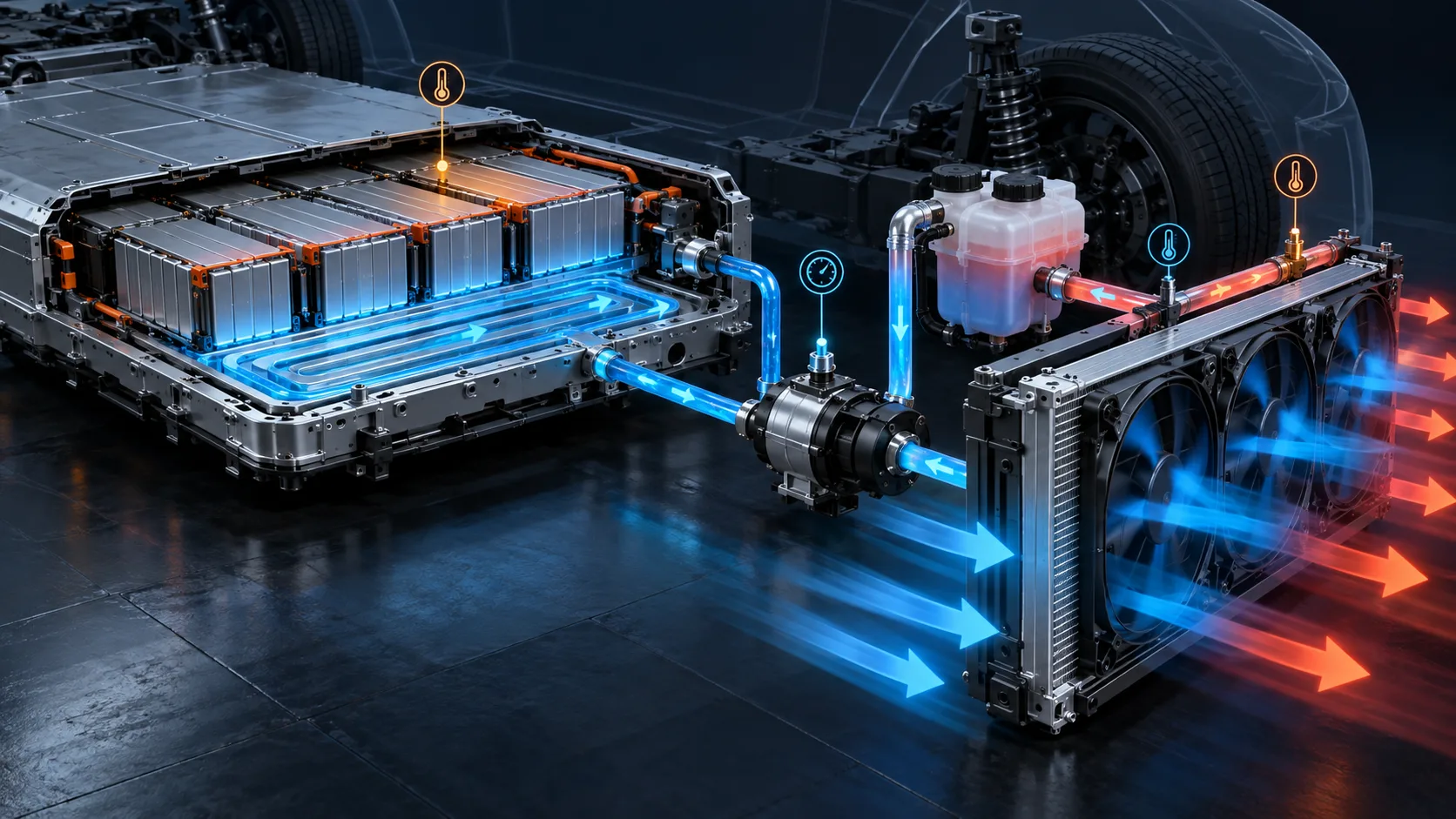
Temperature range: a fan in a passenger compartment might see −40 °C to +85 °C across seasons and markets, and under-hood or near power electronics the upper end climbs well past +85 °C. The range is not the hard part — the cycling is: thousands of thermal cycles over the vehicle’s life, each one expanding and contracting every joint, seal and housing at different rates.
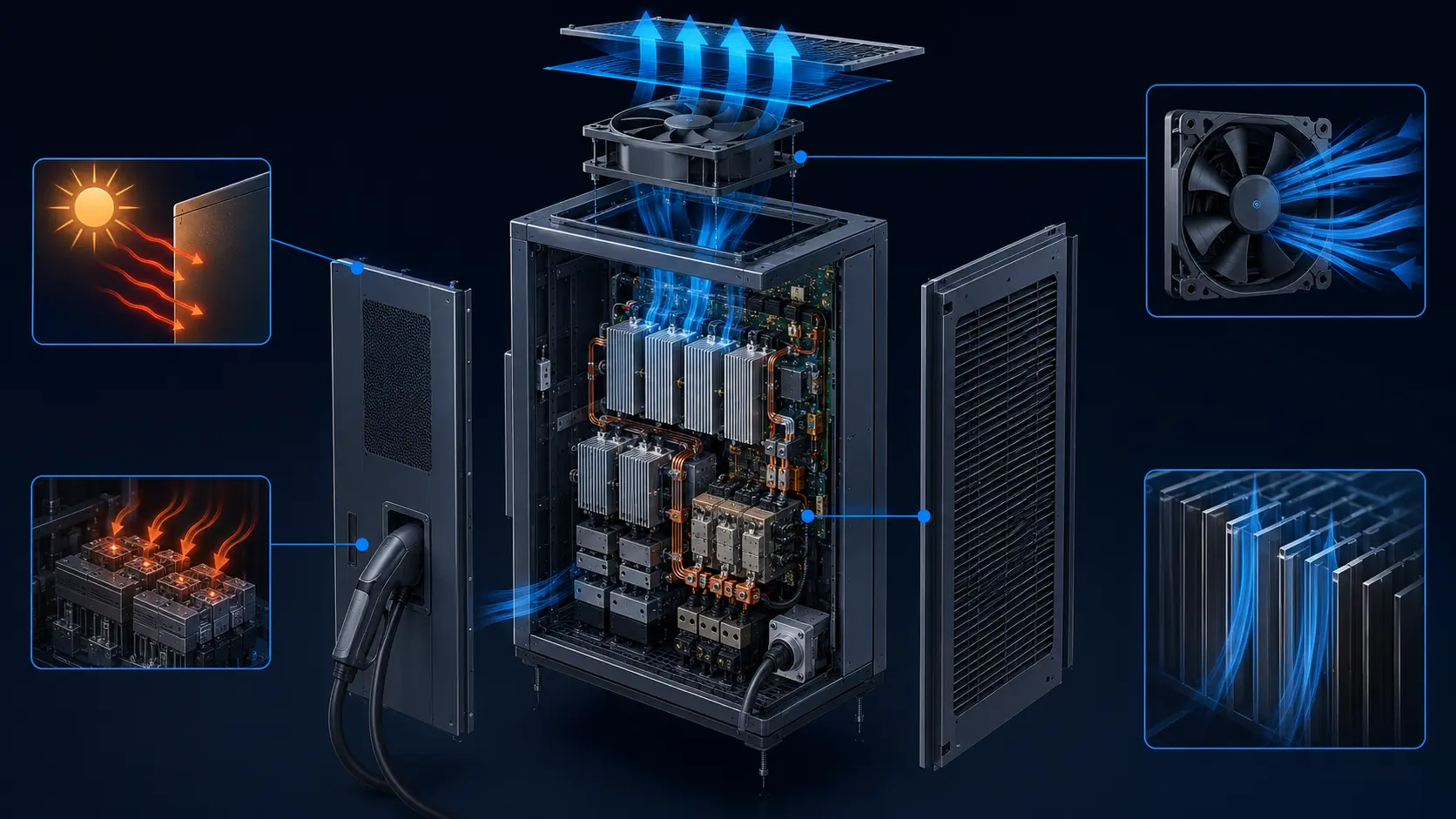
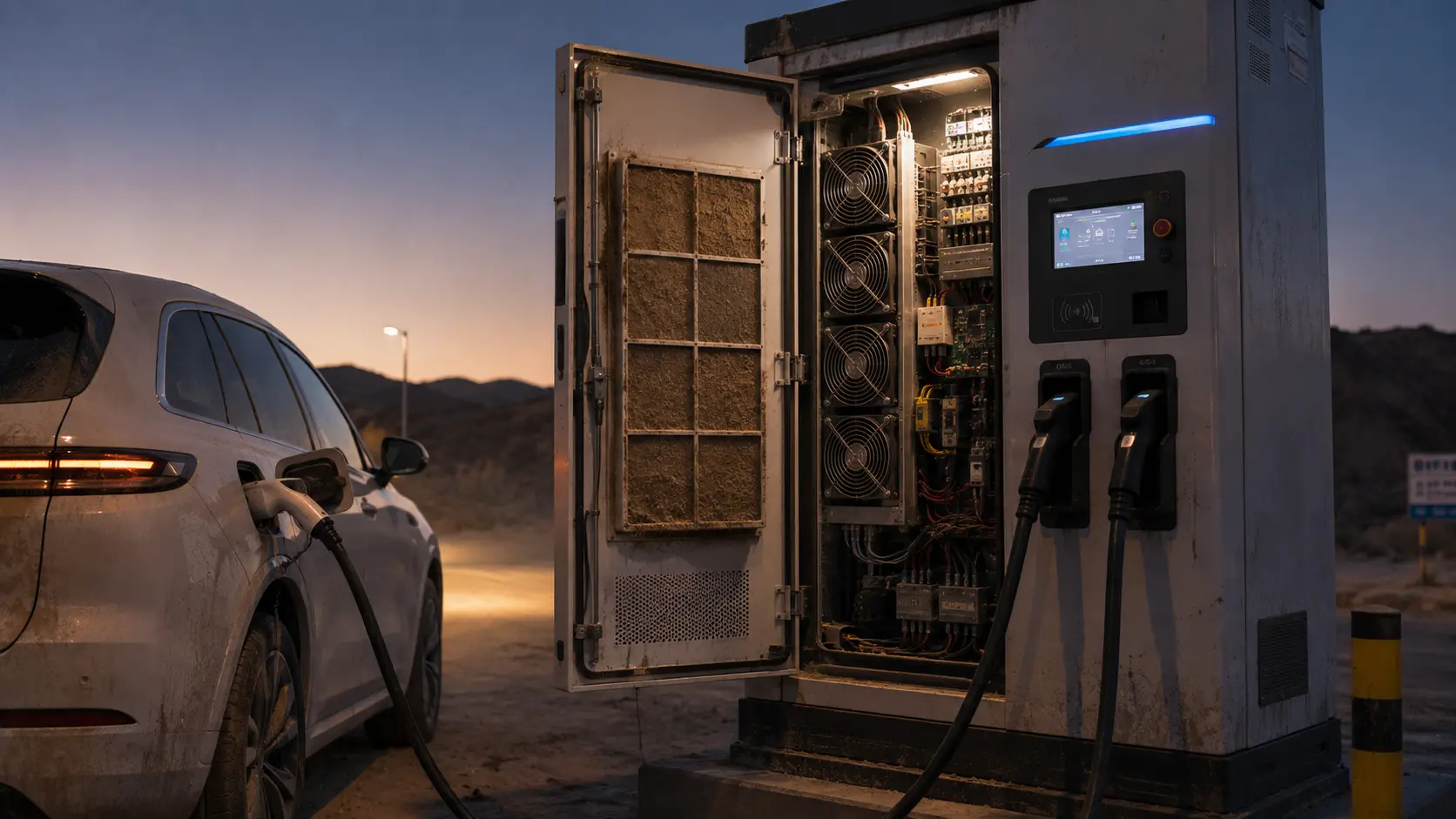
Vibration and shock: engine vibration, road input through the chassis, and the specific resonances of the mounting bracket — broadband, multi-axis, for hundreds of thousands of kilometers — plus shock events like potholes, curb strikes, and the occasional shipping drop before the fan is even installed. Humidity and condensation: cold starts in humid climates condense water inside the fan, and winter road spray adds salt — electronics that were fine in a dry lab corrode quietly in the field.
Electrical environment: load dump, jump starts, reversed battery, voltage dips during cranking — the vehicle’s 12/24 V rail is not a lab supply, and the fan’s driver electronics must ride through all of it. Lifetime and duty: fifteen years or 300,000 km is the design horizon many OEMs use, with fans running a large fraction of operating hours — an industrial fan’s 40,000-hour L10 at 40 °C is a different universe from a decade of thermal cycling with vibration. None of this is exotic. Validation standards exist to compress that life into testable form.
ISO 16750: the structure of automotive environmental testing
A toolbox, not a pass/fail stamp — it defines test methods and severities, and the vehicle manufacturer selects which apply.
ISO 16750, “Road vehicles — Environmental conditions and testing for electrical and electronic equipment,” is the international framework most of the industry references. It is a toolbox, not a pass/fail stamp: it defines test methods and severity levels, and the vehicle manufacturer selects which apply to a given mounting location. The parts that matter for fans:
ISO 16750-1, General: definitions, the philosophy of the series, and how to specify which tests apply — read this first, it explains how to read the rest. ISO 16750-2, Electrical loads: DC supply voltage variations, overvoltage, superimposed AC, slow decrease and increase of supply voltage, interruptions, reverse voltage, ground and supply offset, open circuits, short circuits, insulation resistance — the fan’s driver must survive the rail, not just the nominal 12 V.
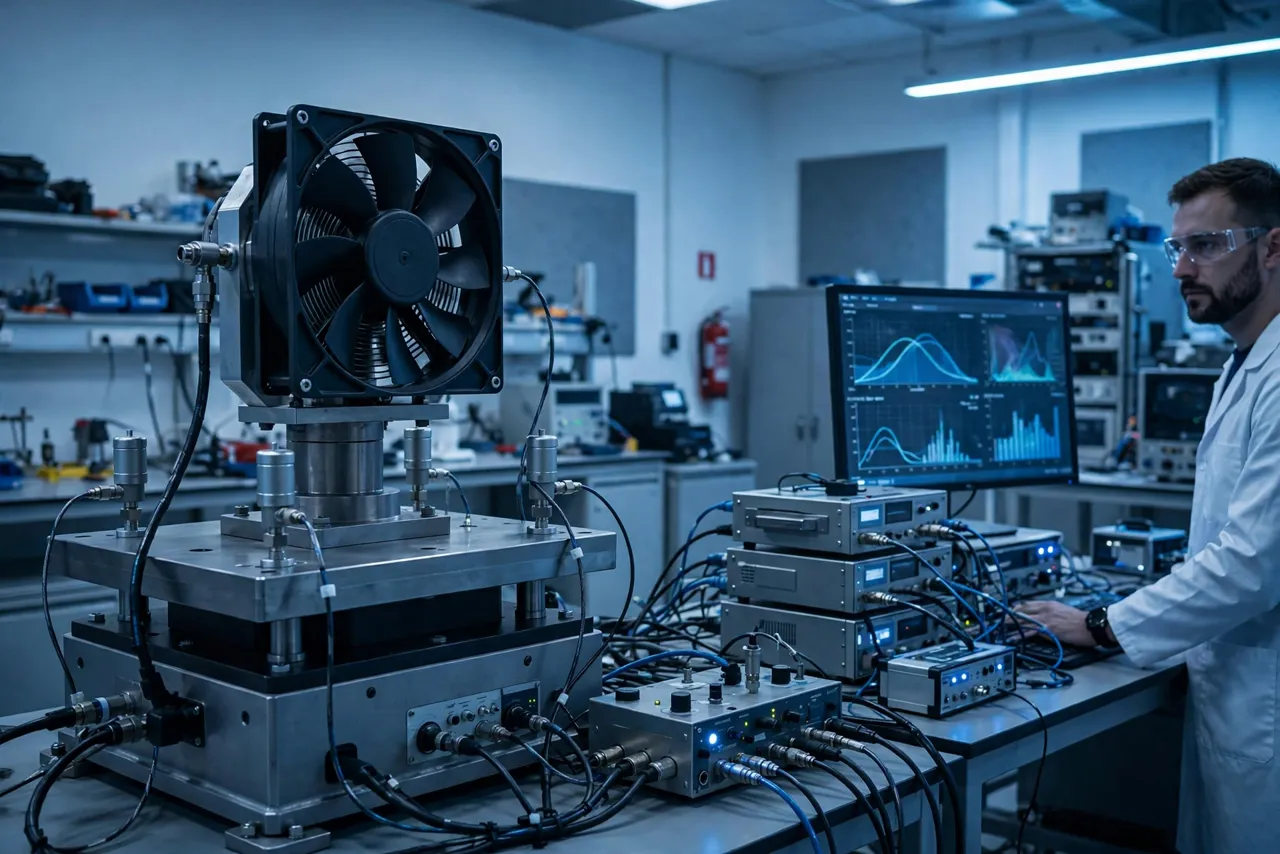
ISO 16750-3, Mechanical loads: vibration testing — sinusoidal, random, and combinations — plus mechanical shock and free fall. Severity depends on mounting location: engine-mounted equipment faces the harshest profiles, body-mounted less. This is where the “passed vibration” claim gets its meaning: passed which profile, for how long, on which axes. ISO 16750-4, Climatic loads: constant and cyclic temperature and humidity, thermal shock, solar radiation, dust, salt mist, icing — with coded temperature ranges spanning from −40 °C up to well beyond +85 °C for the harshest locations. ISO 16750-5, Chemical loads: fluids the equipment may contact — for fans, usually road salt and cleaning agents rather than engine fluids.
The practical reading: when a supplier says “tested to ISO 16750,” ask which parts, which severity codes, and for which mounting location. The standard’s power is in its specificity — a vague claim to the whole series means nothing.
LV 124: what the German OEMs actually require
Not a law and not a certification — it is what these OEMs put into supply contracts.
LV 124 — “Electric and electronic components in motor vehicles up to 3.5 t” — is a requirement specification published jointly by German vehicle manufacturers (Audi, BMW, Daimler, Porsche, Volkswagen). It is not a law and not a certification; it is what these OEMs put into supply contracts. If you sell into their supply chains, LV 124 is the test plan.
Its structure mirrors the physics: mechanical tests (vibration, mechanical shock, free fall, fastening strength), climatic tests (low/high temperature storage and operation, temperature shock, cyclic humidity, salt mist, dust, solar radiation, icing), electrical tests (the full catalog of rail abuse), and lifetime tests that combine them. Two features distinguish it from a generic reading of ISO 16750: the severity levels are fixed by the OEMs rather than negotiated per project, and the pass criteria are defined in terms of the component’s function classes — a fan that degrades gracefully is judged differently from one that must not deviate at all.
The important nuance: LV 124 describes requirements for components in vehicles up to 3.5 tonnes from these manufacturers. Other OEMs have their own equivalents with different severities. “LV 124 tested” is meaningful within its jurisdiction; outside it, translate the requirements rather than assuming equivalence.
One more feature worth understanding: both frameworks include lifetime and combined-load tests, not just single-stress clauses. A fan can pass vibration at room temperature and temperature cycling on a bench, then fail when vibration, thermal cycling and humidity run together — because the combination attacks the solder joints, the connector fretting and the seal aging simultaneously. When you review a test report, check whether combined or sequential multi-stress testing was included; single-stress passes are necessary but not sufficient evidence for a fifteen-year vehicle life.
Four misconceptions that ship bad fans
The four beliefs that survive every design review — and keep causing field failures.
Misconception 1: “Our industrial fan is automotive-ready.” Industrial ratings assume benign vibration, moderate cycling, and a clean electrical supply. Vehicle service adds all three stressors at once, for longer. An industrial fan may survive in a vehicle — but “may” is not a validation plan.
Misconception 2: “It passed vibration testing.” Which profile? Sinusoidal sweep at 5 g tells you nothing about random vibration at the bracket’s resonance. Duration, axes, severity, and the mounting fixture all change the result — a fan tested hard-mounted can fail softly-mounted and vice versa. The profile is the claim; “vibration tested” without it is noise.
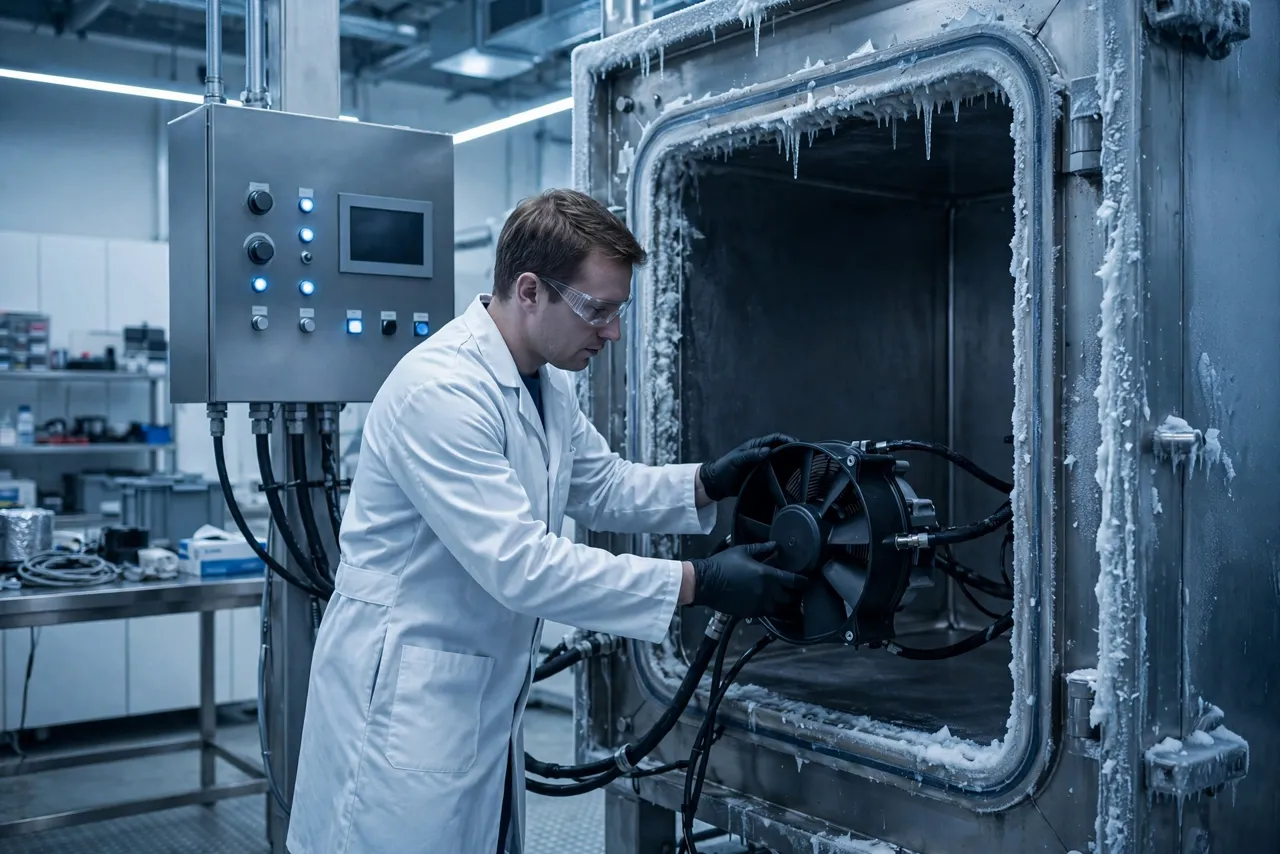
Misconception 3: “It survived −40 °C, so the temperature range is covered.” Cold storage survival is one clause. Cold-start operation — grease stiffness, locked-rotor current, brittle plastics under shock — is another. And the range’s upper end plus thermal cycling plus humidity is where most field failures actually live. One cold test proves one thing.
Misconception 4: “AEC-Q100 qualified parts inside means the fan is automotive grade.” AEC-Q100/Q101 qualify integrated circuits and discretes, not assemblies. A fan built from qualified components can still fail at the solder joints, the connector, or the housing — the assembly-level validation (ISO 16750-3/-4, LV 124) is what covers the fan as a product.
Five buyer checkpoints for vehicle fans
Five questions that turn “automotive grade” from a slogan into a test matrix.
Checkpoint 1: define the mounting location and its code. Passenger compartment, chassis, under-hood, near power electronics — each maps to different temperature and vibration severities in ISO 16750 and LV 124. Get the location in writing before discussing any test. Checkpoint 2: demand the test matrix, not the summary. Which clauses of ISO 16750-2/-3/-4 (or LV 124 sections), at which severity codes, with what pass criteria and what function class. A one-line “tested to ISO 16750” is a red flag; a table of clauses with results is the real thing.
Checkpoint 3: ask about cold start, not just cold storage. Grease selection for low-temperature torque, locked-rotor protection behavior at −40 °C, and materials that stay ductile. Storage tests are easy; starting is hard. Checkpoint 4: inspect the vibration-sensitive details. Connector locking (not friction-fit), solder joint geometry and staking of heavy components, bracket resonance relative to the test profile, wire routing and strain relief. Most vibration failures are in the interconnect, not the motor.
Checkpoint 5: confirm the electrical abuse list. Load dump, jump start, reverse polarity, cranking dips — which ISO 16750-2 clauses were run, and what the driver did during each. A fan that survives mechanically but latches up on a voltage dip fails just as finally.
The design details that decide survival
Standards define the tests; design decides the results — and none of this is visible on a datasheet’s headline specs.
Low-temperature grease and bearing system: grease viscosity rises exponentially as temperature falls, and the wrong grease turns the bearing into a brake at −30 °C. Vehicle fans need greases specified for the cold end, validated by cold-start torque tests — not just storage. Locked-rotor and stall protection: a fan that cannot start in the cold must not destroy itself trying — current-limited start, retry logic, and thermal protection in the driver turn a stall into a recoverable event instead of a burnout.
Interconnect robustness: locking connectors, positive retention, strain-relieved harnesses — vibration loosens what friction holds, so design for retention, then test to the profile. Solder and component mounting: heavy components staked or glued, joint geometry suited to thermal cycling, conformal coating where condensation is expected — the driver board lives the same thermal cycles as the motor, design it like it.
Housing and seal materials: plastics that stay ductile at −40 °C, seals that survive thermal cycling without taking a permanent set, corrosion-resistant hardware for salt exposure — cold makes materials honest. None of these is visible on a datasheet’s headline specs. All of them are visible in the test report — which is why Checkpoint 2 comes before trust.

How MEGA Tech supports automotive thermal projects
Validation as part of the design — not as a gate at the end.
Vehicle programs reward suppliers who treat validation as part of the design, not as a gate at the end. MEGA Tech supports automotive thermal projects through its standard five-step engagement: custom cooling fan development and manufacturing, fan selection, airflow path review, sample validation, and mass production.
In practice: selection starts from the mounting location and its environmental code, so the test matrix is defined before the fan is; the design addresses the Section 7 details — grease, interconnect, driver protection — as requirements rather than afterthoughts; sample validation runs the relevant ISO 16750 and LV 124 clauses against agreed severities and produces the test report the program file needs; and mass production holds the validated configuration steady with change control.
A note on claims, stated plainly: validation results belong to specific fan configurations tested against specific clauses and severities — they are never a blanket attribute of a catalog. If a program needs a clause proven rather than assumed, the sample-validation step is where the testing happens and the report gets written.
Engineer FAQ
Short answers to the questions buyers actually ask.
Q: Can we use an industrial IP-rated fan in a vehicle if the IP rating is high? A: IP ratings cover dust and water ingress, not temperature cycling, vibration, or electrical abuse. A high IP rating is necessary for some locations but nowhere near sufficient — the ISO 16750-3 and -4 test matrix is the actual requirement.
Q: What is the difference between ISO 16750 and LV 124? A: ISO 16750 is the international standard framework defining test methods and severity levels, with the vehicle manufacturer selecting what applies. LV 124 is a requirement specification published by German OEMs that fixes the severities and pass criteria for their supply chains. LV 124 references the same physics; it just removes the negotiation.
Q: Does “tested to ISO 16750” mean the fan is certified? A: No. ISO 16750 defines tests, not a certification scheme. There is no ISO 16750 certificate — the deliverable is a test report against specific parts, clauses and severity codes. Ask for the report.
Q: Our fan passed vibration but failed in the field. What did we miss? A: Usually the profile: wrong severity for the mounting location, wrong axes, hard-mounted fixture versus soft vehicle mounting, or insufficient duration. Or the failure was never vibration alone — thermal cycling plus vibration plus humidity combine worse than any single test. Check Checkpoint 4’s interconnect details first.
Q: Is cold storage testing enough for the low-temperature requirement? A: No. Storage proves the fan survives being cold; operation proves it starts and runs cold. Cold-start torque, locked-rotor behavior, and material ductility under shock at temperature are separate clauses — make sure they are in the matrix.
Q: Do we need LV 124 if we are not selling to German OEMs? A: LV 124 is those OEMs’ contract language. Other OEMs have their own requirement specs with different severities. Use LV 124 as a reference for rigor, but validate against your customer’s actual specification — severities differ.
Questions for your next design review
Bring these to the review; leave with a test matrix you can defend.
- What is the mounting location — and which temperature/vibration severity codes does it map to?
- Have we seen the test matrix: which ISO 16750 parts and clauses, at which severities?
- Is cold-start operation tested, or only cold storage?
- What retains the connectors and harness against vibration — friction or positive locking?
- Which ISO 16750-2 electrical abuse clauses were run, and what did the driver do?
- What grease is in the bearing — and what is its low-temperature torque behavior?
- Are heavy driver-board components staked, and is conformal coating specified?
- Do the validation results belong to our exact configuration — or to a similar one?