The Scanner Was Quiet in the Demo, but Hot in the Duty Cycle
An anonymized European medical-equipment team needed a quieter cooling fan without losing the temperature margin of a compact imaging enclosure.
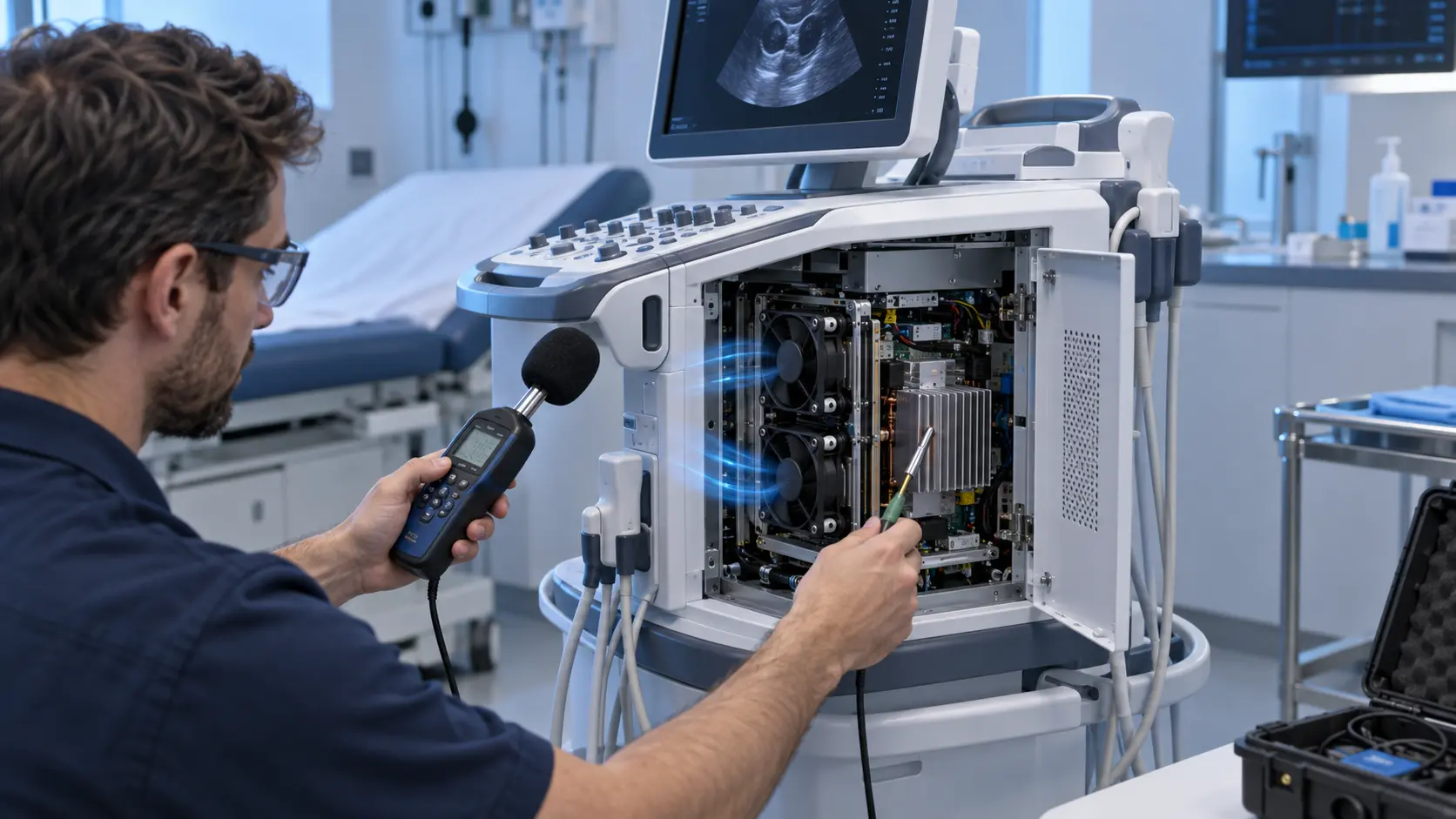
The device contained a power stage, control electronics and a sensitive measurement assembly inside a compact enclosure. During a demonstration, the fan was slowed to reduce audible noise. The room sounded better, but a power module near the end of the airflow path ran warmer during repeated scans. A second sample produced acceptable average dBA but introduced a narrow tonal peak through the enclosure panel.
The customer did not need a fan with the lowest catalogue noise number. It needed a fan and installation that met the device's heat-load, pressure, acoustic, vibration, control and reliability requirements together. MEGA Tech reviewed the original fan, the enclosure sample, the grille, the heat sink, the controller command and the measurement positions. The customer and released values remain confidential; this case describes the validation method.
The First Hook: Lower dBA Can Still Be the Wrong Answer
A quieter fan at one operating point can create a hotter component or a more noticeable tone at another.
Fan sound depends on speed, blade loading, pressure, installation and the receiver position. A lower average A-weighted level does not describe every tonal peak. Conversely, reducing RPM can move the fan away from a resonance while also reducing airflow. The device therefore needs an acoustic and thermal operating window, not a single headline number.
For a screening estimate, if a 2.0 kW internal loss is cooled by 0.18 m³/s of air and the effective air-side capacity is approximated as 1.2 kJ/(m³·K), the average air rise is about 9.3 K before local thermal resistances and bypass are included. If a quiet command reduces useful flow to 0.15 m³/s, the same simplified model rises to about 11.1 K. These are planning examples, not medical-device acceptance limits; the installed device must be measured.
The customer agreed to evaluate sound pressure, frequency spectrum, vibration and component temperature at the same command and installed pressure. That single decision prevented the project from optimizing one metric while damaging another.
| Question | Measurement | Release decision |
|---|---|---|
| Is the device thermally safe? | Hotspot, inlet and exhaust temperature | Pass at repeated and peak duty |
| Is the sound acceptable? | A-weighted level and frequency spectrum | No unacceptable tonal band |
| Is the chassis amplifying vibration? | Accelerometer and mounting review | No dominant panel resonance |
| Does the controller behave? | PWM, RPM, FG and startup | Stable control and fault recovery |
Sample 01: Reproduce the Complete Air Path
The fan was tested in the medical-equipment enclosure, not only on an open bench.
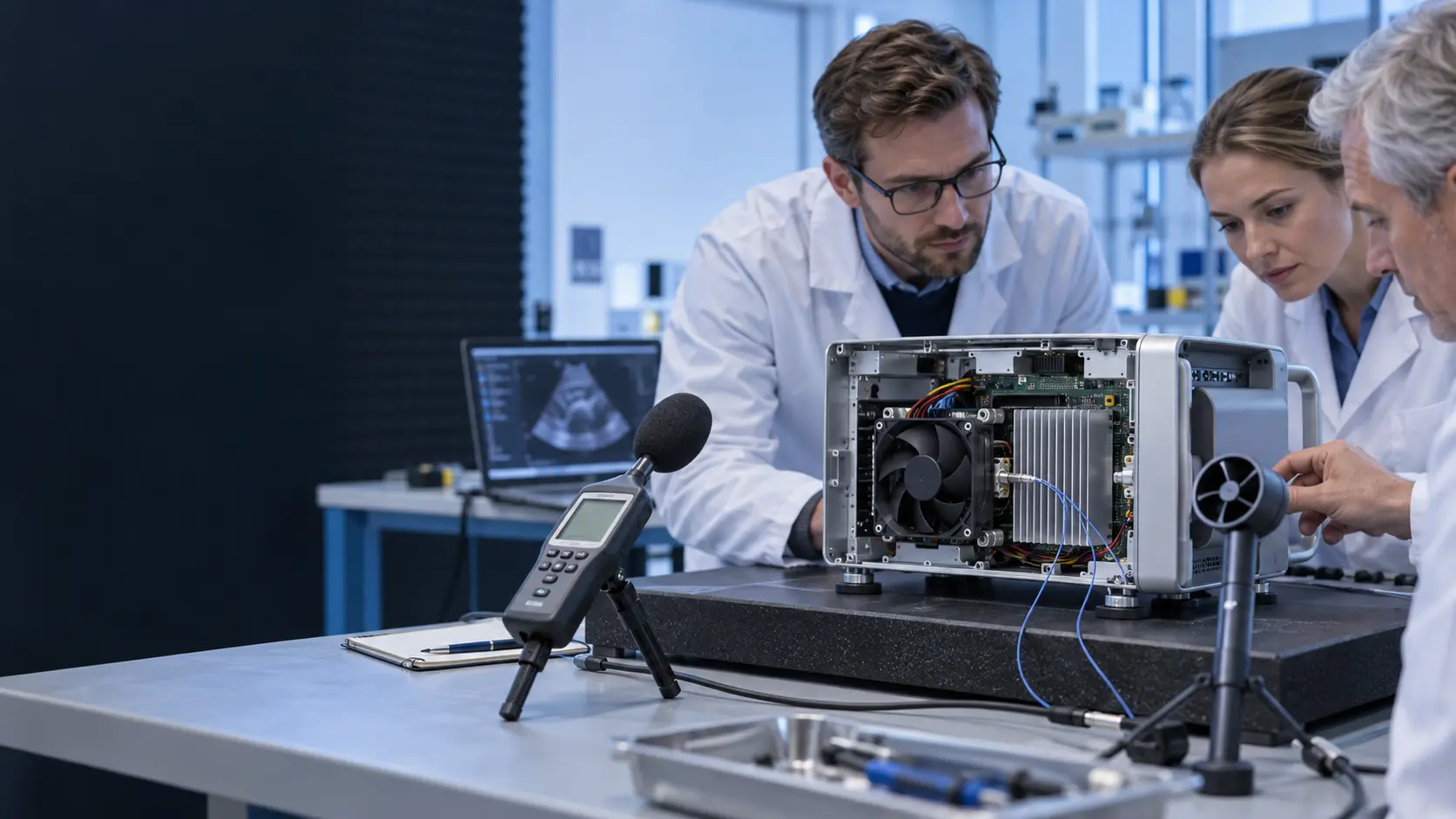
MEGA Tech installed the original and candidate fans in the same frame, gasket, grille and heat-sink path. The team recorded voltage, PWM command, RPM, current, pressure or airflow reference and the hottest component temperature. Microphone position, bandwidth, weighting and operating state were kept constant between samples.
The mechanical review also checked clearance, cable routing and panel stiffness. A fan can transfer vibration into a thin cover, while a grille can add turbulence or change the operating point. The result is why a larger fan at lower RPM is often a useful hypothesis in quiet equipment, but not a guarantee: the final answer still depends on the installed resistance and thermal target.

Sample 02: Find the Tonal Band Before Changing the Fan
The engineering team used the spectrum to identify whether the peak followed RPM, PWM or the enclosure.
The command was swept through idle, normal scan and peak-duty ranges. A blade-pass estimate was used as a diagnostic marker: blade count multiplied by RPM divided by 60. It did not predict the final sound, but it helped correlate a peak with rotor speed. The team then checked harmonics, driver frequency, grille installation and panel vibration.
When the peak moved with RPM, the fan-side geometry and operating window became candidates for tuning. When it remained fixed while the fan speed changed, the enclosure or control electronics required more attention. This distinction is valuable for procurement because replacing a fan cannot solve a panel resonance that is excited by every candidate.
The candidate sample was adjusted around the customer's PWM range, startup requirement and connector. The goal was not to promise silence; it was to avoid the tonal band while retaining the pressure and airflow required by the device.
Sample 03: Validate Noise and Temperature in the Same Run
A medical device cannot trade a patient-facing acoustic improvement for a hidden thermal limit.
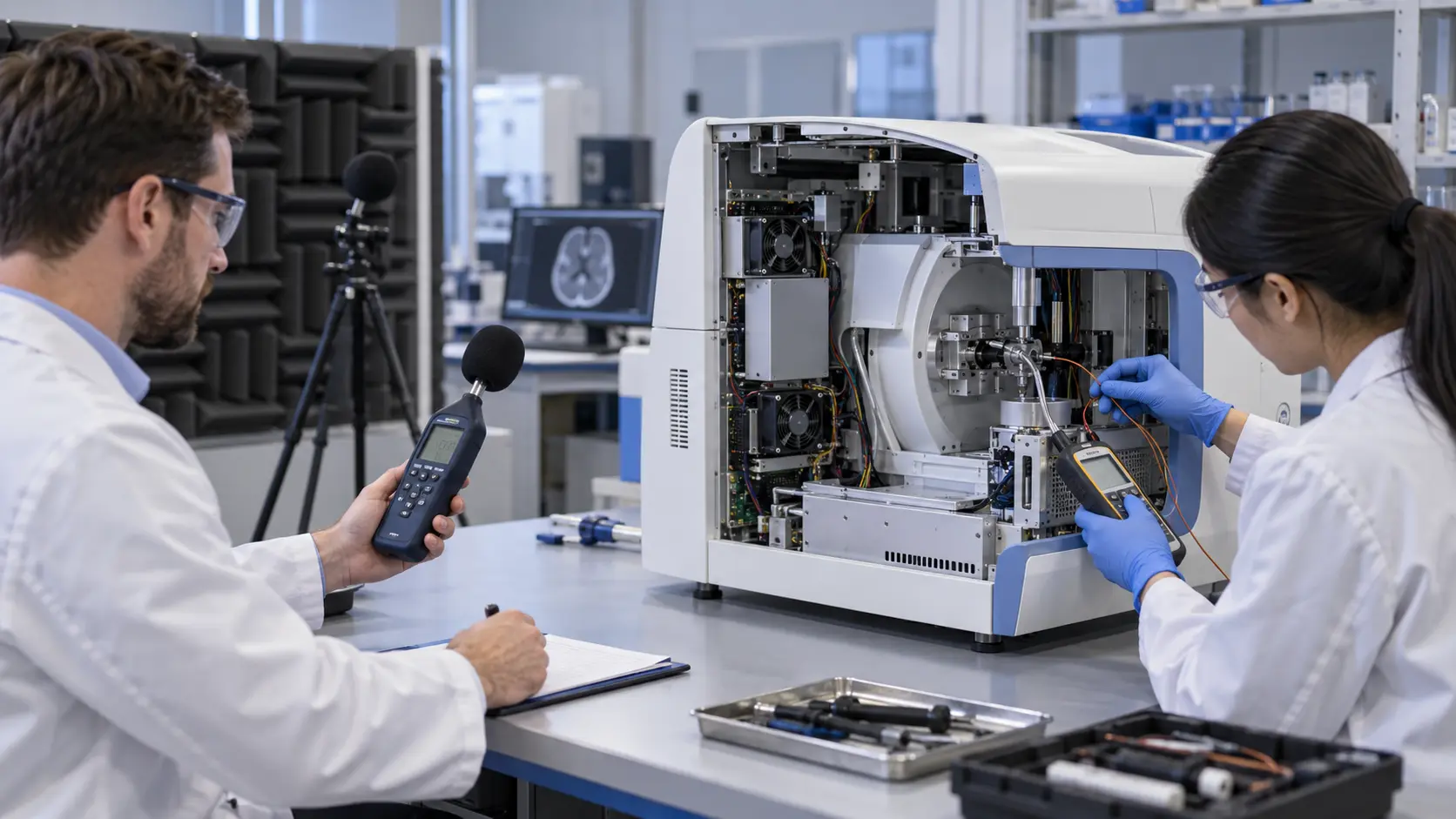
The final comparison repeated the acoustic test while the device ran its representative scan sequence. The log combined fan command, RPM, current, airflow or pressure, hottest component temperature, surface temperature where relevant, sound level and spectrum. The same sequence was repeated after warm-up so the result did not describe only a cold start.
A project-specific acceptance matrix separated normal, peak, restart and fault-recovery states. The fan was accepted only when the quiet command kept the protected components within their approved temperature limits and the noise spectrum remained acceptable at the declared receiver position. If the device requires a medical electrical safety or EMC assessment, the fan is one component inside the complete system approval; it does not carry that approval by itself.
The customer also considered maintenance and replacement. A production fan must preserve connector, mounting, direction, control behavior, material and traceability requirements. A quieter sample that changes the service interface can create a different risk later.
Result: A Controlled Acoustic Window Replaced a Subjective Preference
The customer obtained a repeatable path from fan sample to device validation instead of choosing the quietest catalogue number.
The approved configuration defined the installed pressure and airflow reference, PWM operating window, RPM feedback, connector, mounting and the acoustic measurement setup. It also recorded the thermal state that the device team would repeat during production approval. The result was a specification that engineering, quality and procurement could share.
The useful lesson is transferable: quietness is an operating condition, not a permanent property of a fan model. A design can improve by changing fan size, blade behavior, motor drive, PWM window, mounting isolation or airflow geometry, but each change must be measured against the same thermal duty.
MEGA Tech can start from a customer's existing fan and enclosure sample, build a small batch, adjust the fan-side parameters and return a configuration for installed testing. That is especially useful for medical and laboratory equipment teams that need to learn from a physical prototype before committing to volume production.
How MEGA Tech Supports Medical Equipment Fan Customization
We develop the fan around the device's real heat load, airflow path, acoustic target and interface.
MEGA Tech can review custom DC axial fans and compact centrifugal blowers for medical and laboratory equipment. The review can include pressure and airflow at the installed point, low-noise blade and motor behavior, PWM control, FG/RD feedback, connector, cable exit, mounting isolation, bearing option, temperature range and sample validation on the customer's unit.
For a first review, provide the current fan or sample, enclosure section, heat sources, target component temperatures, airflow direction, filter or grille, pressure target if known, voltage tolerance, PWM frequency and pinout, connector, acoustic method, vibration concern, service life and expected quantity. Tell us which values are device requirements and which are still estimates.
We do not certify the complete medical device, replace the manufacturer's risk file, or claim that a fan alone satisfies IEC 60601. We supply the custom fan engineering and sample evidence needed by the responsible device team to complete its own system validation.
Engineer Questions About This Medical Fan Case
These questions help separate acoustic preference from an approvable cooling requirement.
Q: Is the quietest fan always the best choice? A: No. It must meet installed airflow, pressure, temperature, control and reliability requirements at the same time.
Q: Why measure an FFT instead of only dBA? A: A narrow tonal peak can be more noticeable than broadband sound even when the overall number is lower.
Q: Can PWM remove a resonance? A: It can avoid a speed band, but startup, EMC, thermal response and feedback must be checked across the full control range.
Q: Why test after warm-up? A: Bearings, electronics, enclosure temperature and airflow conditions can change after the device reaches its normal operating state.
Q: Does a medical fan need to be certified by itself? A: The applicable requirements depend on the complete device and intended use. The manufacturer owns system-level compliance and risk management.
Q: What does MEGA Tech need to start? A: The fan and device sample, heat load, pressure or airflow target, voltage and PWM interface, acoustic method, mounting and quantity.
Questions for a Medical Equipment Fan Design Review
Use this checklist before freezing a fan or approving a low-noise sample.
- Is noise measured at the installed pressure and airflow used by the thermal test?
- Does the report include both overall dBA and a frequency spectrum?
- Does a peak follow RPM, PWM, the grille or the enclosure panel?
- Were idle, normal, peak, restart and fault-recovery states tested?
- Are microphone position, weighting, bandwidth and warm-up time documented?
- Are hotspot temperature, airflow, pressure and fan current logged with acoustics?
- Are connector, cable, mounting, cleaning and service requirements frozen?
- Which requirements belong to the fan supplier and which require complete-device approval?