The BESS Passed Thermal Checks but Failed the Listening Test
An anonymized European BESS developer needed to reduce fan-related acoustic impact without losing hot-ambient thermal margin.
The cabinet met its short thermal test, but the cooling fan became noticeable at the site boundary during evening operation. The complaint was not explained by one dBA number. A steady broadband airflow sound, a narrow blade-pass tone, inverter noise and cabinet-panel vibration created different perceptions at different operating states.
MEGA Tech reviewed the customer's cabinet, fan opening, grille, control curve, voltage, heat load, operating schedule and measurement points. The objective was not to promise a universal noise reduction. It was to develop a fan-side sample and validation method that separated acoustic behavior from thermal duty.
The customer identity and released acceptance values remain confidential. Illustrative calculations are labelled clearly; they are not customer test results.
The Engineering Hook: Total dBA Does Not Describe Every Noise Problem
A lower overall level can still leave an intrusive tone, while a quiet fan at low speed can simply be moving too little air.
BESS noise comes from more than the impeller. Fans, inverters, transformers, grilles, louvers and cabinet panels can interact. A tonal component near a blade-pass frequency may be more noticeable than broadband airflow at the same overall level. Installation direction and nearby barriers also change the result at a property boundary.
PNNL identifies noise and visual impact as practical BESS siting considerations. TÜV NORD notes that the fan side of a battery container is often the noisy side and that equipment orientation, barriers and frequency-focused silencers should be considered early. The Institute of Acoustics also highlights uncertainty in supplier noise data and the need to understand when cooling fans operate.
The design-review question is therefore: at which thermal state, fan speed, frequency band, distance and installation condition does the noise limit matter? The fan specification should answer that question rather than list only a single free-air dBA value.
The Problem in Operation: The Fan Curve and Acoustic Curve Moved Together
The original control strategy reduced speed in one mode, but the installed grille and panel amplified a narrow tonal region.
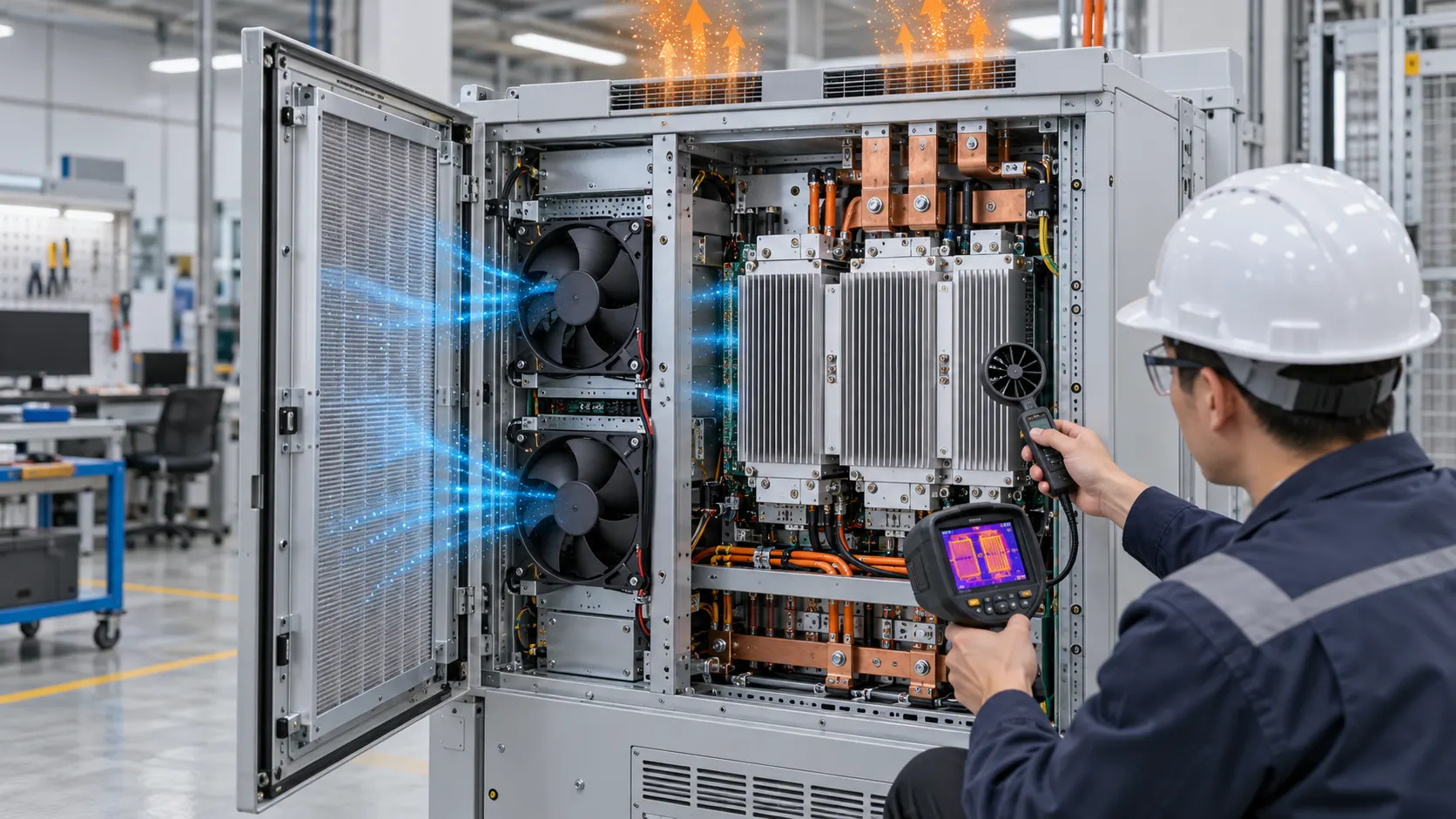
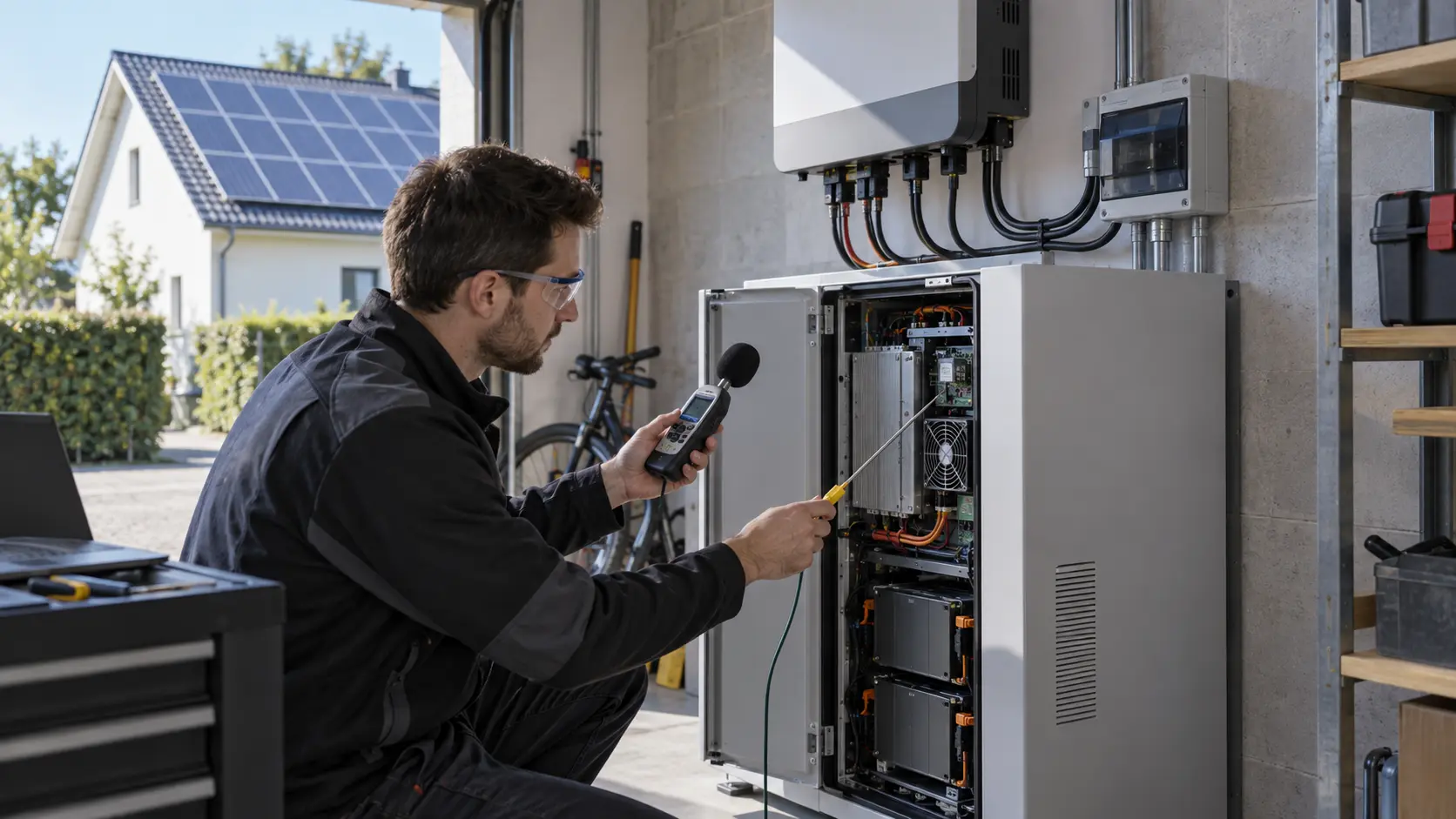
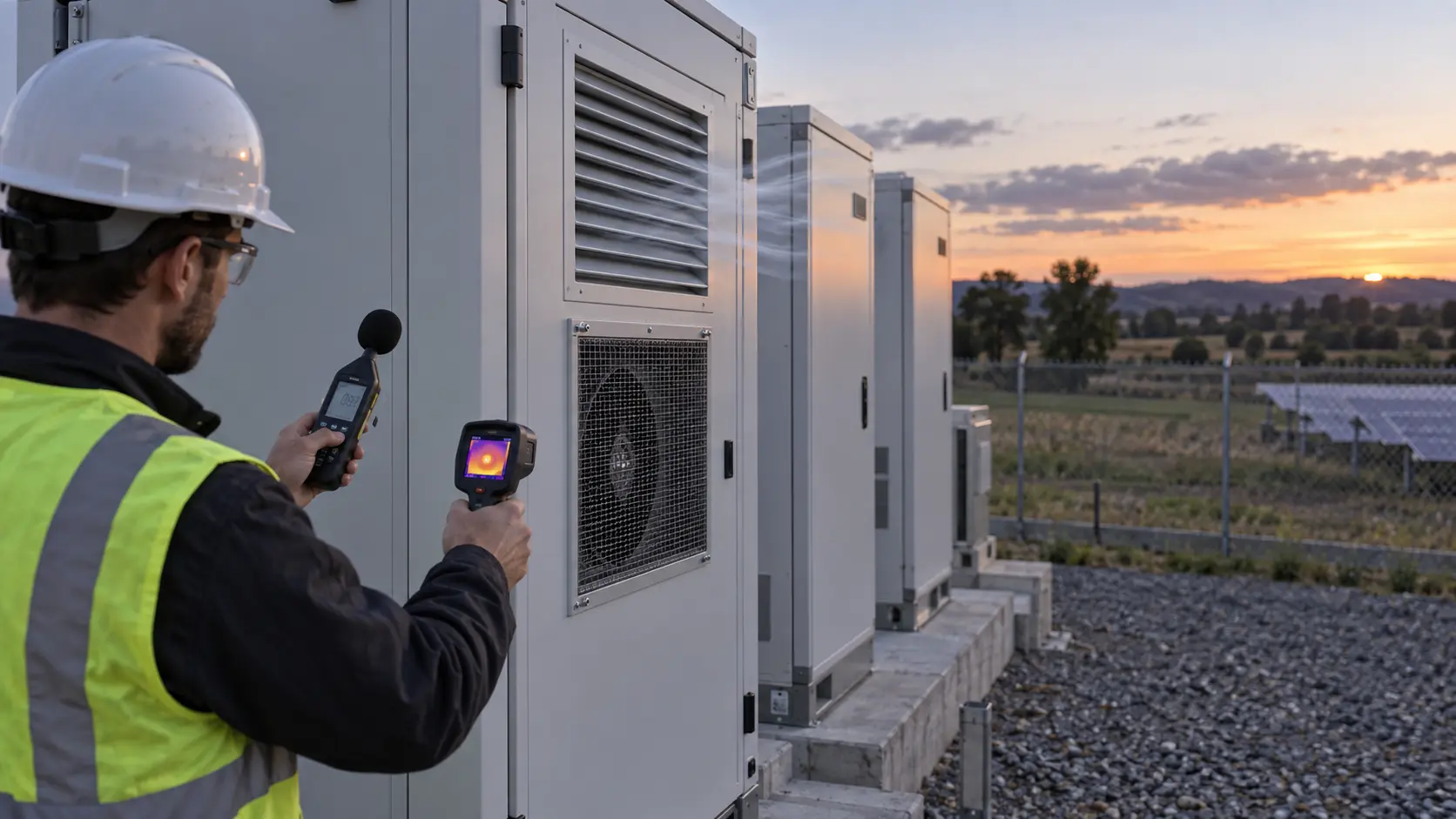
The team measured sound pressure at the operator side, fan side and project boundary while logging fan command, RPM or FG, current, component temperature and ambient conditions. The same command was not assumed to produce the same acoustic result after the filter, guard, grille and cabinet panels were installed.
The acoustic record separated overall A-weighted level from narrow-band content. It also marked the distance, microphone position, background level, wind condition and operating state. A smartphone reading was not used as the acceptance method; it could be a field clue, but not a substitute for a controlled measurement plan.
Thermal validation ran at the same speed points. If a 4 dBA improvement came from removing useful airflow, it was rejected. The limiting electronics and battery zones had to remain within the approved thermal envelope before any acoustic change was accepted.
Interactive: Watch Fan Duty and Tonal Risk Change Together
The animated schematic shows why lowering RPM may reduce noise while a grille, resonance or operating point can still create a narrow peak.
The figure is qualitative, not an acoustic test or sound-power certificate. It shows three review states: low-duty circulation, normal thermal duty and high-duty hot-ambient operation. The production test must record sound and temperature at the same fan command and installed configuration.
The sample sequence included speed ramps, steady points, start and stop, filter conditions, cabinet covers installed, and a controlled hot-load run. This made it possible to distinguish a fan tone from a cabinet resonance or a grille turbulence problem.

Sample 01: Define the Thermal and Acoustic Operating Envelope
The developer first defined when the fan is allowed to run, how much heat must be removed and where the noise limit is applied.
Inputs included heat load during charge and discharge, ambient temperature, allowable component temperature, fan size, voltage, pressure path, control signal, operating schedule, property-boundary distance, background noise and the required acoustic metric. The team also documented whether the limit applied at the cabinet, operator position or nearest sensitive receptor.
As an illustrative estimate, a 2 kW sensible load with an 8 K air rise requires about 0.207 m3/s, or approximately 438 CFM, at the assumed density before filter and grille losses. This is not a fan specification. The installed P-Q operating point and the limiting temperature determine the acceptable command.
The acoustic plan used the same states as the thermal plan. This prevented an attractive quiet-mode result from being presented without proving that the cabinet could recover from a high-load or hot-ambient event.
Sample 02: Change the Air Path Before Chasing the Motor
The review found that inlet clearance, grille geometry and panel stiffness could be as important as the fan motor or bearing choice.
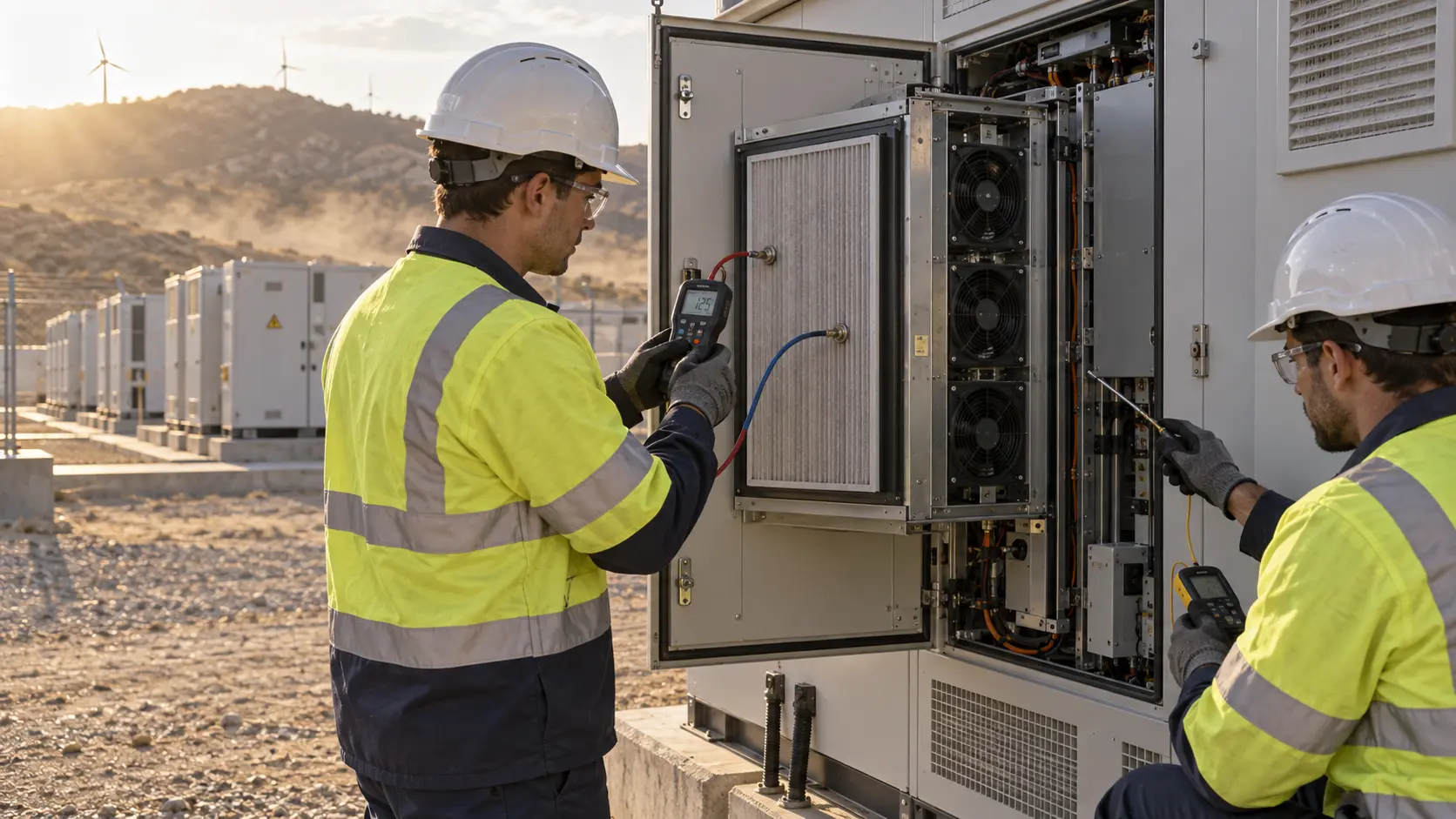
The candidate sample was compared with the actual guard and grille. Sharp edges, partial blockage and a short inlet can add turbulence and tonal content. The outlet direction was reviewed against the cabinet wall and site barrier so that a lower component noise did not become a louder installation noise.
The mount was checked for structure-borne vibration. A compliant mount can reduce panel transmission, but it must not allow the fan to move into the grille or change the clearance during service. The final sample kept the fan, mounting, wiring and control response under configuration control.
A larger fan at a lower speed can create acoustic headroom in some systems, but it also changes the envelope, pressure curve and cost. It must be compared at equal useful airflow and pressure, not equal RPM or equal frame size.
Sample 03: Validate Night Control, Tonality and Fan Faults
The final test reproduced the low-load and transition states that often determine community acceptance.
The controller used a thermal minimum, a normal operating band and a hot-ambient reserve with hysteresis. The developer reviewed whether the fan could stay below a project-defined night command without causing a slow thermal drift. If the battery or PCS load increased, the transition to higher duty was recorded for both noise and temperature.
A fan-fault condition was also checked. A stopped fan can create reverse flow or extra resistance in a multi-fan path. The surviving fans were tested for acoustic and thermal behavior rather than assuming N+1 automatically preserves the same sound profile.
The acoustic report documented overall level, selected frequency bands, fan speed, current, thermal points, microphone position and background conditions. MEGA Tech supplied fan-side sample data; the BESS owner retained responsibility for site noise modelling, permit criteria, fire safety and final compliance.
Validation Result: A Quiet Fan Must Still Preserve Thermal Margin
The selected sample gave the developer a repeatable way to trade acoustic output against operating-point airflow and thermal reserve.
The release package documented the fan P-Q curve, operating voltage, control response, current, RPM or FG, tonal observations, mount, grille, measurement position, hot-ambient condition and life assumption. It did not claim one universal dBA value because installation and operating state change the result.
The transferable lesson is to avoid three shortcuts: comparing noise figures made at different distances, reducing RPM without checking the limiting temperature, and changing the fan while leaving a restrictive grille or resonant panel untouched. A custom sample can address the fan, but the whole installed path must be validated.
For procurement, this makes a replacement or customized fan easier to review. The useful question is not 'which fan is quietest in free air?' It is 'which sample keeps the required airflow and pressure while producing an acceptable spectrum at the actual site boundary?'
How MEGA Tech Supports Low-Noise BESS Fan Customization
MEGA Tech develops fan samples around the BESS heat load, installed pressure path, acoustic target and control state.
We can review high-ambient DC axial fans and compact centrifugal blowers, P-Q duty, grille and filter losses, PWM and FG/RD signals, connector and lead-wire details, bearing and life targets, mounting, voltage tolerance, acoustic measurement points and small first-build quantities. We can also evaluate alternatives to Sanyo Denki, SUNON, Delta, NMB, ebm-papst and other installed brands when the operating point is defined.
Please provide heat load, airflow and static pressure at that airflow, temperature and altitude basis, fan size, voltage, quantity, control interface, connector, noise metric and distance, environment, operating schedule and life assumption. If data is incomplete, send the current fan part number, cabinet photos, grille details and any measured temperature or sound points.
Our scope is fan and air-path engineering, sample customization and comparative validation. We do not supply the customer's acoustic permit, site barrier, BMS, HVAC, emergency ventilation or battery safety design.
Engineer Questions About This BESS Acoustic Case
Use these questions before approving a fan or noise study.
Q: Is a lower dBA number always better? A: No. Check useful airflow, pressure, thermal margin, frequency content and measurement condition together.
Q: Can the fan be slowed at night? A: Often the control strategy can use a lower command, but the limiting component temperature and recovery time must be validated.
Q: Why is a tone more noticeable than broadband noise? A: A narrow spectral peak can be more intrusive even when the overall A-weighted level appears acceptable.
Q: Does a grille affect fan noise? A: Yes. Clearance, blockage and sharp edges can change both pressure drop and turbulence-related noise.
Q: What should I send for a fan review? A: Send heat load, airflow and pressure, fan size, voltage, control, noise metric and distance, environment, schedule and life target.
Q: Can MEGA Tech provide a custom low-noise sample? A: Yes. We can review the installed duty and support a sample comparison before production release.
Need a BESS Fan Acoustic Validation?
Send the heat load, installed airflow and static pressure, fan size, voltage, control interface, noise metric, measurement distance and site constraints. MEGA Tech will review the operating point before recommending a sample.
Include the current fan model, cabinet and grille photos, operating schedule, hot-ambient condition, acoustic data and any thermal measurements available. This helps separate a fan problem from a grille, mount, panel, barrier or control problem before the production BOM is locked.