The Fan Still Spun, but the Rack Was Getting Louder
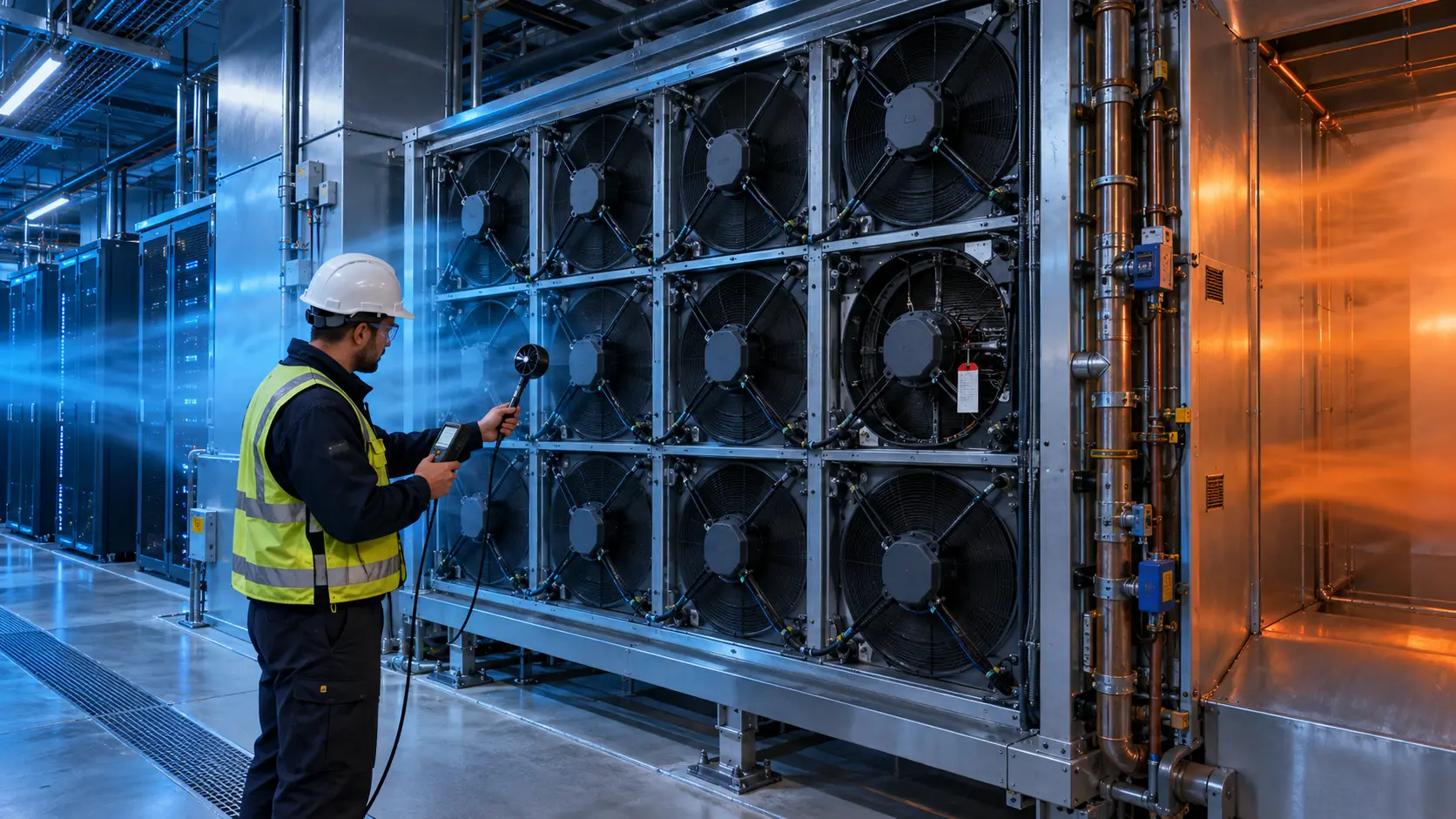
An anonymized AI-infrastructure integrator saw a gradual rise in fan noise and vibration during continuous operation, even though RPM feedback and inlet temperature remained within the normal dashboard range.
The team did not want to wait for a locked-rotor alarm. A change in bearing condition, imbalance, mounting resonance or dust loading can appear first as vibration, tonal noise or a shift in current. In a dense rack, the resulting response may be a higher fan command, uneven airflow or an acoustic complaint before a thermal trip occurs.
MEGA Tech reviewed the fan construction, duty cycle, installed pressure, speed range, mounting stiffness, vibration points, acoustic spectrum and maintenance plan. The objective was to define a practical validation record for a custom fan sample and to distinguish fan condition from tray or rack structure effects.
The customer identity and released acceptance values remain confidential. Values marked illustrative are engineering examples, not customer test results.
The Engineering Hook: Catalogue Life Is Not a Rack-Life Guarantee
A fan datasheet life value usually depends on defined temperature, speed, voltage and test conditions; it is not automatically the life of a fan inside a loaded server tray.
Life must be read with its basis. A published L10 value is a statistical reliability reference, not a promise that every fan will fail at that time. Temperature, speed, bearing construction, lubrication, vibration, mounting, dust and the actual pressure duty can all change the result.
ASHRAE identifies fan reliability, acoustics, vibration, cooling performance, power and redundancy as linked characteristics in datacom thermal design. Its fan guidance also notes that vibration is affected by imbalance, aerodynamic forces, drive alignment, bearing properties and critical speeds, and that vibration should be monitored or periodically checked.
A supplier comparison should therefore record the life basis, operating temperature, speed range, bearing type, vibration condition, current and airflow duty. ‘100,000 hours’ without those conditions is not enough information for a server-rack purchase decision.
The Problem in Operation: RPM Stayed Normal While the Signature Changed
The server controller saw a normal tach signal, but the maintenance team saw a rising tonal component and a small increase in current at the same command.
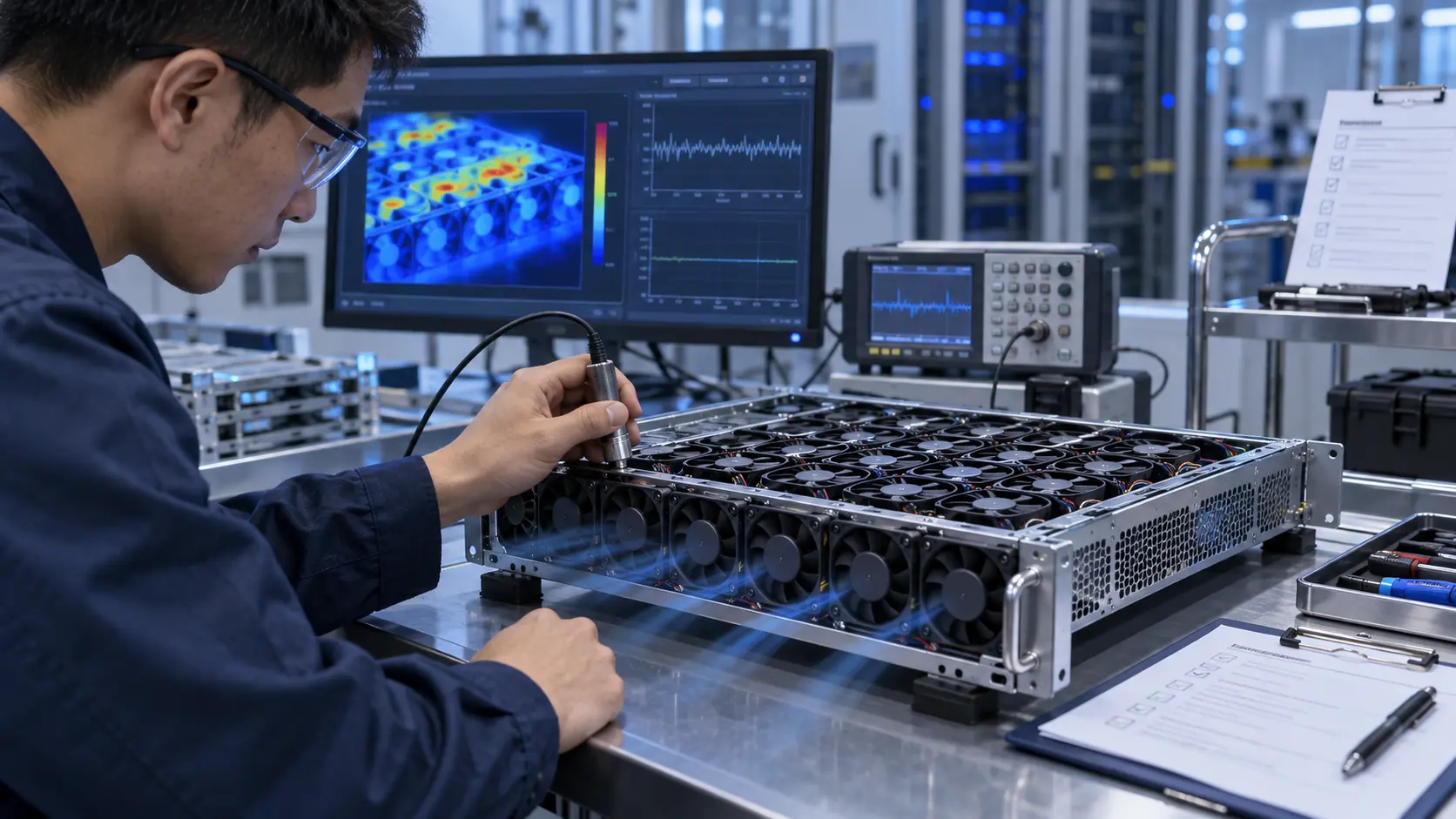
The integrator recorded PWM command, FG or RPM, current, inlet and exhaust temperature, installed pressure, overall sound pressure and the spectrum around the blade-pass frequency. Measurements were repeated at idle, inference and sustained training load so the speed-dependent signature could be separated from the workload noise.
A fan can keep its average RPM while imbalance, bearing friction or a mounting resonance changes the vibration amplitude. A grille or tray panel can also amplify a narrow tone without changing the fan itself. This is why a simple ‘RPM normal’ status is useful but incomplete.
The maintenance plan used a baseline spectrum and vibration reading for each fan zone. A later trend could then be compared with the same speed, pressure and rack load rather than with a different operating condition.
Interactive: Watch a Stable Fan Move Toward a Maintenance Trigger
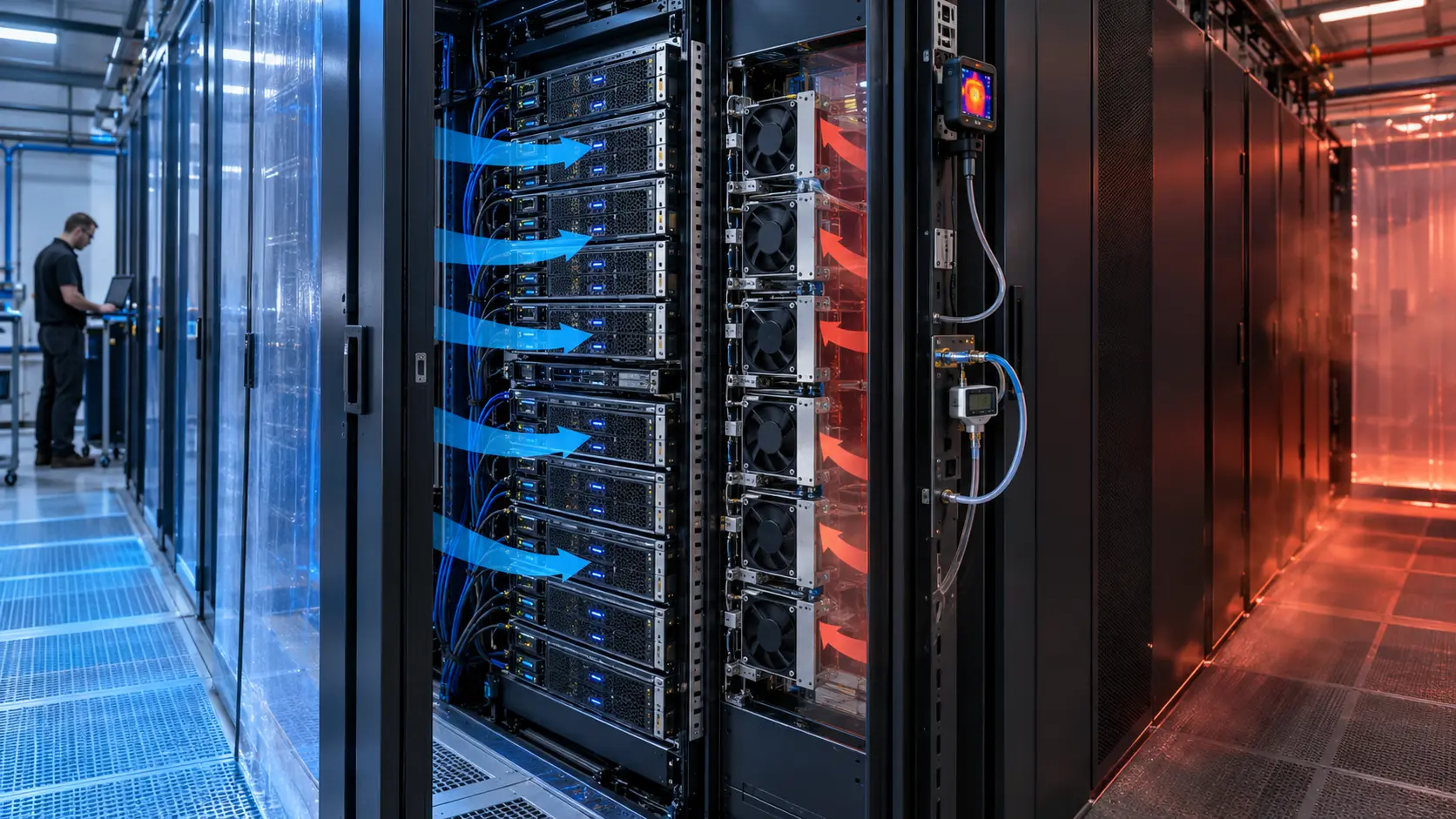
The animated schematic compares a stable fan path with a rising vibration and tonal-noise condition that still has airflow.
The figure is qualitative, not a condition-monitoring threshold or a product test result. It shows why airflow and temperature can remain acceptable while a mechanical or acoustic trend deserves attention. The trigger must be set from the fan, tray, sensor method and customer acceptance history.
The validation record compared normal duty, a controlled speed sweep, a fixed-pressure point and a warm steady-state point. This helped separate a speed-related resonance from a temperature-related bearing change or a tray-panel amplification.

Sample 01: Freeze the Life Assumption and Environment
The first sample step was to state the conditions behind the required life instead of choosing a large hour number in isolation.
The customer supplied expected annual operating hours, inlet-temperature distribution, speed profile, voltage tolerance, pressure duty, dust and humidity conditions, mounting orientation, vibration exposure and service policy. The team then defined whether the requirement meant continuous L10 life, a field replacement interval, or a qualification target for a specific product generation.
For an illustrative conversion, 24/7 operation for five years is 5 × 365 × 24 = 43,800 hours. A ten-year planning horizon is 87,600 hours. These are calendar-hour requirements, not proof that a fan with the same headline L10 value will meet them in the tray.
MEGA Tech can adjust bearing selection, motor behavior, impeller balance, frame support and control strategy around the stated environment. The acceptance document keeps the environmental basis attached to the sample.
Sample 02: Check Vibration at the Installed Mount
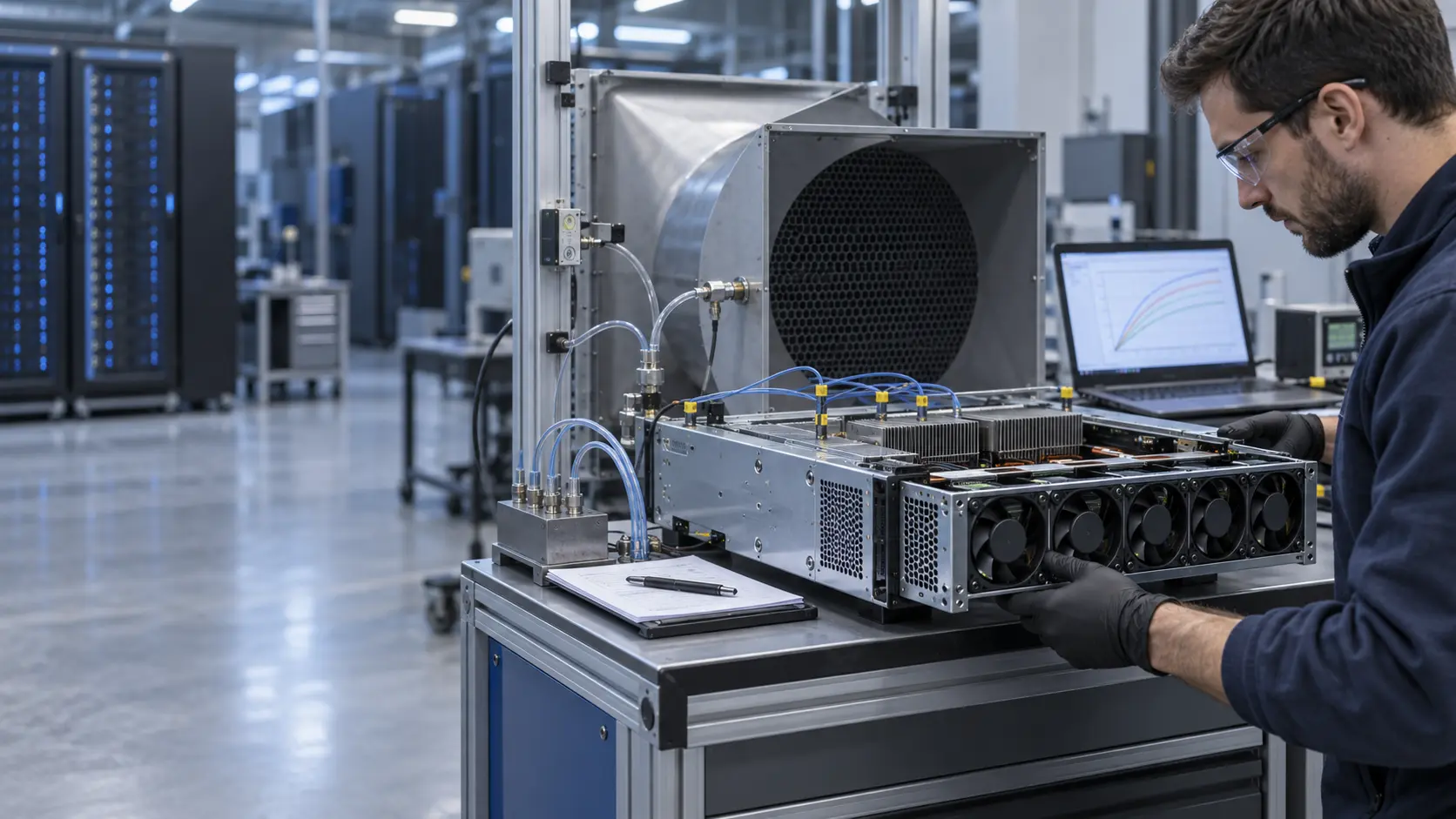
The second sample was measured on the fan frame, tray and rack structure so a resonance was not incorrectly blamed on the bearing.
The test recorded vibration at the fan frame, tray rail and nearby chassis point. The fan was swept through the declared command range while the pressure path and mounting screws remained in the production condition. Any narrow peak was checked for repeatability after reseating the tray and changing the neighboring fan state.
ASHRAE fan guidance notes that variable-speed control can expose critical speeds in the fan or support structure. The practical implication is to identify unstable bands or resonance peaks before the control curve is released. A fan that is quiet at one speed can become noisy at another even when its airflow remains acceptable.
The same run also recorded current, FG, inlet temperature and acoustic spectrum. The sample was not accepted from one vibration number alone; it was accepted when mechanical, electrical, thermal and acoustic observations agreed.
Sample 03: Build a Maintenance Trend, Not Only a Failure Alarm
The final sample step linked condition indicators to a service decision before the fan became a thermal incident.
The integrator defined a baseline at a known pressure and speed, then repeated the measurement during normal service. A trend could include vibration amplitude, narrow-band tone, current at equal PWM, startup time, FG stability and the temperature required to hold the same operating point.
An illustrative screening rule might flag a persistent 3 dB narrow-band increase or a 10% current change at the same speed and pressure for engineering review. These values are examples only; the real threshold must be set from the measurement repeatability, sensor placement and customer risk tolerance.
The service decision then had three levels: continue and trend, inspect and reseat the tray, or replace and investigate the fan. This is more useful than waiting for a binary RD alarm because the fan may still be spinning when its condition has already changed.
Validation Result: Life, Noise and Airflow Were Reviewed as One Duty
The final sample package connected the fan-life assumption to the installed pressure, thermal state, acoustic signature and maintenance action.
The release record documented the life basis, temperature and voltage, speed profile, P-Q points, vibration method, acoustic measurement position, current, mounting condition, workload state, service interval and fault behavior. This made a replacement comparison possible without hiding a different tray condition inside the result.
The transferable lesson is that reliability is not only a bearing label. A fan can be thermally adequate but mechanically noisy, electrically compatible but acoustically unsuitable, or quiet in free air but unstable in a stiff tray. The customer needs a defined operating point and a repeatable condition-monitoring method.
For procurement, compare life at the actual temperature and duty, not only the largest hour value in a table. Ask how the supplier defines L10, what conditions support it, and how samples will be checked in the customer's assembly.
How MEGA Tech Supports AI Server Fan Life and Vibration Validation
MEGA Tech helps server and rack integrators select and customize DC fans around continuous duty, installed pressure and measurable maintenance limits.
We can review compact DC axial fans and blowers, bearing and life targets, pressure and airflow, PWM and FG/RD behavior, startup and restart, vibration, acoustic spectrum, mounting stiffness, connector details, temperature, voltage tolerance and small first-build quantities. We can also evaluate alternatives to Sanyo Denki, SUNON, Delta, NMB, ebm-papst and other installed brands when the operating point is defined.
Please provide rack or chassis heat load, airflow and static pressure at that airflow, temperature and altitude basis, fan size, voltage tolerance, quantity, control interface, connector, noise target, vibration or maintenance limit, environment and life assumption. If data is incomplete, send the current fan part number, tray photos, rack layout and any sound, current or temperature trend available.
Our scope is fan and air-path engineering, sample customization and comparative validation. We do not supply the customer's server firmware, DCIM/BMS, CRAH/CRAC, containment or facility safety design.
Engineer Questions About This Fan-Life Case
Use these questions before approving a server fan sample or setting a predictive-maintenance threshold.
Q: Does a high L10 number guarantee a long server-rack life? A: No. Check its temperature, speed, voltage, bearing, airflow and environmental basis, then validate the installed duty.
Q: Can normal RPM hide a fan problem? A: Yes. Trend vibration, narrow-band noise, current and temperature at the same operating point.
Q: Is every rising tone a bearing failure? A: No. Check imbalance, tray resonance, grille interaction, neighboring fans and measurement repeatability.
Q: Should I specify a single replacement interval? A: Define the duty and trend method first. A condition-based review can prevent both premature replacement and late failure.
Q: What should I send for a review? A: Send heat load, airflow and pressure, fan size, voltage, quantity, control, noise, vibration, environment and life target.
Q: Can MEGA Tech provide a custom sample? A: Yes. We can review the installed duty and support a sample comparison before production release.
Need an AI Server Fan Life and Vibration Review?
Send the rack heat load, installed airflow and static pressure, fan size, voltage, control interface, operating temperature, speed profile, noise or vibration target and maintenance constraints. MEGA Tech will review the operating point before recommending a sample.
Include the current fan model, fan-tray photos, rack layout, workload profile, inlet-temperature data, current or acoustic trends and any maintenance history available. This helps separate a fan condition issue from a tray resonance, grille, control or facility-airflow problem before the production BOM is locked.