The Cooling Architecture Decision Starts Before Fan Selection
An outdoor 5G or edge cabinet can be thermally acceptable in the lab and fail in the field because the cooling architecture was selected from indoor assumptions.
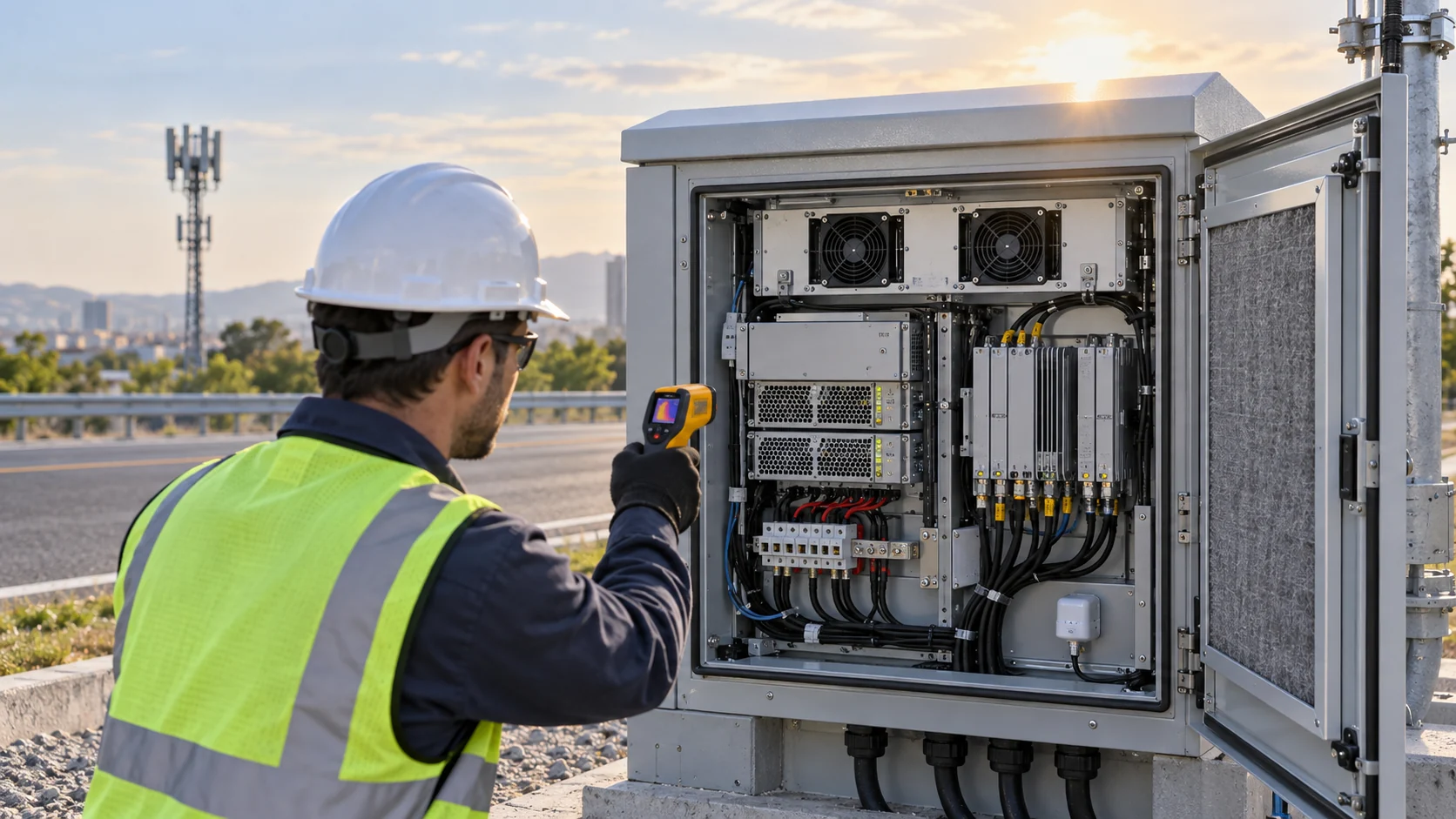
A roadside telecom cabinet has to reject electronics heat while facing solar radiation, wind, rain, dust, salt, humidity, altitude and limited maintenance access. The equipment may include radio power amplifiers, baseband processing, DC power conversion, battery backup and network electronics. These loads do not always peak together, but the design must define the combination that is credible for the site and the service level.
The first architecture question is whether the cabinet can use outside air. Filtered fans are simple and efficient when contamination, humidity and temperature limits allow a controlled air exchange. An air-to-air heat exchanger keeps the electronics circuit separated from outside air, but adds core resistance and fan power. Air conditioning can hold the internal temperature below ambient, but it adds compressor power, condensate, service and another failure mode.
This guide provides a selection method rather than a universal capacity table. The correct choice depends on the heat load, design ambient, solar contribution, allowable internal temperature, protection boundary, air path and maintenance plan. MEGA Tech can support the fan and air-side interface, but the complete enclosure, heat exchanger or air-conditioning safety design remains a system responsibility.
Build the Outdoor Heat Balance With an Explicit Solar Case
Do not size a telecom cabinet fan from electronics watts alone when the enclosure is exposed to direct sun.
Start with measured or supplier-provided equipment loss at the operating state: radio modules, power supplies, converters, batteries and auxiliary electronics. Then add the heat that enters through the cabinet skin. Solar load depends on orientation, colour, surface absorptivity, wind, shading, roof geometry and the time of day. A white cabinet in shade and a dark cabinet in full afternoon sun are not the same thermal case.
For a screening estimate, assume 1.2 kW of electronics loss and a 10 C allowed air rise. With air density 1.2 kg/m3 and specific heat 1005 J/(kg K), the ideal ventilation flow is about 1,200/(1.2 x 1005 x 10) x 3600 = 358 m3/h. This is only the internal heat term. If solar gain adds 300 W, the same calculation becomes approximately 448 m3/h before filter, grille, recirculation and fan efficiency effects.
If the outside ambient is already close to the equipment inlet limit, filtered ventilation cannot produce a colder cabinet than the incoming air. A heat exchanger can approach the outside ambient with an additional approach temperature, while AC may be required when the protected internal point must stay below the available outdoor heat sink. State that boundary early so the fan is not asked to solve a refrigeration problem.
| Input | Example evidence | Decision effect |
|---|---|---|
| Equipment heat | radio, power, battery and converter losses | sets required heat rejection |
| Solar exposure | roof/wall orientation, colour, shading and wind | adds external heat to the budget |
| Ambient envelope | maximum, minimum, altitude and humidity | sets fan, exchanger or AC boundary |
| Protection | IP/NEMA target, filter grade and rain path | determines whether outside air is acceptable |
| Maintenance | filter access, site interval and service power | sets lifecycle and failure evidence |
Filtered Fan Ventilation: Efficient, Simple and Contamination-Limited
Filtered fans are attractive when the outside air is a usable heat sink and the cabinet can tolerate the pressure, maintenance and moisture boundary.
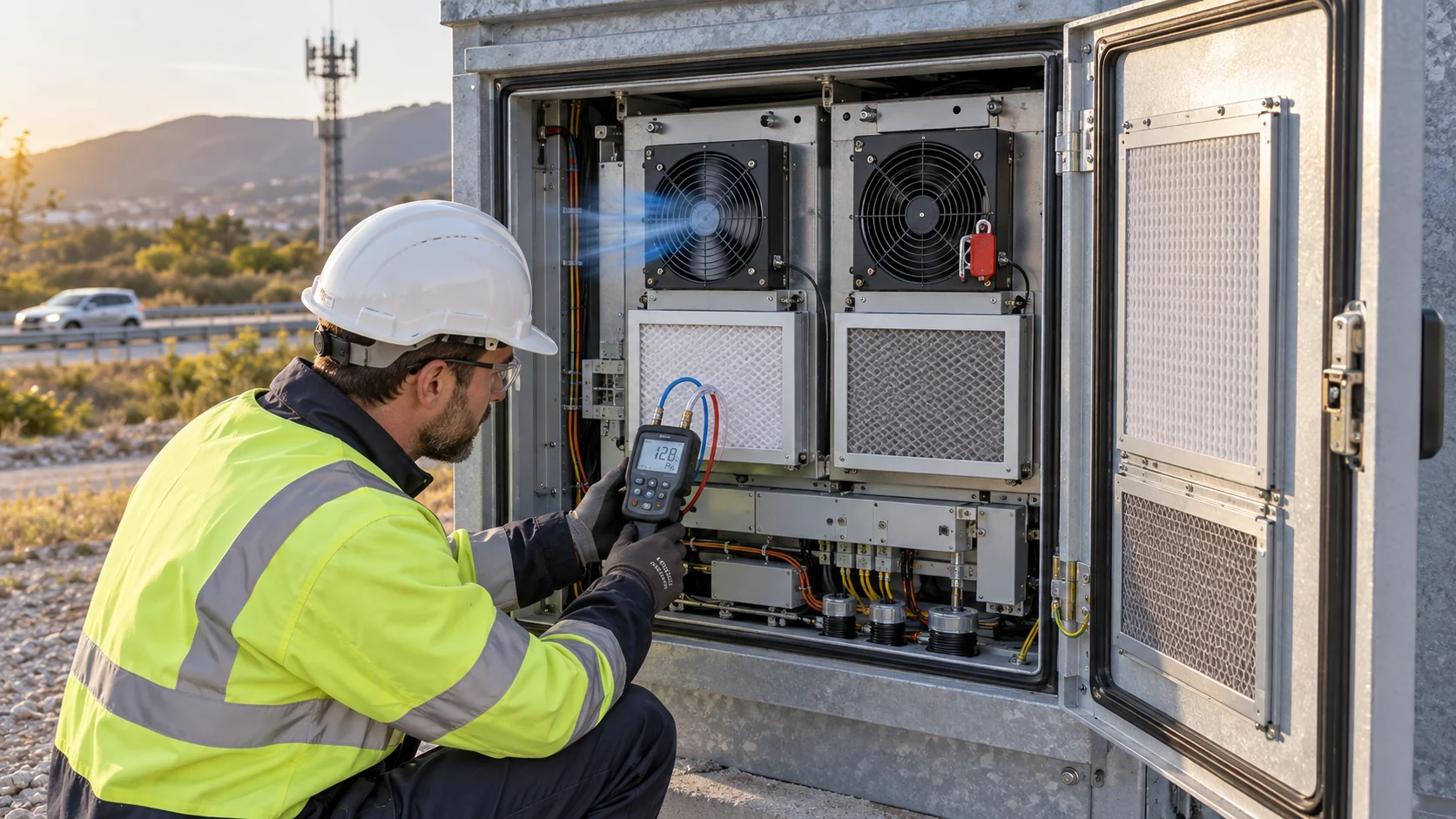
A filtered fan system normally draws outside air through a grille and filter, moves it across the electronics and exhausts warmer air through a protected outlet. Positive pressure can reduce unfiltered leakage if the cabinet seals and cable entries are designed correctly. The fan must be selected at the installed pressure created by the filter, grille, baffles, heat sinks and outlet, not at free-air flow.
For an illustrative path, a grille contributes 18 Pa, a clean filter 32 Pa, internal baffles and component passages 46 Pa, and the exhaust louvre 24 Pa. The clean path is about 120 Pa. If the filter reaches 70 Pa in service, the path becomes about 158 Pa. A fan that looks comfortable at 120 Pa may lose a meaningful part of its airflow at the service condition while its RPM still appears normal.
The fan architecture should also specify airflow direction, voltage range, PWM or voltage control, FG/RD feedback, startup, locked-rotor alarm, bearing life, corrosion exposure and service access. A component IP rating does not establish the rating of the complete modified cabinet. Verify the gasket, filter frame, door, cable glands, drainage and exhaust hood together.
Interactive: Follow Heat Through Three Cooling Architectures
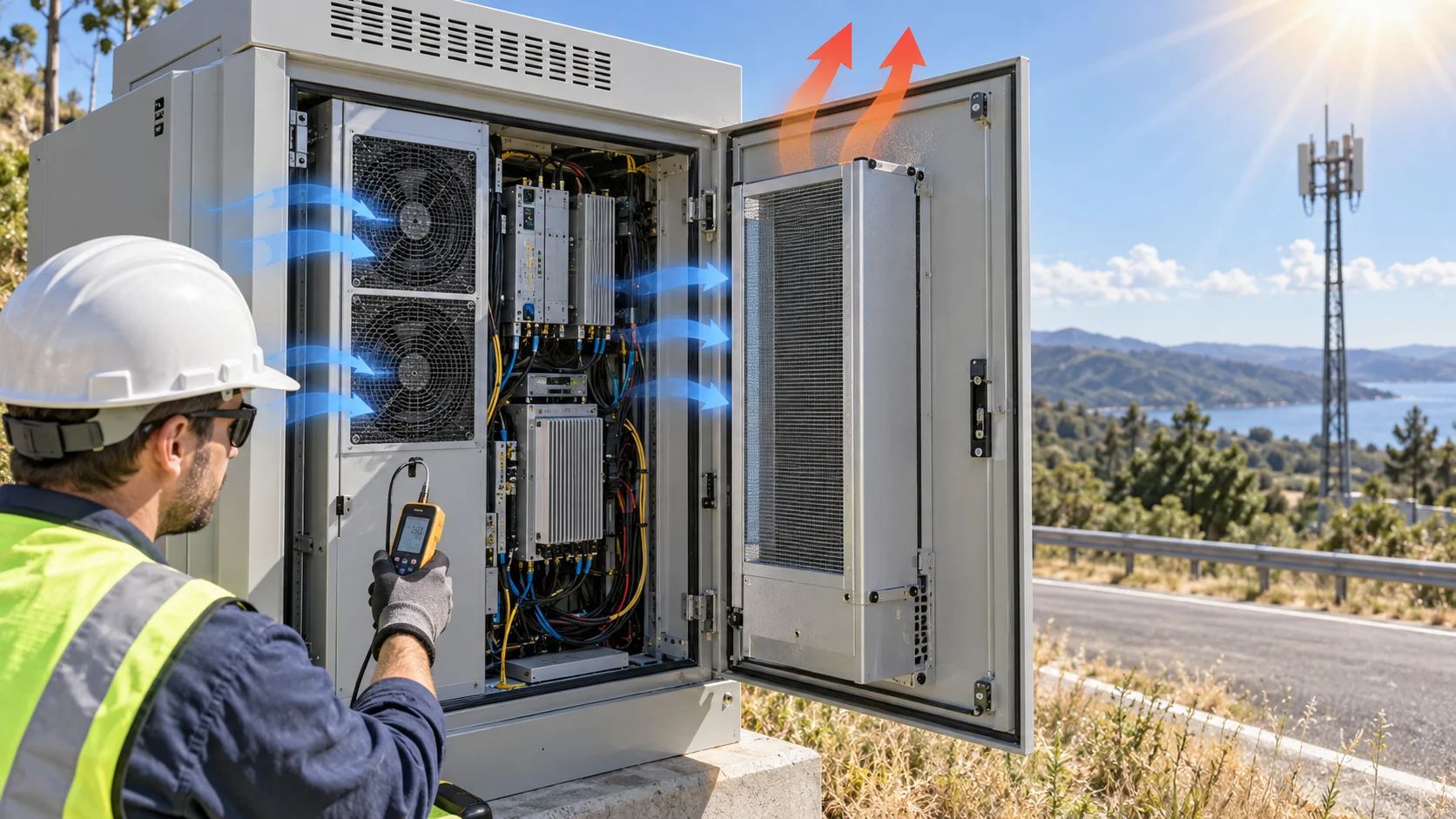
The schematic compares outside-air ventilation, separated air-to-air exchange and refrigeration as different thermal boundaries.
Use the visual to ask three questions. First, is the outside air cold enough and clean enough to enter the cabinet? Second, if it is not, can an air-to-air exchanger reject the heat while keeping the electronics circuit separated? Third, if the required internal point is below the outdoor heat sink, is an air conditioner and its service system justified?
The animation is a design-review aid, not a capacity result. In a real test, measure supply and return temperatures on both sides of the exchanger, pressure across filters and cores, fan power, internal hotspot temperature and the effect of solar loading. For AC, record compressor duty, condensate path, restart behavior and the internal circulation fan separately from the outdoor heat rejection path.
Do not confuse internal circulation with heat rejection. A circulation fan can reduce local temperature differences, but it cannot remove cabinet heat unless the enclosure boundary transfers that heat to a lower-temperature sink.

When an Air-to-Air Heat Exchanger Is the Better Boundary
A heat exchanger can preserve a separated electronics air circuit when dust, salt or humidity makes direct ventilation unattractive.
The heat exchanger keeps outside air on one side of a core and cabinet air on the other. This helps control contamination, but it does not eliminate thermal resistance. The core, filters, fan guards and ducts add pressure, and the approach temperature means the internal air will normally be warmer than the outside air under load. The selection must therefore include both sides' flow and pressure curves.
For a simple example, a cabinet has 1.5 kW of heat, a 12 C outside-to-inside approach allowance and a 10 C internal air rise across the electronics loop. The external side must reject the heat through its own fan and core, while the internal circulation fan must distribute roughly 1,500/(1,005 x 10) = 0.149 kg/s of air before density conversion and local heat-transfer constraints. The result is not a product rating; it is a reminder that both fans and both pressure paths require validation.
Inspect the core for fouling, drainage, corrosion and service access. If the external surface becomes blocked, the internal fan may continue rotating while the electronics hotspot rises. Add temperature and differential-pressure evidence that can distinguish a failed fan from a loaded core or a high outdoor ambient.
When Air Conditioning Is Justified, and When It Is Not
AC is useful when the required protected temperature is below the outdoor heat sink, but it should not be selected to hide an unmeasured air-path problem.
Consider AC when the cabinet must maintain an internal temperature below a hot outdoor ambient, when humidity control is required, when the electronics cannot accept outside contamination, or when the heat load exceeds what a practical exchanger can reject. Also consider the available DC or AC bus, battery-backed operation, compressor derating, condensate, service intervals and the consequence of an AC failure.
Do not jump to AC because a fan test used the wrong operating point. A filter, grille or baffle with excessive pressure can often be corrected with a better fan, lower-loss filter, a larger opening or a revised flow path. Conversely, adding a higher-pressure fan does not solve a requirement to maintain the enclosure below a hotter outdoor ambient. The architecture choice must follow the heat sink and the protected temperature requirement.
For procurement, compare total lifecycle energy and service, not only purchase price. A fan system may use little power but require filter visits; an exchanger may reduce contamination but add core and fan maintenance; AC may provide the strongest thermal boundary but consume more energy and need refrigeration service. Document the failure state and the fallback mode for each architecture.
Solar, Altitude and High Ambient Change the Fan Operating Point
Outdoor conditions change both the thermal budget and the air density used to interpret a fan's performance.
At altitude, lower air density reduces the mass flow and heat capacity delivered by the same volumetric flow. The fan curve and the heat-balance calculation should use a consistent density basis. A cabinet that passes at sea level may lose margin at a high-elevation site even if the fan RPM and nominal m3/h are unchanged.
Solar loading can make the enclosure wall or roof much hotter than ambient air. Measure internal temperature with the cabinet in the sun, with the intended finish, insulation, shade and installation clearance. Repeat with the fan at the control state used in the field. If the cabinet is close to a wall or ground surface, include the changed exhaust and recirculation path.
For an illustrative density comparison, if a design expects 400 m3/h at 1.2 kg/m3, the air mass flow is about 0.133 kg/s. At a lower density of 1.05 kg/m3, the same volumetric flow carries about 12.5% less mass. The exact site calculation should use approved atmospheric data and the fan supplier's corrected performance information.
An Anonymous Customer Example: Selecting a 48 V Cooling Boundary
A European telecom integrator compared filtered ventilation and a separated exchanger for a roadside cabinet with radio and power electronics.
The first concept used direct filtered air because the fan power was low and the cabinet heat load appeared manageable. During a summer site review, the team identified a dark roof, a high afternoon ambient, salt exposure and a maintenance interval longer than the clean-filter test. The fan was not the only issue: the architecture had to preserve equipment protection while maintaining a workable service state.
MEGA Tech reviewed the heat ledger, 48 V supply range, filter pressure, grille opening, fan direction, exhaust clearance, control interface and service access. The team compared a higher-static-pressure axial sample with a compact centrifugal option at the installed path, then mapped the result against the alternative exchanger pressure path. The customer also added an inlet temperature sensor and filter differential-pressure threshold.
The final decision was based on the site's approved ambient and contamination case rather than a catalogue airflow claim. The fan sample was retained for the ventilation option with a documented service-state operating point; the exchanger option remained the fallback if the site protection requirement changed. This kept the architecture decision traceable and allowed the customer to compare energy, service and thermal margin honestly.
This is an anonymized engineering scenario, not a published customer performance claim. The transferable lesson is to decide the thermal boundary first, then select the fan or fan pair from the pressure and temperature conditions that actually exist.
| Test state | Measurements | Decision |
|---|---|---|
| Clean and shaded | heat load, flow, pressure and internal temperature | establish the baseline |
| Loaded filter | filter DP, fan command, flow and hotspot | define the service threshold |
| Solar / high ambient | skin temperature, inlet temperature and recirculation | check the real thermal boundary |
| Rain / humidity case | drainage, condensation and protection condition | confirm the enclosure interface |
| Fan or exchanger fault | alarm, fallback and protected temperature | define the degraded state |
Where MEGA Tech Fits In
We help telecom and edge-equipment OEMs develop the fan interface for outdoor cabinets, heat exchangers and filtered ventilation assemblies.
MEGA Tech can review custom DC or EC axial fans, compact blowers and fan modules for 5G cabinets, roadside network enclosures, radio units, power shelves and edge-compute cabinets. The engineering review can include P-Q behavior, filter and core pressure, 12/24/48 V operation, PWM or voltage control, FG/RD feedback, startup, bearing selection, corrosion exposure, IP interface, noise, connector position and small-batch samples validated on the customer's assembly.
For a first review, provide equipment heat load, solar and ambient basis, altitude, target internal temperature, cabinet dimensions, filter and grille data, exchanger or duct pressure, voltage tolerance, control signal, feedback, noise target, service interval and quantity forecast. If a replacement is being considered, send the current fan part number and measured operating point; identical frame dimensions do not prove equivalent cooling.
We can also support cost-competitive replacements for Sanyo Denki, SUNON, Delta, NMB and ebm-papst fans when the replacement is checked at the same installed pressure, mounting, voltage, feedback, acoustic and environmental condition. Our scope is the custom fan and air-side interface; the cabinet IP, heat exchanger, air conditioner, telecom safety and site approval remain system responsibilities.
Engineer FAQ: Outdoor Telecom Cabinet Cooling
These questions help engineers and procurement teams compare fan ventilation, heat exchangers and AC without hiding the system boundary.
Q: When is filtered fan ventilation a good fit? A: When outside air is an acceptable heat sink and the filter, sealing, moisture and maintenance plan can support the required protection.
Q: Does a heat exchanger remove the need to validate fans? A: No. Both internal and external air paths have fans, cores, pressure drop and service failure modes.
Q: Can a stronger fan make an outdoor cabinet cooler than ambient? A: No. A fan increases heat transfer to the available air stream; it cannot provide refrigeration below the heat-sink temperature.
Q: How should solar load be included? A: Add it to the heat balance or model the cabinet skin and repeat the populated-cabinet test in the intended sun, finish, shade and installation condition.
Q: Does an IP-rated fan make the cabinet IP-rated? A: No. The completed fan cut-out, gasket, filter, grille, cable entry, door and drainage path must be evaluated together.
Q: What should I send for a custom 48 V fan review? A: Send airflow at pressure, voltage range, size, PWM/FG/RD interface, noise target, filter/core data, ambient, altitude, contamination and quantity.
Q: Can MEGA Tech support small outdoor-telecom prototypes? A: Yes. We can adjust the fan interface, build samples and support pressure, thermal, noise, environmental and service-state validation before production.
Outdoor Telecom Cooling Review Checklist
Use this checklist before freezing the fan, heat exchanger, filter, air conditioner or maintenance interval.
- Was equipment heat separated from solar and external environmental heat?
- Was the maximum ambient, altitude, humidity and contamination condition defined?
- Was the internal temperature requirement compared with the available outdoor heat sink?
- Were filtered fan, heat exchanger and AC options compared on energy and service as well as thermal capacity?
- Was the fan or fan pair selected from the installed pressure curve?
- Were clean and service-state filter or core pressure measured?
- Were fan voltage, PWM/EC, FG/RD, startup and fault responses tested?
- Were rain path, drainage, cable glands, gasket and service door included in the protection boundary?
- Was solar recirculation and exhaust clearance checked at the real site arrangement?
- Were the degraded state, maintenance threshold and replacement procedure documented?
- Are measured values, estimates, supplier data and certification limits clearly separated?