Outdoor Telecom Cooling Is a Moisture Problem as Well as a Heat Problem
A street cabinet can meet its daytime temperature target and still suffer a night-time reliability problem when warm humid air meets a cold internal surface.
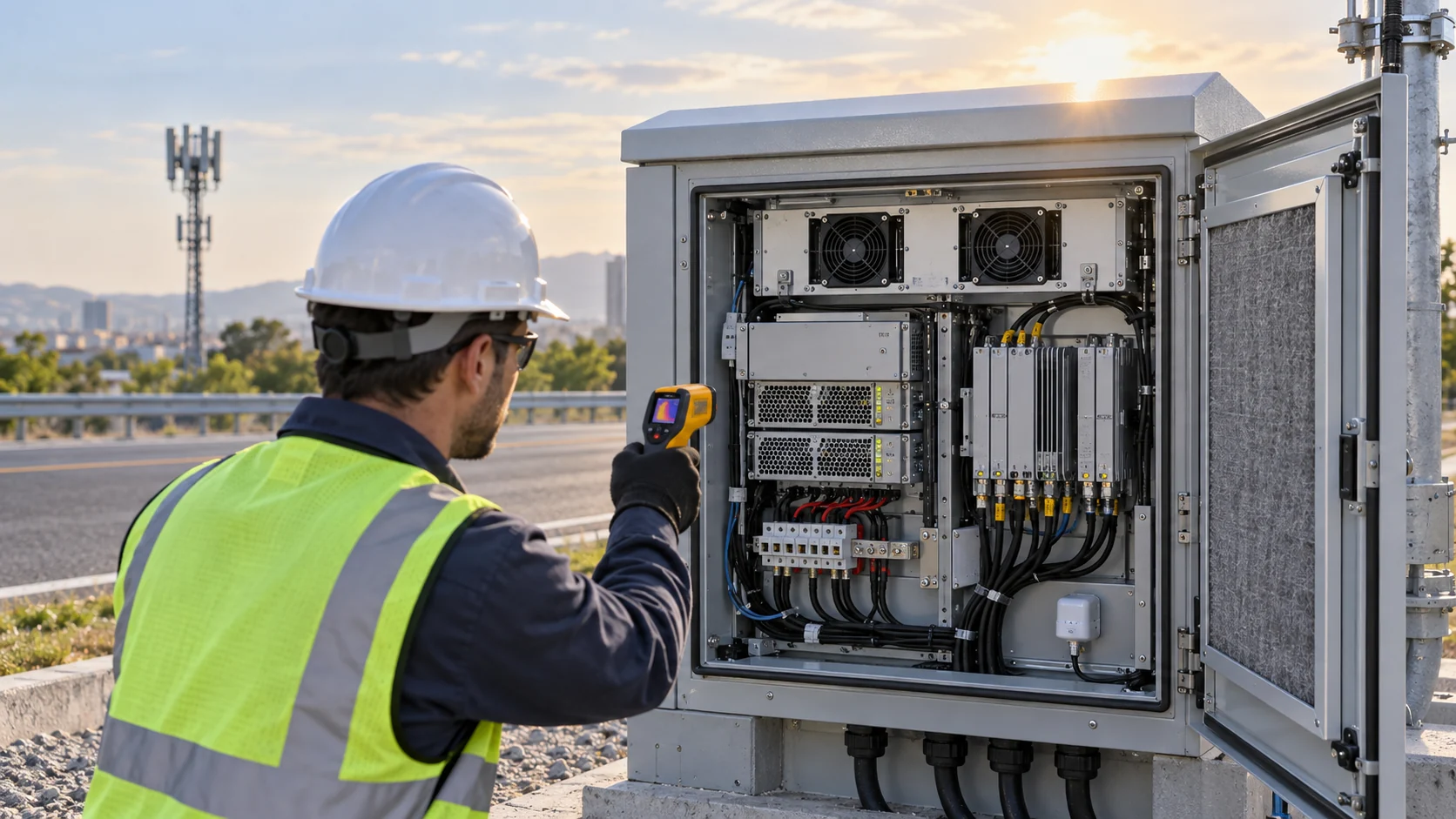
Outdoor 5G and edge cabinets often combine radios, power conversion, batteries, optical equipment and control electronics in a small metal enclosure. The thermal architecture may use a filtered fan, a heat exchanger, an air conditioner or a hybrid of these. Each option changes the way heat, humidity, dust and service load enter the design review. A fan that looks adequate at a clean laboratory condition does not prove that the cabinet will remain safe after a wet evening, a dirty filter or a blocked exhaust path.
The engineer must separate cabinet-air temperature from the surface temperature that matters for condensation. Relative humidity alone is not enough: dew point, cold spots, air mixing, enclosure leakage and shutdown behavior determine whether moisture can form. The fan control also matters because a sudden stop can leave a cold heat exchanger, a damp filter or a metal rail below the dew point while the cabinet air is still changing.
This article gives thermal, mechanical, firmware and procurement teams a testable method for outdoor telecom fan selection. It uses engineering estimates and public environmental guidance as a starting point, not as a substitute for the cabinet owner's qualification and regional compliance work.
Define the Cabinet Architecture Before Choosing a Fan
The correct fan depends on whether the cabinet exchanges outside air, transfers heat through a core or relies on a sealed cooling loop.
A filtered fan cabinet brings outside air across the electronics and exhausts it again. It can be efficient at moderate ambient, but the filter pressure, dust exposure and moisture path become part of the electronics environment. A heat exchanger keeps the internal and external air circuits separate while transferring heat through a core. It reduces contamination risk but adds two fan duties, core pressure drop, seals and a second failure path. An air conditioner or thermoelectric cooler adds another control and maintenance boundary.
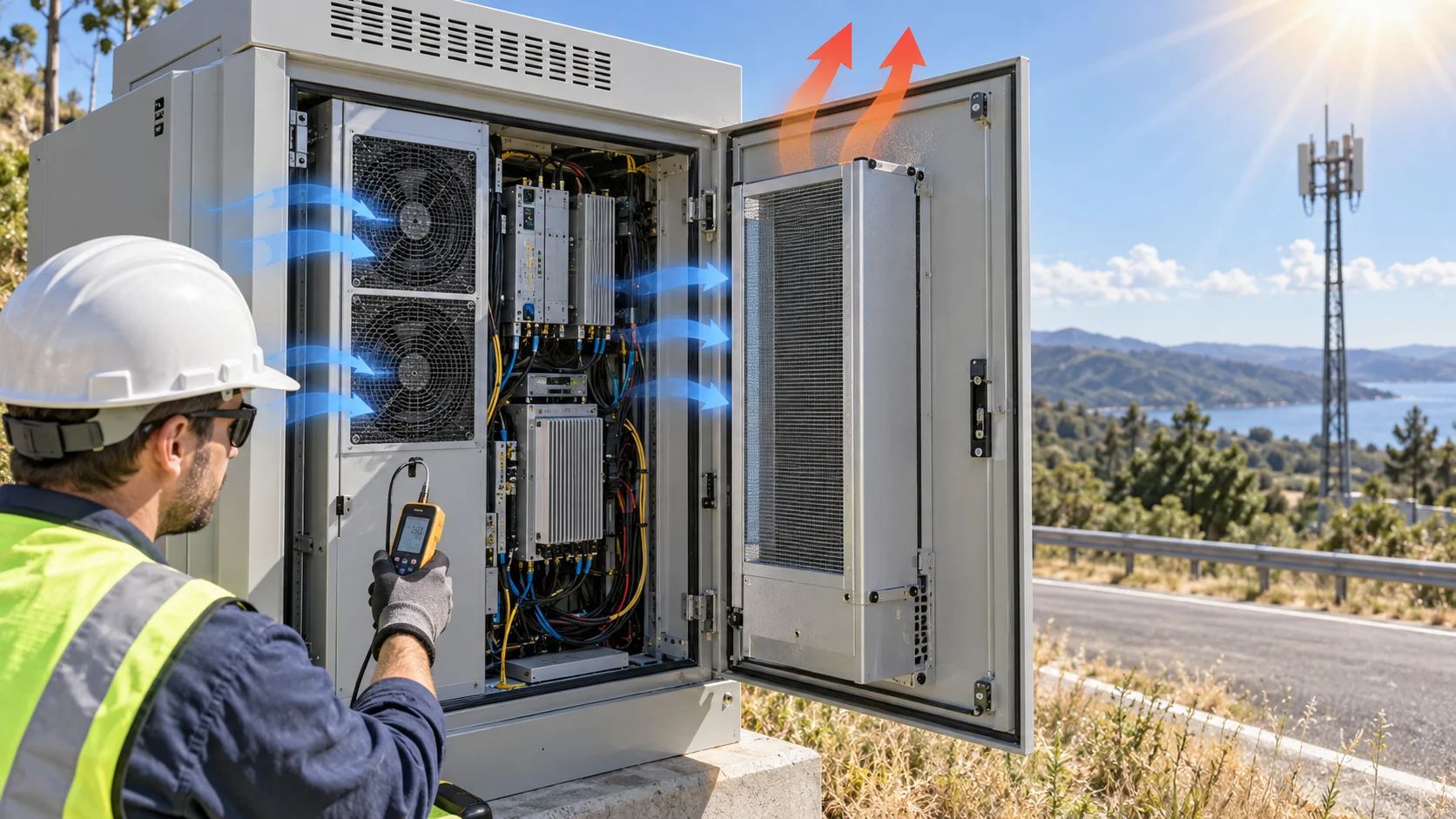
Draw the air circuits with arrows and label every restriction: inlet louvre, insect screen, filter, fan guard, heat sink, radio shelf, cable bundle, core, drain and exhaust. Then identify where temperature and humidity sensors actually sit. A sensor near the inlet may report a comfortable value while a shielded radio or cold metal edge experiences a different condition.
Public telecom-enclosure designs commonly offer fan filters, heat exchangers and air conditioners as different thermal options. That is a useful reminder that cooling architecture is a system decision. The fan supplier should not claim that one fan construction or IP label certifies the complete enclosure, condensation strategy or telecom environmental class.
Calculate the First Airflow Target From Heat Loss
A simple heat balance does not finish the design, but it prevents a fan selection from being driven only by cabinet volume or free-air CFM.
Suppose an outdoor cabinet rejects an estimated 420 W from radios, DC conversion and auxiliary electronics. If the design allows a 15 K air-side rise and uses an air heat-capacity estimate of 1,200 J/(m3 K), the first flow estimate is Q = 420/(1,200 x 15) = 0.0233 m3/s, or approximately 49 CFM. If solar radiation adds 120 W to the cabinet heat balance, the estimate becomes 540/(1,200 x 15) = 0.030 m3/s, or approximately 64 CFM.
These values are screening estimates. They do not account for local component limits, hot-air bypass, temperature stratification or the fact that a heat exchanger may have different internal and external flow requirements. They do show why a cabinet that seems acceptable at night can lose margin during a sunny afternoon even when the electronics power is unchanged.
Next add the installed pressure. A filter, louvre, core and compact outlet may require 120 Pa at the target flow. The candidate must deliver the required CFM at 120 Pa and at the service-limit pressure, not at zero Pa. Record voltage, current, RPM or FG, pressure and flow during the test so procurement has a repeatable requirement instead of a catalogue headline.
| Input | Example | Engineering use |
|---|---|---|
| Electronics heat | 420 W estimate | Base thermal load before solar |
| Solar contribution | 120 W estimate | Check exposed cabinet condition |
| Allowed air rise | 15 K | Sets a first flow target |
| Calculated flow | about 64 CFM | Screening value before distribution checks |
| Installed pressure | 120 Pa plus service drift | Select on the loaded P-Q point |
The Animated Air-Path Model: Dry Night, Wet Morning and Dirty Filter
The same fan speed can produce different results as inlet air, pressure and surface temperature change.
In a dry night state, the fan may operate at a low stable command and exchange enough air to remove the electronics loss. In a humid morning state, the same command may still move air, but the dew-point margin at a cold wall or heat-exchanger surface may be small. In a dirty-filter state, RPM can remain normal while the operating point moves to lower flow and the internal hotspot rises.
The animated schematic below is qualitative. Blue particles represent the intended air path, amber particles represent heat, and red particles identify the restriction or recirculation risk that consumes margin. The animation is not a CFD result. Its purpose is to make the commissioning states explicit before the team decides which variables to measure.
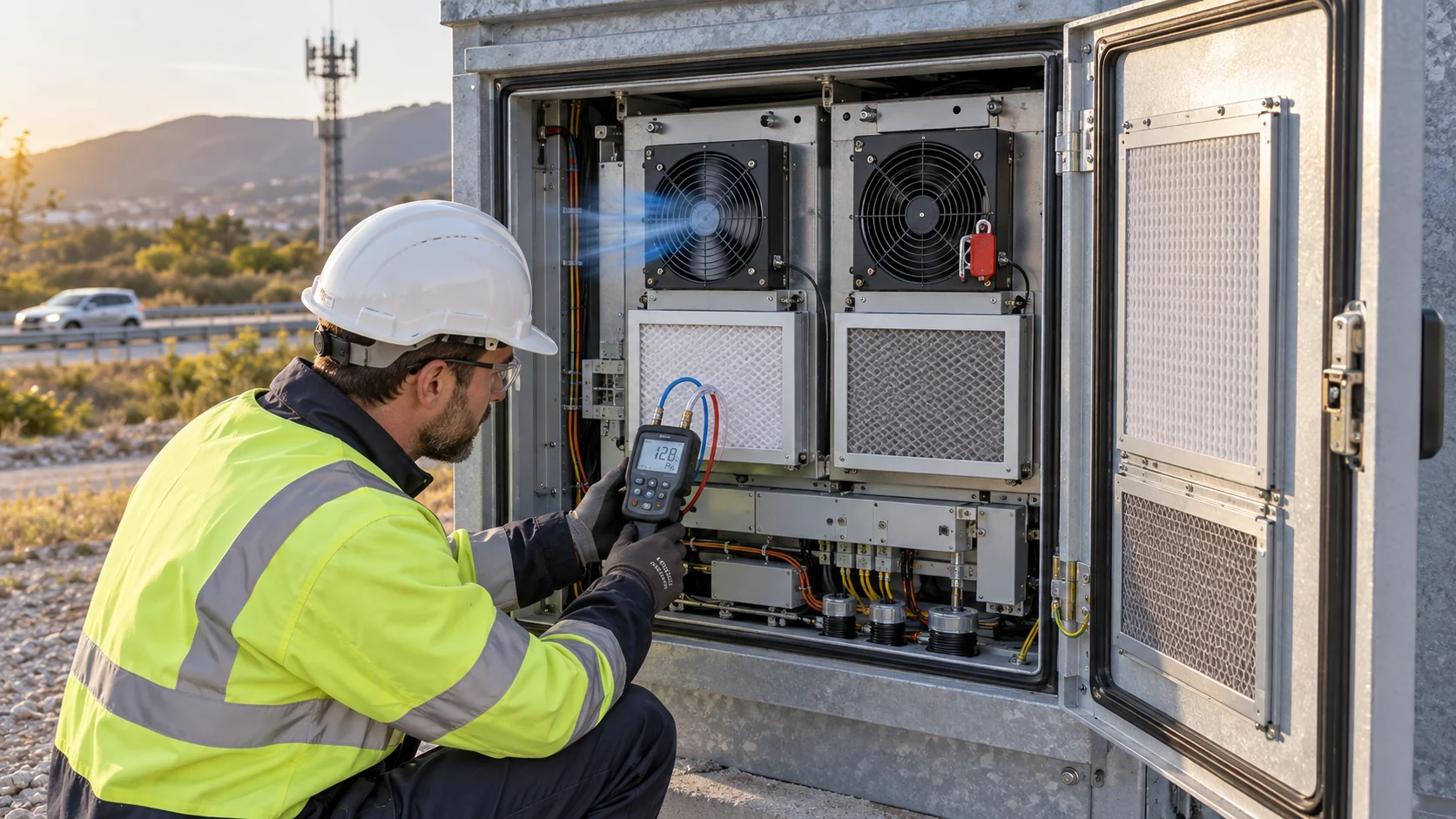
For a real test, time-align cabinet inlet temperature, internal temperature, surface temperature, relative humidity, dew point, differential pressure, fan command, actual RPM, current and alarm state. A single temperature reading taken after the cabinet has reached equilibrium cannot explain a condensation event that occurred during shutdown or a pressure rise during filter loading.

Dew Point and Condensation: Specify the Margin, Not Just Relative Humidity
Condensation risk appears when a surface is at or below the air dew point, so the design record needs both values and a recovery sequence.
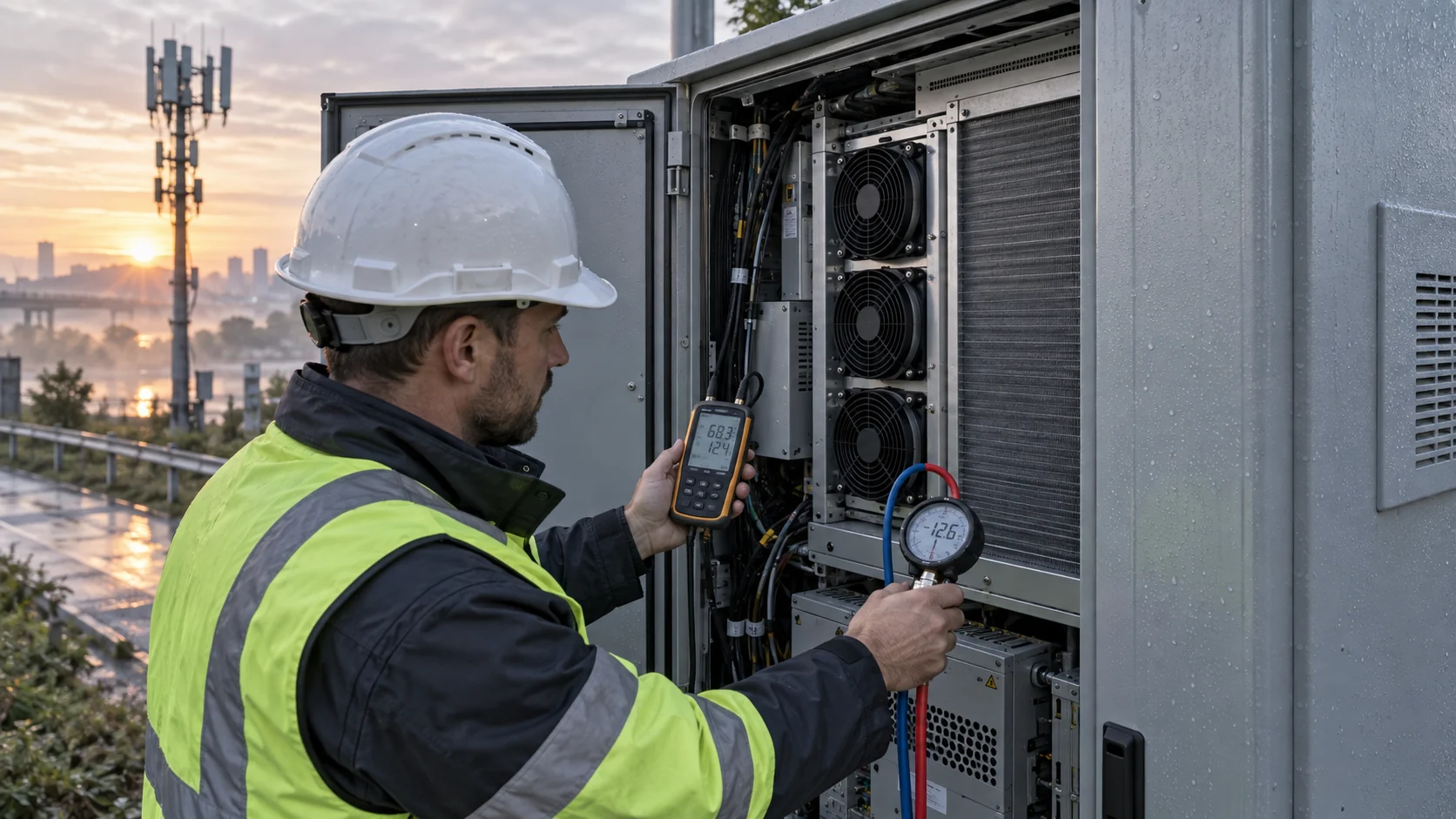
Relative humidity changes when temperature changes even if the moisture content stays similar. A cabinet that is warm in the afternoon can cool rapidly after the fan stops, after rain or after a cold front arrives. If the internal air remains humid while a heat-exchanger plate, door rail or electronics shield cools below the dew point, water can form locally even though the average cabinet temperature appears acceptable.
Use a dew-point estimate as a screening tool, then measure the critical surface. For example, air at 30°C and 70% RH has a dew point around 24°C. If a metal surface is measured at 23°C, the nominal margin is negative and the cabinet needs a control or mechanical response. The calculation is illustrative; sensor accuracy, stratification and surface emissivity must be included in the real test.
Possible responses include controlled fan operation, a heater, reduced cooling during a high-risk transition, better sealing, a drain path, a different heat-exchanger control point or dehumidification. The fan can support mixing and temperature control, but it cannot by itself guarantee that every surface stays above dew point.
Filter Loading and Solar Heat Consume the Same Fan Margin
Outdoor cabinets often lose margin through two independent mechanisms: more heat enters the enclosure while the air path becomes harder to push through.
Solar radiation can raise the external skin and inlet temperature before the radio load changes. Dust and pollen can increase filter pressure while the filter still looks visually acceptable. If the controller responds only to an internal temperature sensor, it may command the fan later than the filter condition requires. If it responds only to fan RPM, it may miss the falling airflow caused by pressure rise.
Set a clean-state baseline and a service-limit state. Record differential pressure across the filter or core, fan current, actual flow if available and the hottest electronics temperature. Define the service alarm below the point where the fan reaches maximum command and the equipment must derate. The exact alarm value is cabinet-specific; it should be based on the measured pressure-flow and thermal result rather than a generic percentage.
A useful estimate shows the interaction. If the clean path requires 120 Pa and a loaded filter adds 60 Pa, the fan now sees 180 Pa at the same target flow. A candidate with little pressure headroom may move far left on its P-Q curve. The team should decide whether to accept a higher speed, use a higher-static-pressure fan, enlarge the filter, change the airflow path or shorten the service interval.
Fan Control: Temperature, Humidity, Pressure and Fault Feedback
A robust outdoor cabinet controller should not infer the whole air-path condition from a single speed command.
PWM or EC speed control can reduce energy and noise when the cabinet is lightly loaded, but the minimum stable duty and restart behavior must be tested over voltage, temperature and humidity. FG feedback confirms rotation, not necessarily required airflow. A differential-pressure sensor, filter switch or temperature trend can provide the additional evidence needed to detect a blocked path.
Humidity control should include hysteresis and dwell time. A controller that reacts to every small RH fluctuation may cause repeated speed changes and unnecessary acoustic wear. A controller that ignores a dew-point approach may leave the cabinet vulnerable after a cold night. Define the priority between thermal cooling, moisture protection and fan-fault response, then test transitions rather than only stable points.
For redundant fan arrays, decide how much airflow remains after one fan stops and whether the failed fan creates reverse-flow resistance. Test the array with one fan unpowered, one fan locked, the filter at service limit and the cabinet at hot ambient. N+1 is a design claim only after the remaining operating point and temperature response have been measured.
| Signal or measurement | It can show | It cannot prove alone |
|---|---|---|
| PWM / EC command | requested operating state | actual airflow or cooling |
| FG / tach | rotor movement and approximate speed | pressure-flow performance |
| Differential pressure | filter or core restriction trend | component temperature margin |
| Relative humidity | air moisture condition | cold-surface condensation |
| Surface temperature | local dew-point margin | whole-cabinet thermal distribution |
IP Rating, Environmental Class and the Fan Boundary
An enclosure IP code and a fan construction are related decisions, but they are not interchangeable certificates.
IEC 60529 defines degrees of protection provided by enclosures. The rating applies to the tested enclosure configuration and its defined openings, not automatically to every replacement fan or modified service door. Telecom environmental classifications also consider temperature, humidity, chemical substances, dust, biological conditions and mechanical stress. The fan sample must be selected for the actual exposure, while the cabinet owner remains responsible for the complete qualification.
For an open-air path, consider motor and electronics protection, bearing construction, conformal coating where applicable, cable exit, connector sealing, corrosion exposure and the direction of water travel. For a heat exchanger, consider both fan circuits and the possibility that an external fan failure changes internal surface temperature or moisture behavior.
Do not specify IP67 or IP68 as a shortcut for a cabinet design. Ask what the fan face sees, how the fan is mounted, whether a gasket changes the cut-out, how the drain works and what service action does to the boundary. The right choice may be a protected industrial DC fan, a sealed module or a different air-path architecture.
An Anonymized Outdoor Cabinet Validation Example
A realistic case review separates a temperature alarm from the air-path and moisture mechanisms that caused it.
In an anonymized outdoor radio-cabinet development, the equipment passed a dry-room thermal test but produced intermittent high-temperature alarms after several humid days. The installed fan showed normal RPM. The first investigation focused on the radio load, yet the more important clues were a rising filter differential pressure, an exhaust path close to the inlet and a cold internal rail after a night-time fan stop.
The engineering team mapped the two air circuits, measured inlet and exhaust temperature, recorded RH and dew point and repeated the test with a clean and service-limit filter. A custom high-static-pressure fan sample was compared with the original at the cabinet pressure. The control review added a stable low-speed state, a filter service threshold and a transition test after fan stop. A separate check examined the cold rail and heat-exchanger surface rather than relying only on the cabinet air sensor.
The transferable result was a clearer responsibility split. The fan could provide more usable pressure headroom, feedback and environmental construction, but the cabinet still needed corrected exhaust clearance, a defined moisture strategy and service instructions. The case is anonymized and does not claim a universal alarm limit or a named customer's field performance.
How MEGA Tech Supports Outdoor Telecom Fan Development
MEGA Tech helps telecom and edge-equipment teams turn an outdoor cabinet requirement into a measurable fan sample.
We can review custom DC or EC axial fans, compact centrifugal blowers and fan modules for filtered cabinets, heat-exchanger circuits, radio shelves and auxiliary power sections. The review can include pressure-flow behavior, 12/24/48 V operation, PWM or voltage control, FG/RD feedback, startup, bearing selection, cable exit, connector position, corrosion or moisture exposure and sample validation on the customer's populated assembly.
For a first review, send cabinet heat loss by state, solar exposure, ambient and humidity basis, required airflow at static pressure, filter and core pressure data, fan envelope, voltage tolerance, control interface, feedback, noise target, service interval, environmental exposure and quantity. If this is a replacement, send the original fan part number plus the installed pressure and temperature result; same outline dimensions alone do not prove equivalence.
Our boundary is clear: MEGA Tech does not certify the complete telecom cabinet, radio, battery, heat exchanger, IP enclosure or ETSI/IEC environmental qualification. We support the fan and air-side interface, provide samples and help the product team measure the operating point and failure behavior before production release.
Engineer FAQ: Outdoor Telecom Cabinet Fan Validation
Use these questions when reviewing a fan supplier, cabinet design or field alarm.
Q: Is a higher IP-rated fan automatically better? A: No. Select construction for the actual air, moisture, dust, corrosion and service exposure, then qualify the complete enclosure separately.
Q: Does normal RPM prove normal airflow? A: No. Filter or core pressure, bypass, reverse flow and fan aging can reduce airflow while RPM remains normal.
Q: Is relative humidity enough to control condensation? A: No. Compare dew point with the coldest relevant surface and validate shutdown and restart transitions.
Q: Should a heat-exchanger cabinet use identical internal and external fans? A: Not necessarily. The two circuits can have different heat loads, pressure drops, contamination and control requirements.
Q: How should a filter alarm be set? A: Measure clean and service-limit pressure and identify the point before the required flow or component temperature limit is lost.
Q: What should be tested after one fan fails? A: Remaining airflow, reverse resistance, hotspot temperature, alarm delay, derating and recovery at hot ambient and service-limit pressure.
Q: What data should I send MEGA Tech? A: Heat loss, air-path drawing, airflow at pressure, filter/core data, voltage, control, feedback, noise, environment, service interval and quantity.
Q: Can MEGA Tech replace a branded telecom fan? A: We can review replacement options, but equivalence must be proven at the installed pressure, mounting, voltage, feedback, acoustic and environmental condition.
Outdoor Telecom Cabinet Design Review Checklist
Record these items before the fan, filter, heat exchanger and control logic are released.
- Is the cabinet open-air, heat-exchanger cooled, air-conditioned, thermoelectric or hybrid?
- What are the internal and external air circuits, including every filter, louvre, core, cable path and exhaust?
- What is the heat load at radio peak, battery charge, backup and low-load states?
- What solar, wind, rain, humidity and ambient conditions are included in the test envelope?
- What are the clean and service-limit pressure-flow points?
- Where are air temperature, relative humidity, dew point and cold-surface temperature measured?
- What is the minimum stable fan command, restart rule, FG/RD interpretation and fault response?
- What happens if one fan stops or creates reverse-flow resistance?
- Does the service alarm occur before the fan reaches maximum command or the radio derates?
- Which values are measured, which are estimates and which belong to the complete cabinet qualification?