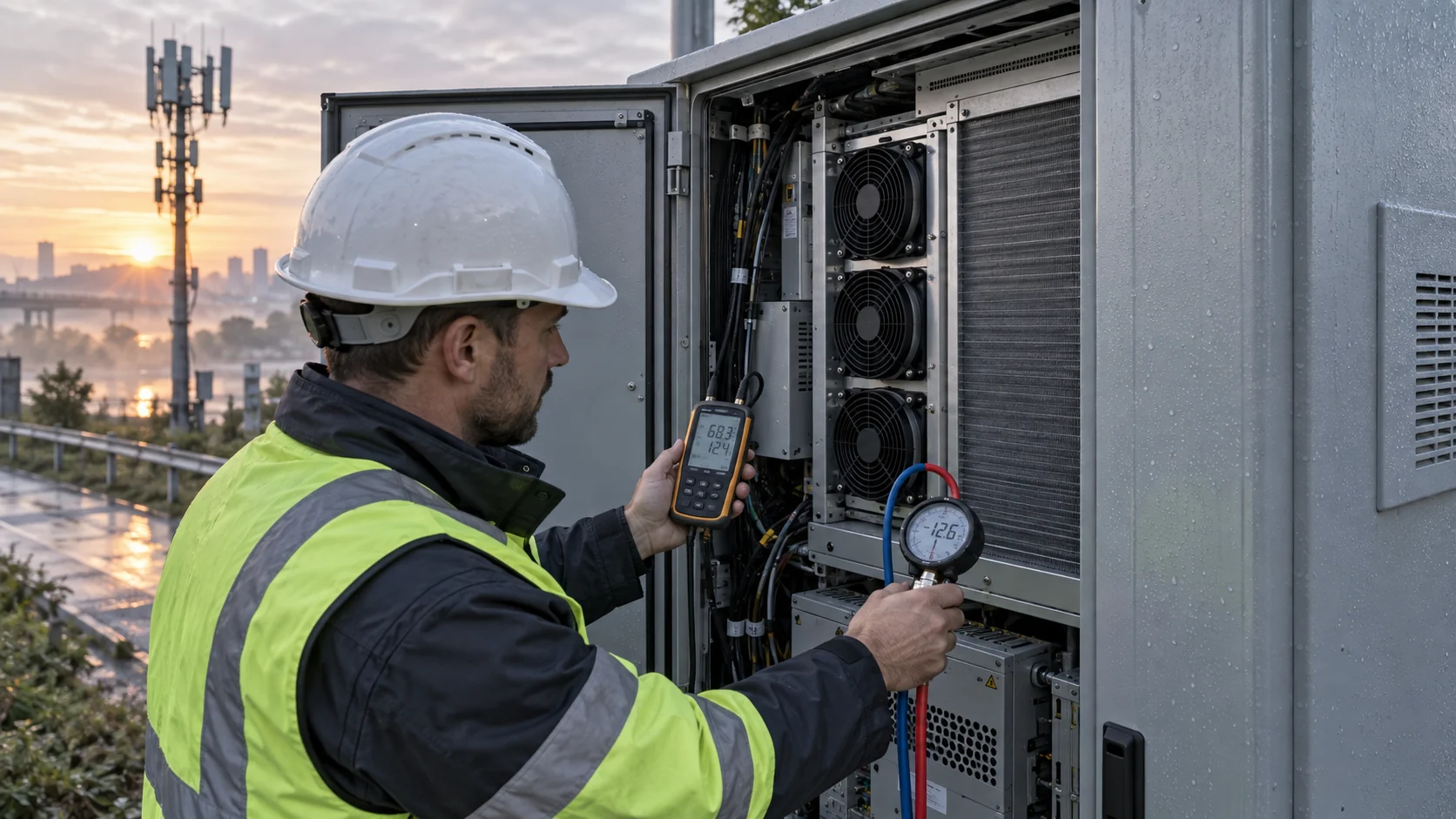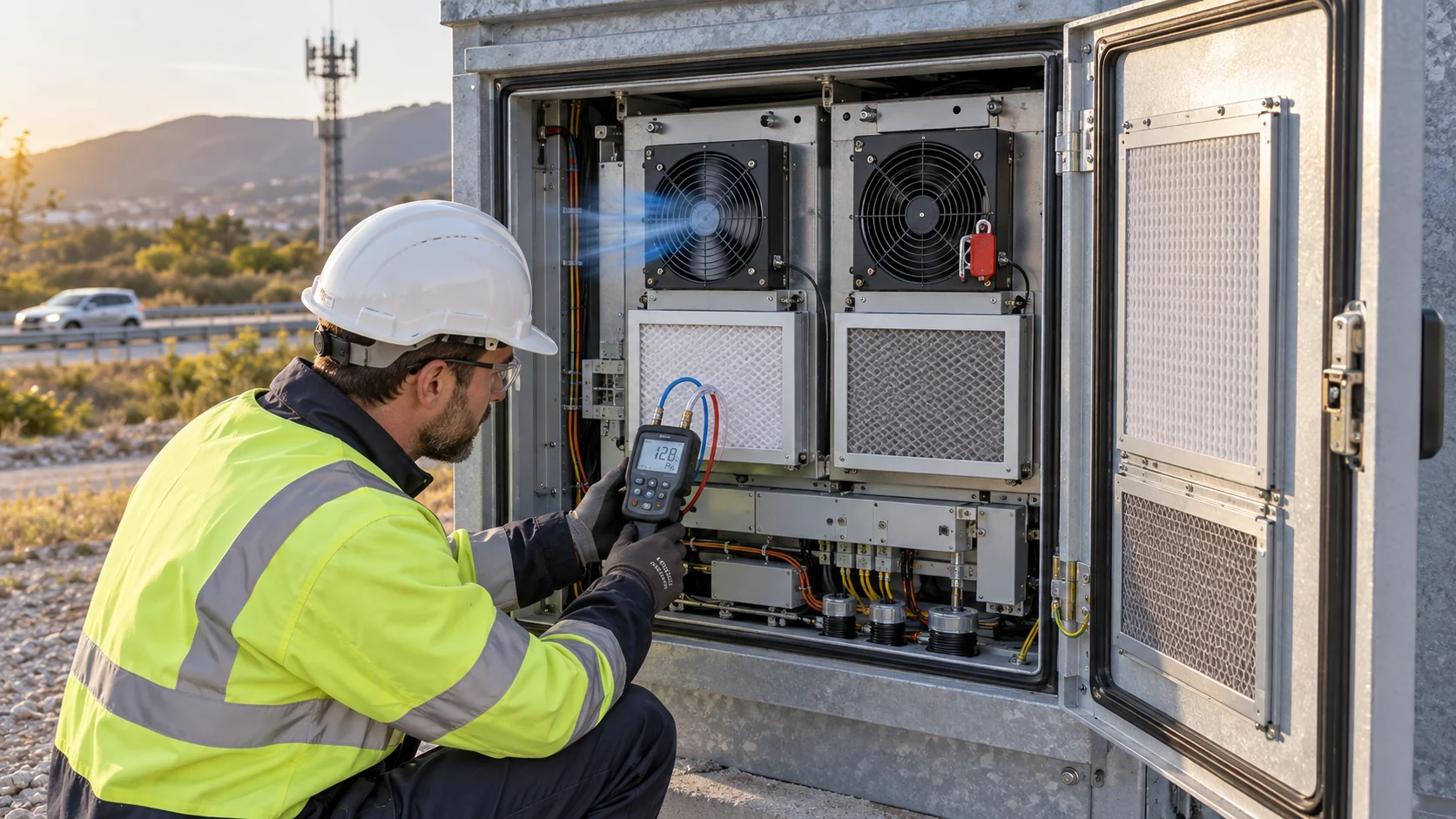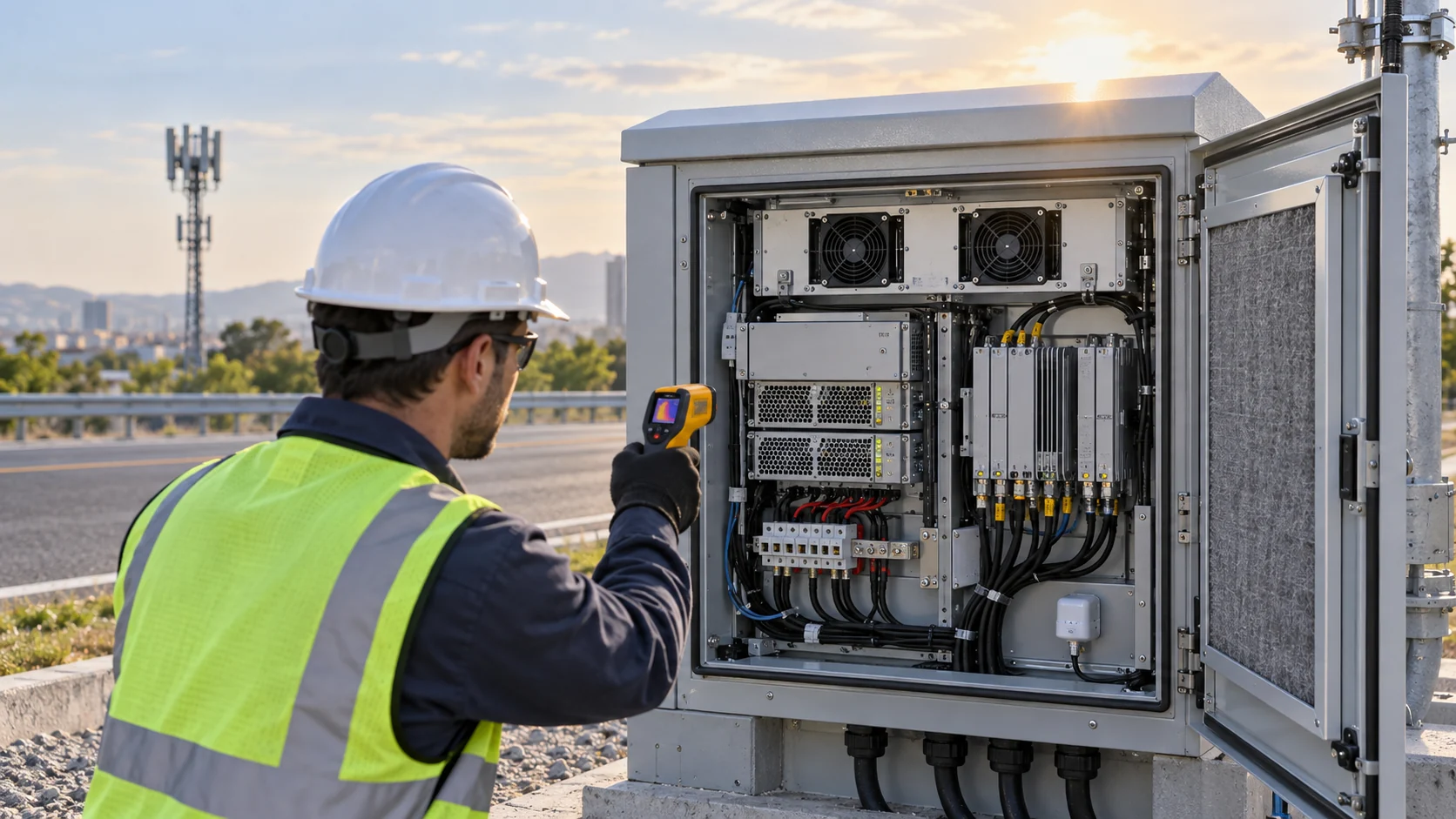
The Cabinet Can Pass the Afternoon and Fail After Sunset
Outdoor telecom cooling is a daily cycle, not a single maximum-temperature test.
A roadside 5G cabinet has to reject heat from radios, rectifiers, converters, batteries and control electronics while exposed to solar radiation, dust, rain, salt and fast humidity changes. The thermal condition that limits the equipment may occur at the hottest afternoon, but the moisture condition that damages connectors may occur hours later when the cabinet skin and cold metal parts fall below dew point. A cooling fan selected only from a daytime CFM number therefore solves only one part of the problem.
The installed fan also sees a changing air path. A clean filter, louvre, rain hood, grille, cable bundle and internal baffle create one pressure drop. As the filter loads, the resistance rises and the working point moves. If the fan holds command speed but useful airflow falls, a controller that monitors only RPM can report a healthy fan while the radio heat sink is receiving less air. The specification must connect fan feedback with pressure, temperature and maintenance state.
This guide uses a practical design sequence for outdoor telecom cabinets: define the heat boundary, separate outdoor-air cooling from sealed heat exchange, calculate a screening airflow, measure the installed pressure, test the service-limit filter, and then review humidity, failure response and service access. The result is a fan requirement that can be sampled and verified instead of a catalogue comparison based on maximum free-air flow.
Start with the Real Heat Boundary, Including the Sun
A fan cannot remove heat that was never included in the cabinet heat balance.
List every source that raises the protected equipment temperature. Radio and baseband losses may change with traffic and transmit power. Rectifiers and DC converters add conversion loss. Batteries create a different state during charging than during standby. A heater, anti-condensation element or small controller may be insignificant alone but important when the cabinet is at low load and humid air is cooling rapidly. If an internal heat exchanger or closed-loop circulation fan is used, include its motor power on the protected side.
Solar load is not a decorative detail. A dark cabinet in direct sun can have a much higher skin temperature than the local shaded air. The useful design input is the permitted equipment inlet temperature under the site’s solar, wind, orientation and mounting conditions, not simply the weather-station air temperature. A roof shade, reflective coating or double-wall construction can change the heat balance before a larger fan is considered.
Use separate operating cases rather than one averaged maximum. A credible set may include high traffic with high ambient, battery recharge after an outage, low traffic with high humidity, fan degradation, clean filter, service-limit filter and a door-open maintenance state. The limiting component may be a radio heat sink, rectifier inlet, battery module, cable termination or connector. State its allowed temperature, measurement location and derating rule before selecting the cooling hardware.
As a screening example, assume 1,200 W of internal loss and a desired 10 K air temperature rise. With air density 1.2 kg/m³ and specific heat 1,005 J/(kg·K), Q = W/(rho × cp × delta T) gives approximately 0.0995 m³/s, or 358 m³/h. That is only the sensible-air estimate. Solar gain, recirculation, altitude, heat-source distribution and installed pressure still need to be evaluated. It is not a fan recommendation or a product result.
Animated Model: Sun, Filter Loading and Condensation Are Different States
The same cabinet can move from high heat rejection to moisture risk as the site condition changes.
In the daytime state, the fan must move air through the populated cabinet while the enclosure skin and outdoor air are warm. A filter can protect the electronics, but it adds pressure drop and can become the dominant restriction after dust accumulation. In the night state, the fan control may slow or stop as the equipment load falls. If humid outdoor air enters and cold metal surfaces fall below dew point, the cabinet can face condensation even though the afternoon thermal test passed.
The animation is a visual model, not a CFD result and not a universal filter multiplier. Its purpose is to separate the engineering tests. Measure the heat case with the actual thermal boundary, measure the filter pressure at clean and service-limit states, and evaluate moisture with air temperature, relative humidity, surface temperature and dew-point margin. Do not infer condensation safety from fan RPM or from a daytime cabinet temperature alone.
A practical control sequence may include minimum ventilation, a high-temperature speed curve, filter-pressure alarm, fan FG/RD feedback and a dew-point or surface-temperature interlock. The final logic depends on the cabinet architecture and equipment requirements. A fan supplier can support the airflow, pressure, control and feedback validation, but the enclosure designer owns the ingress, drainage, insulation and condensation decision.

Choose Ventilation, Heat Exchange or Air Conditioning by Boundary
The right cooling method follows what the cabinet is allowed to exchange with the environment.
Filtered forced ventilation can be attractive when outside air is acceptable, the site is not heavily contaminated, the equipment can tolerate the ambient range and the cabinet can maintain its required ingress protection with the fan, filter, louvre, drain and gasket installed. Its main advantage is simple heat rejection and modest auxiliary power. Its risks are filter fouling, salt or moisture entry, fan failure and the fact that ventilation cannot cool the cabinet below outdoor air temperature.
A heat exchanger or closed-loop system keeps the internal air separate from the outside boundary. This can reduce dust and humidity entry, but it adds two air circuits, heat-transfer resistance, fan power, fouling surfaces and another maintenance path. The external loop still experiences weather and contamination. The internal loop still needs a measured flow path across the limiting heat sources. A circulation fan can reduce local hot spots, but it cannot reject the cabinet heat unless the enclosure boundary has capacity.
Air conditioning becomes relevant when the protected temperature must remain below the design outdoor condition, when solar and internal losses exceed sensible ventilation margin, or when contamination and humidity make open air unacceptable. It adds compressor demand, condensate management, low-ambient behavior, service complexity and a failure mode that should be alarmed. The selection should compare the complete energy and reliability budget, not only the rated cooling capacity.
| Cooling route | Useful when | Evidence still required |
|---|---|---|
| Filtered ventilation | Outdoor air is acceptable and the equipment limit is above the worst outdoor condition | Installed airflow, filter pressure, fouling interval, water path, dust/salt exposure and fan failure response |
| Closed-loop heat exchanger | The protected air boundary must remain separated from dust or humidity | Both air circuits, transfer capacity, fouling, fan power, internal distribution and condensation control |
| Air conditioning | The protected point must stay below outdoor air or the contamination boundary is severe | Sensible capacity at stated conditions, condensate path, power, low-ambient operation and alarms |
The Filter Is a Maintenance Component, Not Just an IP Accessory
Filter grade, open area, mounting, sealing and replacement practice all change the fan working point.
Specify the filter pressure drop at the reference velocity and at the airflow required by the populated cabinet. A filter label alone does not tell the fan what pressure it will see. A small filter face, blocked section, incorrect orientation or poorly sealed frame can create a local high-velocity path and a bypass path at the same time. The result may be less protection and less cooling than the drawing suggests.
The service limit should be measurable. A differential-pressure switch across the filter is more informative than a calendar interval when sites have different dust, pollen, salt or construction exposure. If the controller cannot measure pressure, use a validated pressure threshold and correlate it with delivered airflow and equipment temperature. The alarm should identify a maintenance condition before the thermal trip, not merely report that the fan is still rotating.
Test the clean and loaded conditions with the actual filter frame, gasket, grille, rain hood and cable routing. Record fan voltage, PWM or analogue command, FG/RD state, differential pressure, useful airflow and the limiting equipment temperature. If the system increases RPM to recover flow, check the noise, power and bearing-life penalty. A larger fan operating at moderate speed may provide more usable margin than a small fan at its acoustic or reliability limit.
- Define the filter replacement pressure, not only a visual dirt criterion.
- Seal the filter frame and cable penetrations so air cannot bypass the protection path.
- Measure clean and loaded pressure at the same reference airflow.
- Log fan feedback and pressure together; RPM alone is not proof of airflow.
- Repeat the test after service to confirm the operating point returns.
48 V Fan Selection: Control, Redundancy and Reverse Flow
Telecom cabinets often have a narrow supply range and a service requirement that must be designed into the fan assembly.
A nominal 48 V label is not enough. Confirm the operating range during rectifier variation, battery operation, startup and low-voltage conditions. Check whether the controller uses PWM, analogue speed control or fixed-voltage steps, and define the expected FG or tachometer pulses and RD alarm behavior. The fan should start reliably at the minimum permitted voltage and recover after a transient without creating a false equipment alarm.
Redundancy should be tested as a system. N+1 can mean one fan is stopped, unplugged, blocked or electrically failed; these are not always the same airflow condition. A stopped rotor may create reverse-flow resistance through the idle fan. The cabinet should be tested with the failed position in the actual arrangement, including the remaining fan speed, filter pressure, temperature rise and alarm response. The test should also consider whether the failed fan can be replaced from the front without opening a contaminated or live compartment.
For a custom or replacement fan, review connector retention, cable bend radius, gasket compression, mounting flatness, vibration, bearing life, temperature rating and protection against the site environment. Matching the outline and rated voltage does not prove equivalent pressure flow, acoustic behavior or fault signaling. Send the original part number and the installed operating point when a drop-in replacement is required.
Night Condensation Needs Its Own Acceptance Test
Thermal success during the hottest hour does not prove moisture safety during the coldest surface condition.
Condensation depends on the relationship between air dew point and surface temperature. A cabinet can contain warm humid air during a service event, then cool rapidly after sunset or after a low-load fan mode. Metal door panels, heat-exchanger surfaces, cable glands and battery compartments may cool at different rates. The critical surface may be outside the location where the cabinet controller measures air temperature.
A practical test records ambient temperature, relative humidity, calculated dew point, internal air temperature, representative surface temperature, fan state and heater or ventilation state through the transition. Repeat it after a hot load period and after a door-open maintenance event if those conditions are credible. If the design uses a heater, confirm its control, energy source, sensor location and failure alarm. If it uses minimum ventilation, confirm that the air exchange does not import unacceptable moisture or salt.
Do not claim that a fan prevents condensation by itself. A fan can mix air and reduce local temperature differences, but it can also move humid air across a cold surface. The equipment owner must define the acceptable moisture boundary, the surface-temperature margin and the response when the sensor is implausible or unavailable.
Field Validation: From Roadside Cabinet to Production Release
The final test should reproduce the populated cabinet, the site boundary and the maintenance state.
Freeze the cabinet configuration before testing: equipment population, fan direction, filter grade and frame, louvres, rain path, cable entries, heat shields, solar orientation, sensor positions and control firmware. Measure the installed pressure and flow with the clean filter. Run the high-load thermal case until the limiting equipment temperature is repeatable, then repeat it with the agreed service-limit filter or calibrated restriction.
Repeat the test at the highest ambient and lowest fan supply voltage. If the site has altitude, use the project air-density basis. Test fan stop, blocked filter alarm, sensor failure, loss of one redundant fan, restart and recovery. Record whether the remaining fan can carry the thermal load for the required service interval. For sealed systems, test both internal and external air circuits and include fouling of the heat-transfer surface.
For the moisture case, run a controlled temperature and humidity transition or a representative field exposure. Record the dew-point margin at the critical surfaces, not only the cabinet average. The release report should contain the heat balance, installed P-Q working point, filter pressure, fan command and feedback, temperatures, acoustic result if relevant, alarm timing, service action and the exact acceptance boundary.
How MEGA Tech Supports a Custom Telecom-Cabinet Fan
We help convert the cabinet duty into a sample that can be tested at the real 48 V installation point.
MEGA Tech develops custom DC axial fans, compact blowers and filtered fan assemblies for outdoor telecom cabinets, roadside electronics, radio equipment and power-conversion enclosures. We review the heat load, solar and ambient boundary, filter pressure at the service limit, airflow direction, fan envelope, voltage range, PWM or analogue control, FG/RD feedback, connector, noise, vibration, environmental exposure and maintenance access. The objective is not to replace a catalogue number blindly; it is to demonstrate the required installed working point.
For a first review, send the cabinet drawing or photographs, equipment loss by operating mode, limiting component temperature, outdoor range, solar orientation, required airflow, pressure at that airflow, filter and grille data, voltage range, control interface, redundancy requirement, noise limit, quantity and service interval. For replacement work, send the current fan part number and measured command, voltage, pressure and temperature. These inputs let us propose a sample with a meaningful test plan.
Our role is clear: we support fan selection, customization, samples, P-Q characterization and installed validation. The telecom integrator remains responsible for the final enclosure rating, grounding, battery safety, moisture boundary, site certification and network availability requirements. If a lower-cost alternative is requested, we compare the performance envelope, control signals, reliability and validation evidence rather than promising equivalence from frame size alone.
Engineer FAQ: Outdoor Telecom Cabinet Cooling
Short answers for a 5G cabinet thermal and reliability review.
Q: Is a 48 V fan with high free-air CFM enough? A: No. Confirm the delivered airflow at the pressure created by the filter, grille, rain path, cable routing and populated cabinet.
Q: Can the fan cool the cabinet below outdoor temperature? A: No for ordinary ventilation. The inlet air sets the lower boundary; a heat exchanger or air conditioner is needed when the protected point must remain below outdoor air.
Q: Why can RPM remain normal while equipment temperature rises? A: Filter pressure or another restriction can move the fan operating point. The rotor may hold speed while useful airflow falls, so pair fan feedback with pressure or temperature evidence.
Q: Does a filter guarantee the enclosure IP rating? A: No. The complete installed fan, filter frame, louvre, gasket, drain and cable-entry arrangement must be evaluated as a system.
Q: What should be tested after sunset? A: Air temperature, relative humidity, dew point, critical surface temperature, fan state, heater state and the response to a rapid load or ambient transition.
Q: What information should a fan supplier receive? A: Heat loss by operating mode, ambient and solar condition, required airflow and pressure, filter pressure, voltage, control and feedback, envelope, redundancy, noise, environment and service interval.
Design-Review Checklist for a 5G Outdoor Cabinet
Use these questions before releasing the cabinet or requesting a replacement fan.
- Which component and operating mode defines the limiting temperature?
- Have radio, rectifier, converter, battery, heater and fan motor losses been separated?
- What solar, ambient, altitude, wind and mounting conditions are included?
- Is outdoor air allowed to enter, or is a separated heat-exchange boundary required?
- What are the clean and service-limit filter pressure drops at the required airflow?
- Does the fan start and recover across the complete 48 V supply range?
- What happens when one fan stops, a filter loads, a sensor fails or the controller loses power?
- Has the cabinet passed a night transition or dew-point boundary test?
- Can the fan and filter be serviced without compromising the enclosure or network availability?
- Will the supplier receive the installed pressure and thermal acceptance limits rather than only a frame size?