The night shift noticed before the alarm did
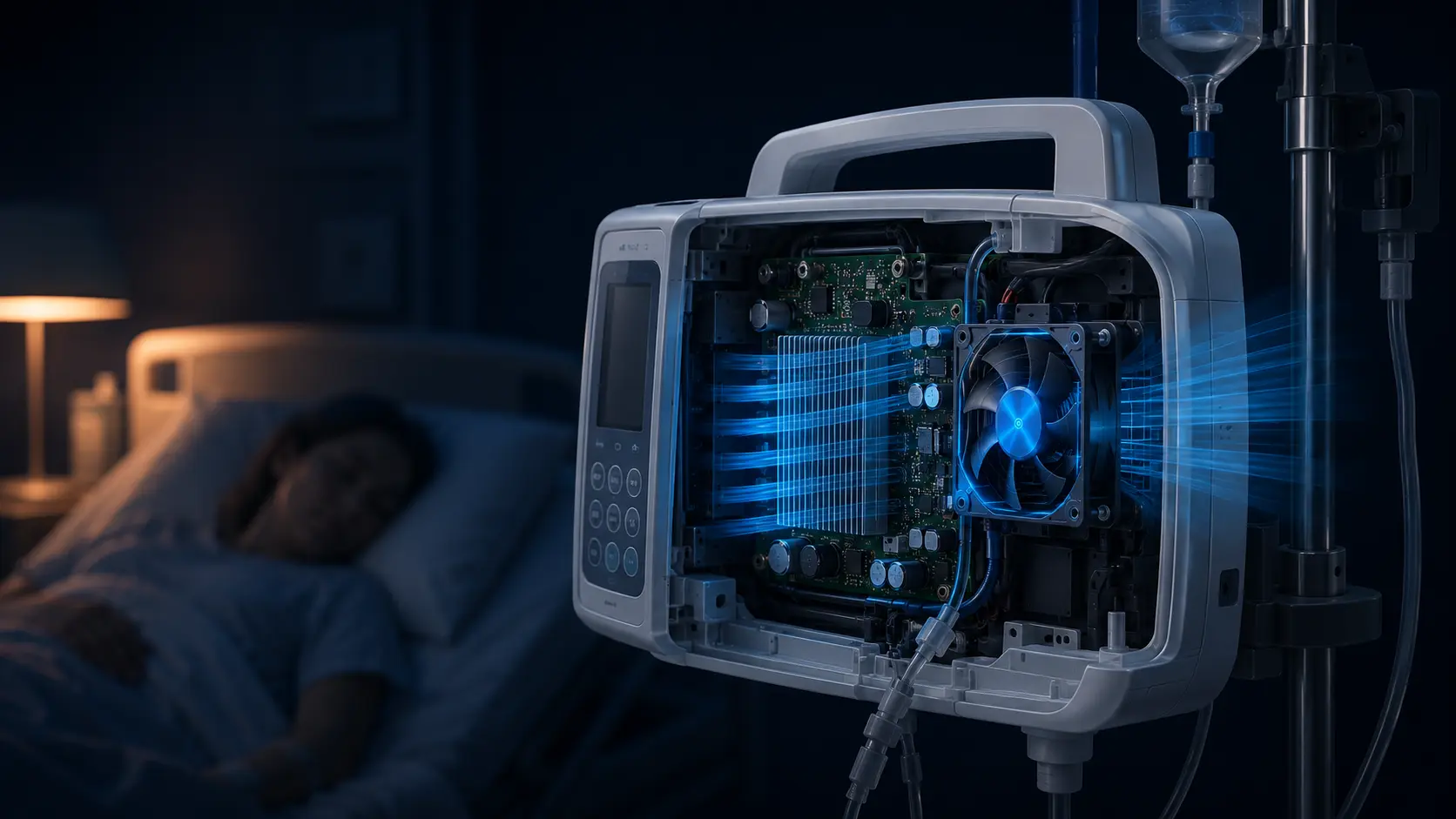
Consider a prototype infusion pump that passes every bench test in the lab. On a real ward, a patient may notice a tonal fan before anyone sees an alarm — and a second unit may keep spinning while its surface warms because airflow has silently decayed.
The lab is a liar when it measures a medical device. A bench in a quiet, climate-controlled room runs the fan flat out at 25°C and calls it a pass. But the device does not live there. It lives at a bedside where an unreported fan stop can become a clinical safety event, depending on the device's essential performance and risk controls — not merely a maintenance ticket — and where the acoustic budget is set by a patient trying to sleep, not by a datasheet.
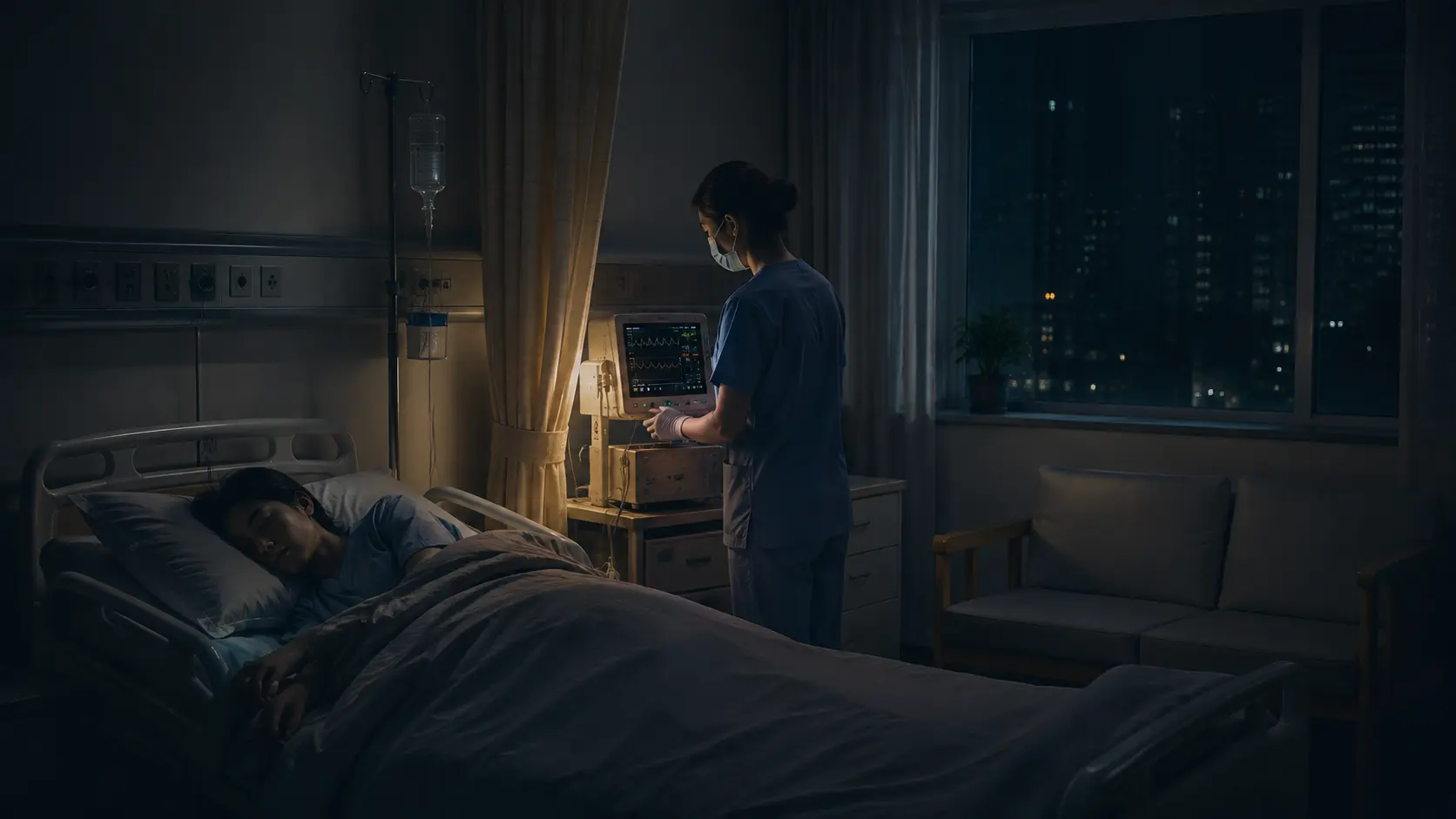
The ward, it turns out, is a harsher reviewer than any test plan. WHO says noise exposure in health-care settings should not exceed 35 dB in most rooms where patients are treated or observed, but the installed environment is full of alarms, voices, doors, pumps and HVAC noise. Against that moving baseline, a fan's tonal component can remain noticeable even when its overall catalogue value looks low. The reason is in the next section, and it is the detail that bench tests miss.
That is the core of medical fan design that this blog keeps returning to: a cooling fan in a hospital device has two independent constraints, and both are measured in patient outcomes rather than decibels or flow, no matter how they are written on the datasheet.
What follows is an engineering scenario and the selection logic that should be on your desk before a device meets its first real night.
Quiet is not comfort — it is clinical safety around a patient
The ward is already loud, but a low overall dBA value does not guarantee that a fan will disappear into the background. Ward noise is mostly changing events — alarms, voices and doors. A fan is different: it is a continuous tonal layer, a whine with a steady blade-passing frequency that the ear can notice precisely because it never stops. Tonal noise can be more disturbing than broadband noise at the same overall level, which is why the acoustic report needs spectral data, not just an SPL figure.
The clinical concern is not only comfort. WHO links health-care noise control with the ambient environment in which patients are treated or observed, and the device team must translate that room-level reference into an installed-device target. For sleep-sensitive or patient-facing equipment, measure at the patient's position and include the actual duty cycle, rather than declaring success from a free-air fan number.
Noise is also interference for the staff. In an operating room, a whining fan masks the subtle sounds a team is trained to hear. And a fan vibrating through a chassis can couple into sensitive analog or optical subsystems, producing measurement drift that is very hard to trace back to the fan at all.
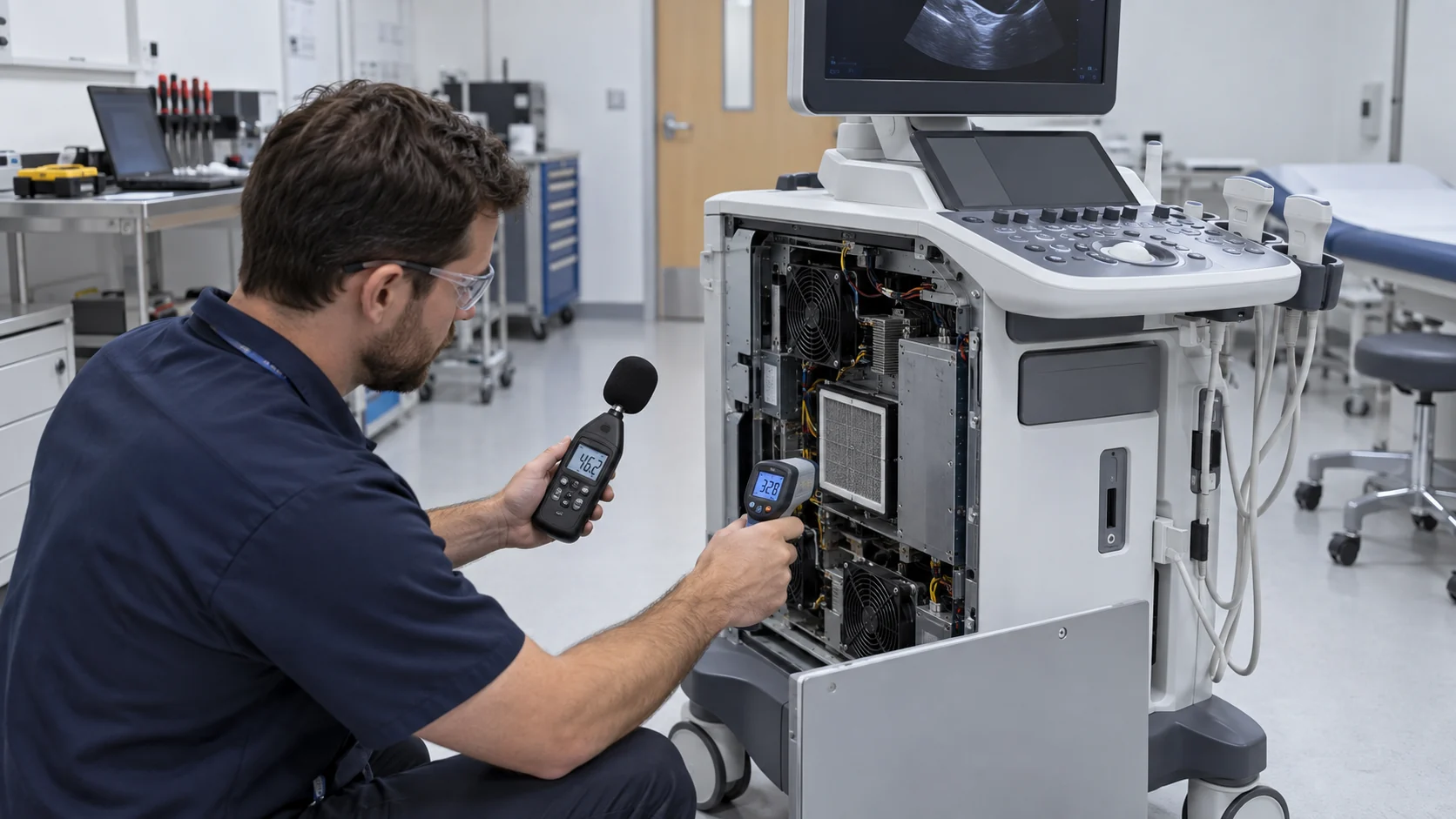
In this engineering scenario, the design team set a target in decibels at the patient's operating distance, not at the fan's free-air maximum. They specified the spectrum and checked blade-passing and PWM tones in the final enclosure. A switching frequency above the audible band may help, but it is not a substitute for a spectral test because motor electronics and chassis resonance can reintroduce audible tones. They also used a soft-start ramp and measured the device running as it would in service.
IEC 60601 turns cooling into a safety question
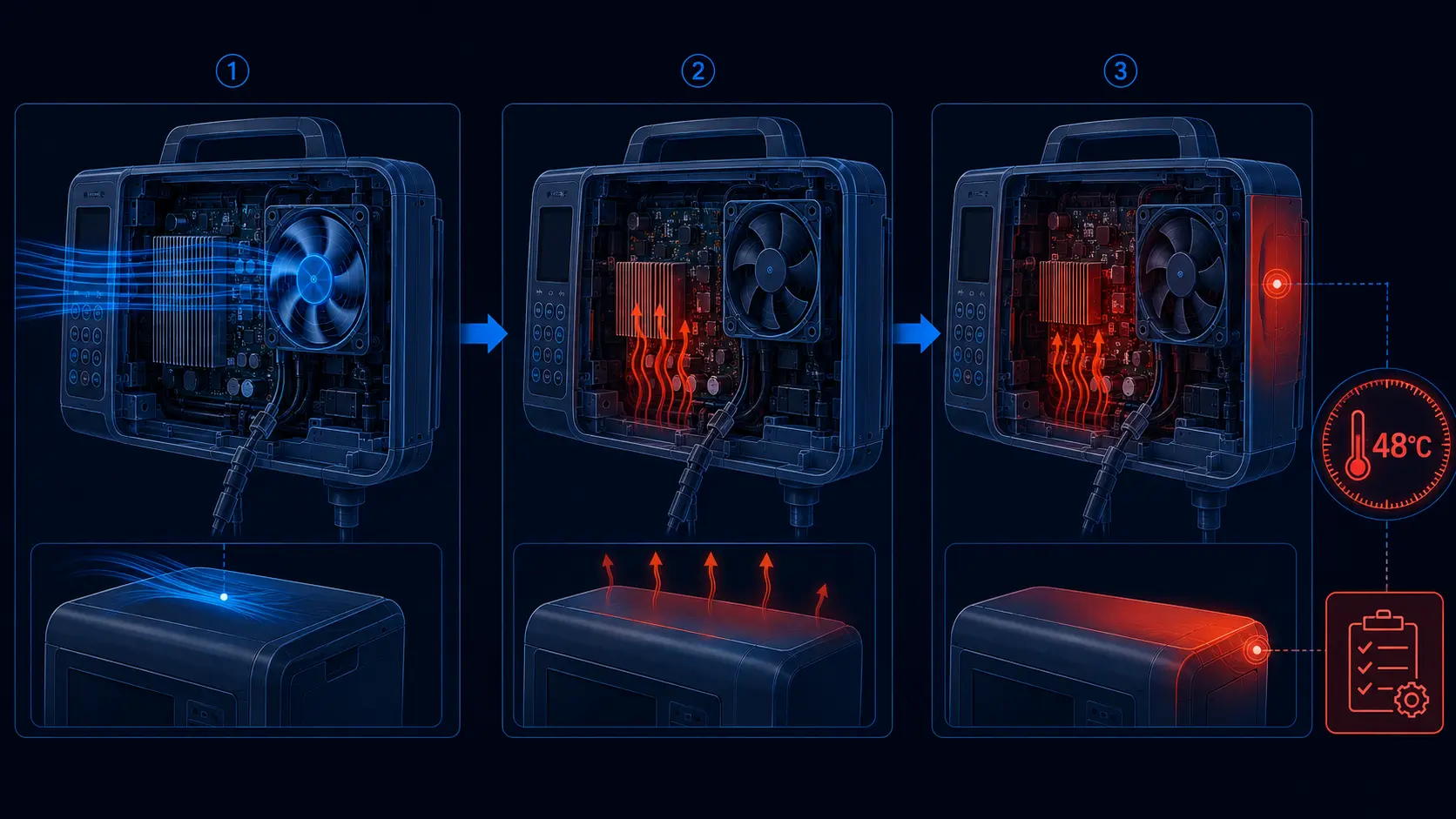
Here is where medical cooling differs most from industrial work: a cooling failure can be a safety failure mode. IEC 60601-1 sets general requirements for basic safety and essential performance, including requirements relevant to accessible temperatures; the applicable limit depends on the edition, contact condition, duration and equipment context.
For the pump team, the unit going warm mid-infusion was exactly the kind of scenario the device risk process should analyse. If a fan failure could cause an accessible surface or essential performance function to exceed its limit, the failure mode must be assessed and controlled in the device's risk-management file under ISO 14971. The number must come from the device manufacturer's compliance interpretation, not from a generic fan article.
The same family of standards reaches into EMC. If the fan's motor drive, PWM controller or filtering is part of medical electrical equipment, it must be evaluated within the applicable IEC 60601-1-2 evidence; a noisy PWM driver can be a compliance problem in its own right. Voltage alone does not decide compliance, and the complete equipment remains responsible for the assessment.
Two more layers land on the fan before the pump could ship. Materials: frame and impeller flammability, electrical insulation, creepage, clearance and leakage-current requirements must be specified for the actual device architecture rather than assumed from a catalogue label. And cleanability: a bedside device gets wiped with clinical disinfectants, so the fan housing has to survive the cleaning protocol and avoid trapping contamination. On a ward, the fan is part of a surface and airflow path the hospital interacts with every day.
The practical lesson is simple: ask the supplier what the fan does on loss of signal and under fault, and what material-change and lot-traceability data the device quality system will need — before you tool the enclosure, not after a unit fails on a ward.
The cheapest quiet is not a quieter fan — it is a slower one
The first thing the design team learned was that they did not need a fan with a better datasheet. They needed the same class of fan running at the minimum speed that still met the thermal need at worst ambient and load.
A fan at reduced speed is usually quieter, but the exact speed-to-noise change depends on fan geometry, control method, enclosure and measurement method. The practical answer is lower-RPM operation delivered with temperature feedback and closed-loop PWM control — a thermistor at the heat source trimming speed continuously — not raw maximum airflow and on/off cycling.
The enclosure worked against them, too. Every pressure drop from a cramped inlet or a sharp duct forced the small fan to spin faster than intended. Opening the air path — smoother ducts, more vent area, vibration-isolated mounts — let them use a bigger, slower fan that moved the same air with more acoustic margin. Test the original and revised airflow path at the same heat load, then record sound pressure, tonal peaks, component temperature and fan speed; the improvement belongs to the tested assembly rather than to the frame size alone.
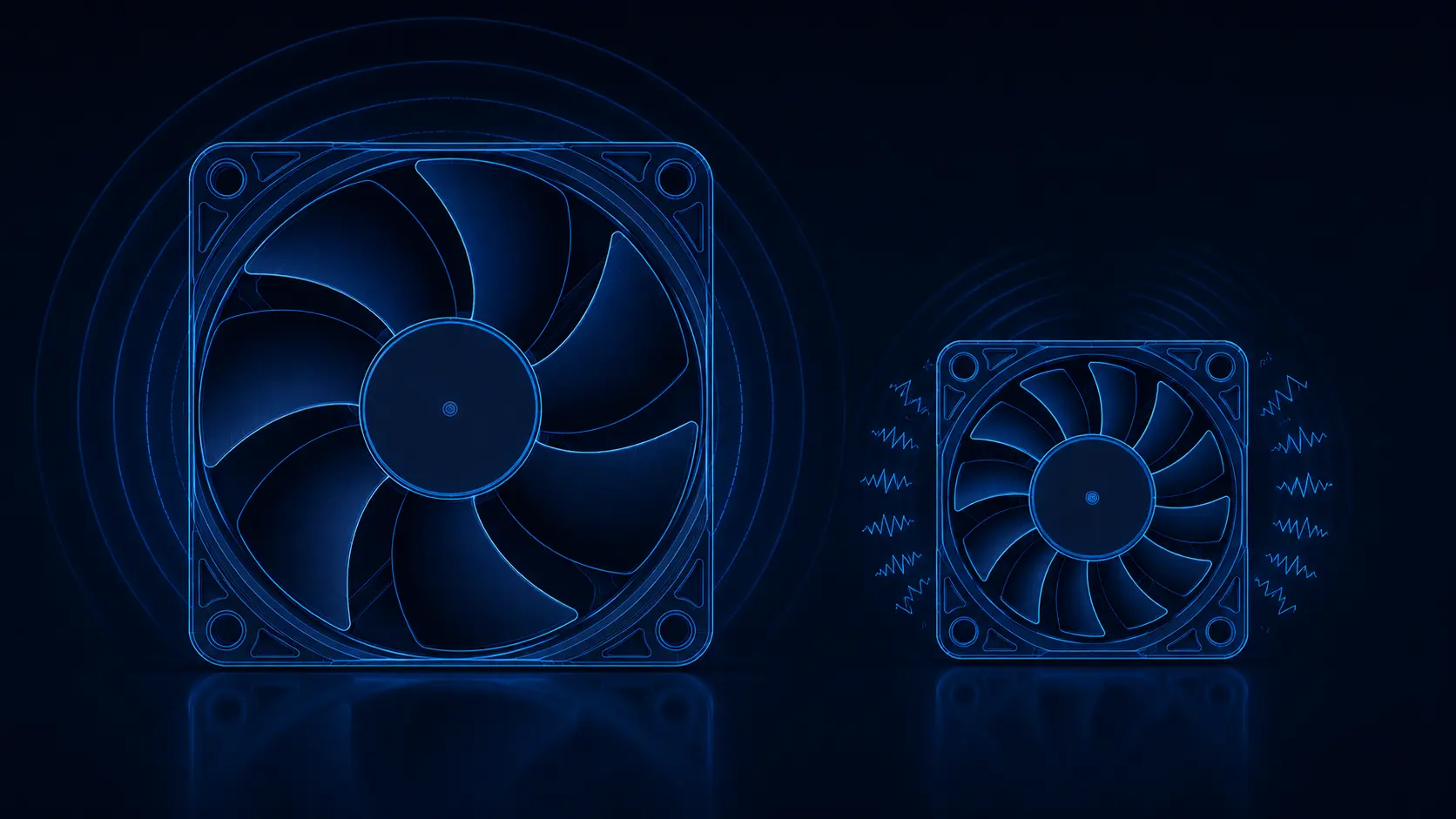
A larger, low-RPM fan is almost always the quieter answer for equal airflow; the constraint is almost always whether the enclosure has room for it.
| What they changed | Why it helped | Result |
|---|---|---|
| PWM speed control with temperature feedback | Runs at minimum speed that still meets thermal need | Visible noise drop at idle and night-time duty |
| Larger, lower-RPM fan | More airflow at lower blade-passing frequency | Quieter at equal cooling |
| Lower system impedance (smoother duct, more vent) | Less pressure drop, so the fan stays slower | Recovered audible margin immediately |
| PWM strategy + soft-start ramp | Reduces the risk of switching and power-up tones | Must be verified in the final enclosure |
The second unit did not fail — it faded
The teardown of the warm-running pump found a fan that was technically alive: spinning, reporting a tachometer signal, and moving perhaps two-thirds of its airflow.
This is the failure class bench tests rarely catch and wards teach the hard way. Overt failures — a stopped rotor, a dead drive — announce themselves. Hidden failures creep: bearing wear and lubricant degradation slow the fan, airflow decays, the tachometer signal stays inside its allowed window, and no alarm fires while the electronics inside spend months under chronic heat stress. On the ward, the 'alarm' was a nurse noticing the surface was warm — a detection method no risk file should rely on.
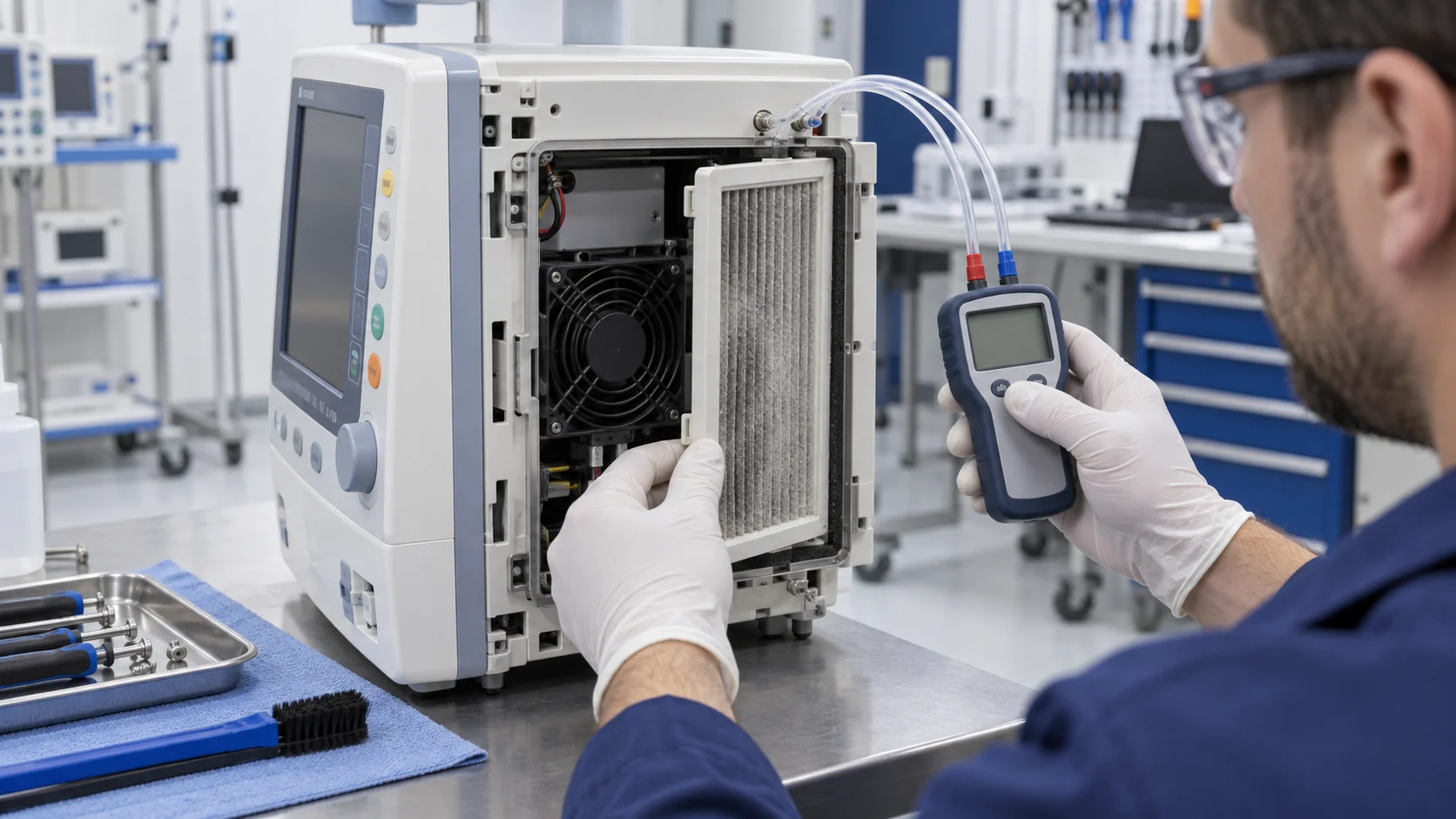
The ward environment accelerates every step of that decay. A hospital is not a clean room: dust loads the filter and raises system pressure, disinfectant gases and humidity attack bearings and windings, and daily cleaning wipes put agents on the housing that the datasheet never contemplated. A fan selected from its day-one curve at 25°C in filtered air is being graded against a world that does not exist.
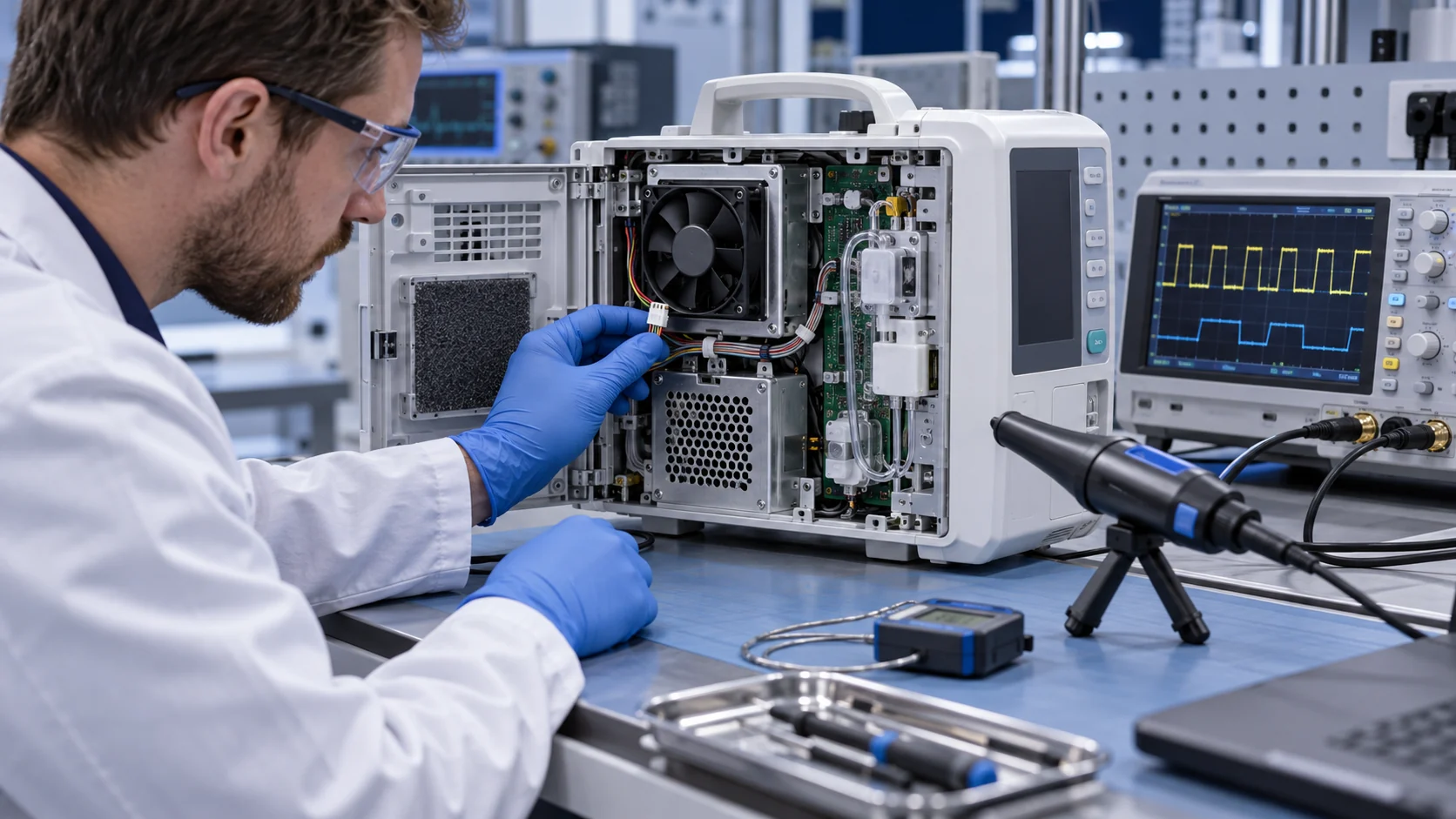
What the team added was a validation plan that treats decay as a first-class failure mode: high-temperature continuous burn-in, PWM control simulated exactly as the firmware will run it — because aggressive cycling and very low speeds shorten bearing life in ways a catalogue curve never shows — and airflow-decay trend monitoring over life rather than a single handover measurement.
The design team then changed the alarm logic to match. A stopped-fan alarm fires on the failure everyone already fears; the failure that actually reaches the ward is underspeed — a fan still spinning below its expected health envelope. Detecting that required the tachometer signal to be supervised against a trend, not just a presence check.
Picking the fan the pump actually shipped with
With a dBA budget set at the patient's distance and a need for a fan that stayed under it while pushing air through a restrictive interior, the team's shortlist came down to the larger low-speed axials in the 48 V line — not because they were the quietest on paper, but because they hit the operating point with margin to spare.
For a bedside device whose whole job is not being noticed, the 92 mm class can be a useful candidate: enough blade area to run slowly while remaining compact enough for many plastic interiors. The 80 mm option may be preferable in a tighter chassis where footprint matters more than peak airflow; both choices must be checked against the installed pressure, noise and thermal curves.
What got rejected told the real story — fans that looked quiet at free air but stalled the moment they met the chassis's impedance, forcing a speed-up that blew the acoustic budget. Selection in medical gear is about the operating point in your box, not the datasheet's best case.
- MG9225L48X — 92×92×25 mm, 48 V, ~31.9 CFM at 2.0 mmH2O, 27.5 dBA: the bedside pick, quiet at a slow operating point.
- MG8025L48X — 80×80×25 mm, 48 V, ~19.2 CFM at 1.8 mmH2O, 25.0 dBA: quieter still, and fitting tighter layouts where portability rules.
- Confirm PWM, tachometer/fault feedback and the operating-temperature range with engineering so the operating point and the IEC 60601 documentation line up.
- Do not pick by decibel rating alone — measure those decibels at the speed the fan actually runs inside your cabinet.
Redundancy and a fault signal the nurse can see
The quietest fan in the world is still a single point of failure, and the ward's second unit taught the team why that matters. A fan that stops without raising an alarm can let an accessible surface or essential function move toward its defined safety limit — a silent, undocumented thermal event right where a patient's hand may rest.
The fix was a design layer, not a part swap. They ran the cooling in N+1 for the life-sustaining models, so one fan stopping left the interior within temperature. And they wired a tachometer/fault output to the device's own supervision, so a stalled or slowing fan brought up a message on the clinical screen instead of letting heat creep upward unobserved.
One warning from the ward shaped how that alarm was designed: alarm fatigue is a documented patient-safety concern. A fan alarm should therefore have a defined threshold, a specific message, a severity appropriate to the device risk and a clear route to the responsible staff. The pump's underspeed alarm was supervised against the expected health envelope rather than only checking whether a tachometer pulse existed.
The supplier relationship mattered just as much as the electronics. Medical products can have long service lives, so the fan vendor should agree on availability planning, lot traceability for critical materials and advance notice of design or process changes. These controls belong in the device quality relationship from the start, not after the first field failure.
A sample must be tested in the device, not only on the bench
For medical equipment, the fan is part of the enclosure, acoustic path and risk file. A catalogue number alone is not a validation result.
MEGA Tech can support medical product teams by turning the actual device requirement into a production-representative fan sample. We review the enclosure space, heat source, airflow resistance, target dBA at the user's position, voltage, PWM range, feedback signal, mounting orientation, cleaning environment and expected service life.
When the standard model is not a complete fit, we can adjust the application around the fan: lower-speed operation, airflow and pressure margin, bearing selection, PWM response, FG or fault output, connector, cable length, material and mounting details. Startups and smaller medical-equipment teams can evaluate a limited sample build while the enclosure and firmware are still changing, rather than committing early to an inflexible high-volume order.
The sample is then tested in the actual device or a representative fixture for noise spectrum, temperature rise, airflow, vibration, fault response and continuous duty. After the team confirms the result, the approved configuration can be transferred into reliable, traceable production with the component information needed for the device's own verification and regulatory process.
- Set the acoustic and thermal target at the installed device, not from free-air fan data.
- Develop the fan, enclosure and control response together.
- Validate a production-representative sample before finalizing the device.
- Carry the approved configuration into reliable, traceable production.
Engineer FAQ: Medical Fan Reliability and Silent Failure
Medical cooling must be evaluated as part of the device safety function, not as an isolated fan replacement.
Q: Does a fan that is still spinning prove that cooling is healthy? A: No. A worn or restricted fan can remain tachometer-active while airflow falls. Compare speed, current, noise, temperature and installed airflow against a healthy baseline, and define the response to underspeed or airflow loss.
Q: What does IEC 60601-1 decide for the fan? A: It applies to the medical electrical equipment and its basic safety and essential performance. The device manufacturer must determine the applicable edition, particular standards, accessible-surface conditions and risk controls; a fan label alone does not establish compliance.
Q: Should medical fan noise be specified only in dBA? A: Not for a patient-facing device. Measure at the relevant patient or operator position, at the actual operating point and duty cycle, and review tonal or vibration components as well as the overall A-weighted level.
Q: Is L10 a guaranteed service interval? A: No. L10 is a population reliability measure tied to stated temperature, speed, mounting, load and test conditions. Use it with field data, fault monitoring and the device risk analysis rather than treating it as a replacement date.
Q: What should be tested before approving a medical fan sample? A: Use the representative enclosure and control firmware to check thermal performance, noise spectrum, vibration, hot operation, start-stop duty, fault or FG/RD behavior, cleaning exposure and accessible-surface temperature under the device's defined single-fault conditions.
- Tie every numerical answer to voltage, speed, temperature, mounting and test condition.
- Separate catalogue maximums, engineering estimates and measured application results.
- Use the FAQ to define the next measurement or sample-validation step.
What the design scenario changed, and what it stopped assuming
The prototype would go back to the bench as a different product: the same nominal CFM at a slower operating point, two fans for critical models, a fault signal visible to supervision, and alarm logic that watched for underspeed rather than only stalling. The documentation would finally include the failure mode that the original bench test had missed.
Here is the honest takeaway for anyone specifying a cooling fan in a medical device, the one this whole teardown keeps coming back to: nobody opens a datasheet on a quiet night shift. They open a room where a patient is trying to sleep, and they open a risk file that has to survive an audit.
Start with a decibel number and a spectrum measured at the patient's distance and at the fan's real operating point, then check the surface-temperature path with the fan stopped, then design for the failure that fades rather than fails — and add the redundancy and the alarm that stays worth hearing. Only then talk to a supplier about bearings and material change notifications. Get that order right and the quiet, reliable fan you need is the one you pick — not the one you hoped for.