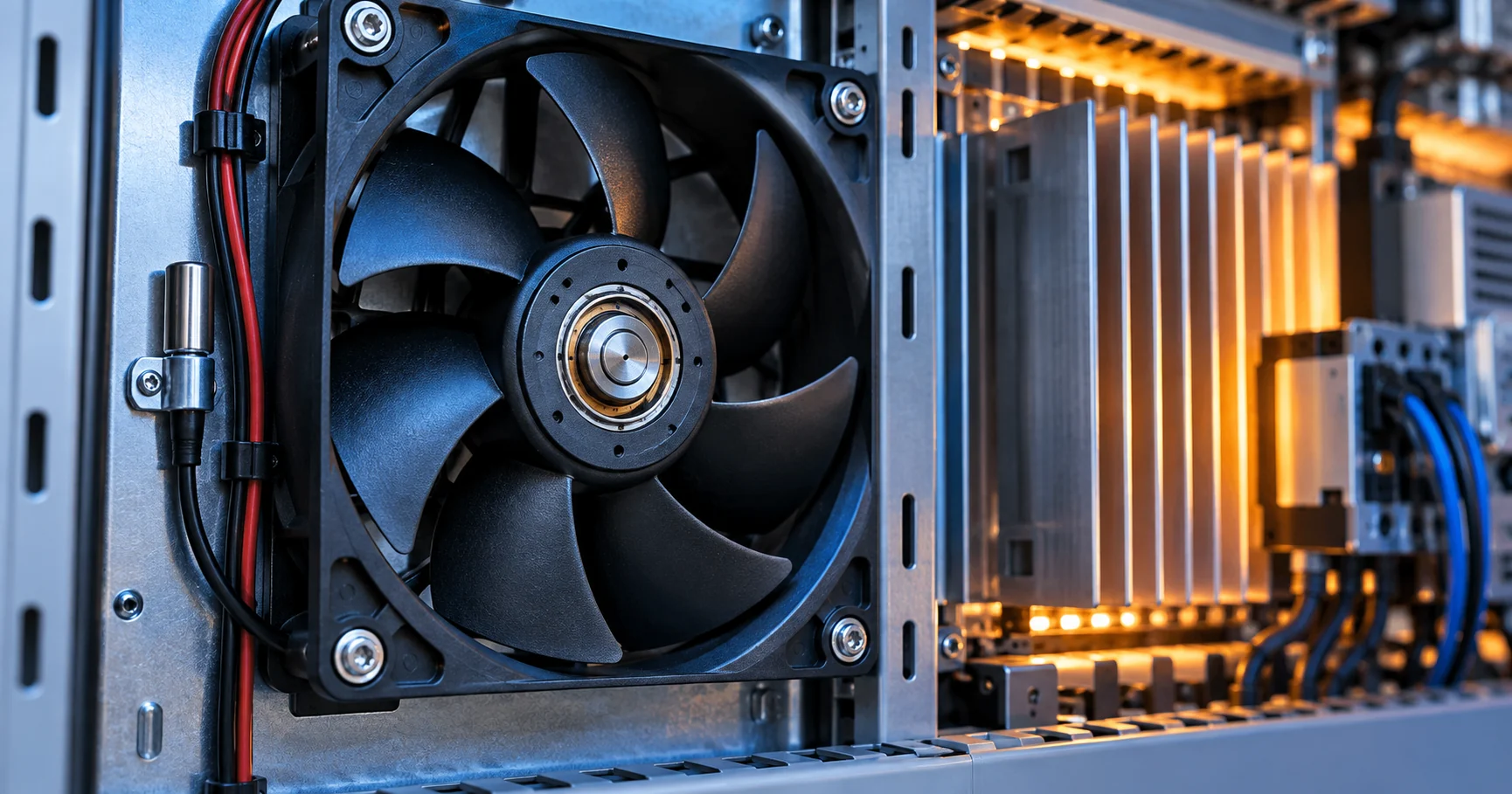
Cooling Fan Bearings: Sleeve vs Ball — Life, Noise, Temperature, and Replacement Planning
A fan can have the correct frame size, voltage, airflow and static pressure while its bearing choice still determines whether the equipment remains quiet, stable and serviceable after years of operation.
Sleeve bearings, ball bearings and magnetic or hydrodynamic bearing systems behave differently under temperature, orientation, vibration, contamination and repeated starts. They also produce different kinds of evidence. A catalogue may show L10 life, expected life, MTBF or a simple operating-hour value, but these terms do not describe the same thing.
For procurement and maintenance engineers, the practical question is not which bearing is always best. It is which bearing system matches the fan's real temperature, speed, orientation, noise target, operating duty and replacement plan. A fan behind a loaded filter or heat sink is a different mechanical and thermal duty from a fan running in free air.
This article is about the decision between bearing families and the maintenance plan that follows. It does not create a universal life rating or a MEGA Tech product guarantee. Use the selected model's evidence, the approved equipment requirement and representative samples.
1. Start with the installed duty, not the bearing label
Before selecting a fan, record the airflow required at the actual static pressure, supply voltage and tolerance, speed or PWM range, start-stop frequency, fan inlet temperature, mounting orientation, vibration and shock exposure, contamination, noise target, service accessibility and expected operating hours.
The same bearing construction can perform differently in a clean laboratory and in a loaded industrial cabinet. A sleeve-bearing fan mounted in a cool, horizontal-shaft application may be acceptable for a small device. The same construction may be a poor choice inside a hot enclosure with a vertical shaft, frequent restarts and limited service access.
The fan also needs to be evaluated at its operating point. A free-air airflow value does not describe airflow through a filter, grille, heat sink and restricted outlet. That installed pressure changes speed, current, self-heating, noise and bearing duty. Review the fan bearing type selection guide and the fan lifetime and bearing guide alongside the equipment requirement.
For maintenance planning, write the duty in the same language used by purchasing, test and service. For example, do not record only continuous operation; record whether the fan runs continuously at one command, starts after every power cycle, changes speed with load, or remains stopped while the enclosure is hot. A bearing comparison that loses this information can select the wrong construction even when the catalogue fields appear complete.
2. Sleeve, ball and magnetic bearing systems are not interchangeable
A sleeve bearing supports the shaft through a lubricated sliding surface. It can be compact, quiet and cost-effective in a suitable application. Its limits are usually related to lubrication, orientation, temperature, start-stop duty and contamination. Temperature can reduce lubricant viscosity and accelerate evaporation or oxidation. A sleeve-bearing fan should therefore be reviewed with its shaft orientation, temperature range, vibration and actual life evidence visible.
A ball-bearing fan uses rolling elements between races. It is often considered when the application requires broader mounting flexibility, continuous operation, higher temperature capability or a particular service duty. Ball bearing is not a complete specification: grease, seals or shields, preload, speed, radial and axial load, noise and vibration still need to be checked.
Magnetic, MagLev, hydro and hydrodynamic are not interchangeable words. Some compact fans use magnetic stabilisation with a fluid or sleeve-like support; fully active magnetic bearings are a different technology. Ask how the shaft is supported while stopped, during startup and during running, what happens after power loss, what orientation is allowed, and what complete-fan test produced the life number.
No bearing name is a universal ranking. The device duty decides the choice.
| Bearing family | Possible strengths | Questions to verify | Decision basis |
|---|---|---|---|
| Sleeve | Compact and often quiet when new | Orientation, lubricant, temperature, starts and actual life evidence | Controlled duty and service access |
| Ball | Established rolling-bearing method and broader mounting options in many designs | Grease, preload, noise, speed, temperature and seals | Complete-fan evidence at the operating point |
| Magnetic or hydrodynamic | Low sliding contact during running in some constructions | Exact architecture, startup support, orientation, temperature and failure mode | Supplier definition plus representative validation |
3. What L10 life really means
For a population of nominally identical rolling bearings operating under stated conditions, L10 is the life at which 10% of the population is expected to have failed from the defined failure mechanism. In other words, 90% are expected to reach or exceed that life. It is not a guarantee that every individual fan will reach the number, a fixed replacement date, the life of the complete equipment, or a valid value at every temperature and speed.
A supplier may define failure as excessive noise, loss of speed, loss of airflow, locked rotor, electrical failure or a bearing-related mechanical limit. The definition must be read together with the number. A useful statement identifies the fan model and revision, bearing type, voltage, speed or control state, temperature, humidity, mounting orientation, operating point, test method and failure criterion.
Keep MTBF separate. MTBF and L10 answer different statistical questions. A large MTBF value cannot replace bearing-life data unless the supplier explains the population, failure distribution, temperature, speed and definition. The SKF bearing-life reference helps separate rolling-bearing fatigue life from grease life, which can be the limiting mechanism in a compact fan.
4. Temperature changes life, but there is no universal 10°C rule
Engineers often ask whether lowering temperature by 10°C doubles fan life. The honest answer is that a supplier's model may use a factor close to that, but there is no universal multiplier for every fan, grease, bearing or operating condition. Different approaches may be based on grease oxidation, lubricant evaporation, bearing fatigue, accelerated testing, fan-maker empirical data or electronics temperature limits.
Some published models use a factor around 1.5 or 2 for a 10°C step under defined assumptions. If a particular supplier has validated a 1.5 factor and the reference life is 20,000 hours, the model would estimate 30,000 hours after a 10°C reduction and 45,000 hours after a 20°C reduction. That is an illustration of a declared model, not a universal fan rating. Another model may use a factor of 2, producing a different result.
Measure fan inlet air, outlet air and bearing-adjacent temperature where practical. The fan may sit downstream of a heat sink, beside a power supply or against a hot panel. Its internal bearing temperature can exceed inlet air temperature. Reducing temperature is usually an effective reliability improvement, but the numerical benefit should come from an accepted model or testing.

5. Noise differences between bearing families
Noise is not only an aerodynamic problem. A fan can produce broadband airflow noise, blade-passing tones, motor commutation noise, bearing rumble, rotor imbalance, panel-transmitted vibration and intermittent click or scrape during wear.
Sleeve bearings can be acoustically smooth when new, especially at lower speeds. As lubricant condition changes or shaft clearance increases, the fan may develop rubbing, rattling or low-frequency roughness. Ball bearings may have a different mechanical character at the beginning of life, while a worn bearing may produce rumble or periodic noise. Magnetic or hydrodynamic systems may reduce some contact noise during running but do not remove commutation, blade-pass, imbalance, mounting or airflow noise.
Compare candidates at the same installed operating point. Define sound pressure or sound power method, measurement distance, weighting, speed, voltage, mounting, grille, filter, background-noise limit and whether a frequency spectrum is required. The NMB fan engineering reference is useful background, but the final acceptance method belongs to the equipment.
6. Mounting orientation can change the decision
The fan's physical position is not enough; what matters is the shaft angle. A fan on a vertical cabinet wall normally has a horizontal shaft. A fan on the base or roof may have a vertical shaft. Those installations can place lubricant and bearing load in different conditions.
Sleeve systems are often more orientation-sensitive because the lubricant film depends on shaft support and distribution. Ball systems may provide broader orientation flexibility, but the selected fan drawing and specification remain the authority. For any replacement review, document shaft direction, airflow direction, mounting plane, fastener preload, bracket stiffness, gasket compression, cable routing and nearby vibration sources.
Orientation can also alter the acoustic result. A flexible panel may amplify vibration in one position and suppress it in another. A cable may touch the frame only after the fan is rotated. A gasket may compress unevenly, changing leakage and vibration. Matching mounting holes is not a complete installation approval.
7. How to read a bearing life specification sheet
A procurement review should ask six questions. What does life mean: L10, expected life, MTBF, MTTF or a service recommendation? What is the failure criterion? Is temperature ambient air, inlet air, bearing temperature or chamber condition? At what speed and voltage was the value established? In what orientation? Does the number apply to the complete fan or only to a bearing component?
The Oriental Motor service-life guidance illustrates why service life must stay connected to operating conditions. Record the selected model, revision, bearing construction, voltage, control state, temperature, mounting, operating point, test method and evidence location. If a required value is missing, mark it for sample measurement rather than inferring it from another model.
Do not merge a manufacturer's life figure with your own estimate without labeling the difference. Catalogue data, engineering estimates and measured application results should remain separate in the approval record.
8. When should a fan be replaced proactively?
Waiting until a fan locks can be reasonable for a low-consequence device with easy access and no thermal risk. It is a poor strategy when one failed fan can cause equipment shutdown, data loss, product scrap, safety alarm, emergency service, customer-site travel, long replacement delays or secondary component damage.
A planned replacement policy should consider failure consequence, detectability, service access, environmental severity and replacement confidence. Can FG, RD, current, speed, temperature, acoustic or vibration trend detect degradation early? Is an approved replacement already validated, or would a new qualification be needed? The priority is determined by the equipment risk, not by fan price.
Maintenance timing should also consider the cost of an unplanned engineering change. If the original fan is discontinued, the team may need to recover drawings, confirm the connector, repeat an acoustic check, inspect the controller response and run an installed thermal test before a replacement can be released. Starting the review before the field stock is exhausted can be more valuable than buying a larger quantity of an unvalidated spare.
A simple decision model can compare strategies. Let Cplanned be planned labour and parts cost; Cfailure be emergency labour, downtime, logistics, collateral damage and customer cost; Pfailure be the probability of failure in the interval; and Cmonitoring be inspection and trend cost. Waiting has an expected cost of Pfailure × Cfailure + Cmonitoring. Planned service has Cplanned + Cmonitoring + residual risk. These are decision inputs, not a reliability prediction.
Do not schedule every replacement at the L10 value as if all fans fail together. Combine life evidence with temperature history, speed duty, alarms, field failures, service access and approved spares.
| Input | Question | Evidence to keep |
|---|---|---|
| Failure consequence | What stops or overheats if the fan fails? | Downtime, safety and equipment-risk assessment |
| Detectability | Can degradation be seen before a thermal failure? | FG/RD, speed, current, temperature, acoustic or vibration trend |
| Service access | Can the fan be replaced without major disassembly? | Work instruction and service time |
| Environment | What heat, dust, moisture and vibration reach the fan? | Measured or defined field condition |
| Replacement confidence | Is a compatible, validated spare available? | Approved model, revision and sample evidence |
9. Spare strategy and replacement validation
A spare is useful only if it is identifiable, compatible and stored correctly. The spare plan should define the approved model and revision, bearing construction, connector and pinout, voltage and control method, airflow direction, mounting orientation, storage conditions, lot traceability, application approval and revalidation trigger.
Do not allow purchasing to replace a fan by matching only frame size and voltage. A candidate should be checked at the equipment's operating point and, where necessary, sampled in the actual unit. Revalidation is especially important when the bearing type, supplier, connector, speed range, operating temperature or application changes, or when a new filter, grille or heat sink is added.
Use the cooling fan sample validation checklist to structure the sample review. For lifecycle cost and service planning, see Cooling Fan Obsolescence and Lifecycle Management and Cooling Fan Total Cost of Ownership.
10. MEGA Tech custom fan development and scope boundary
MEGA Tech develops and manufactures custom cooling fans through fan selection, air-path review, sample validation and volume production. For a bearing and replacement review, provide fan size and envelope, airflow and static pressure at that airflow, voltage and tolerance, speed-control method, FG/RD needs, bearing preference, shaft orientation, inlet-air temperature, noise target, vibration, environment, quantity and existing approved baseline.
We can compare sleeve, ball and other bearing configurations against the operating duty, review the installed air path, support sample validation in the customer's equipment and carry the approved configuration into repeatable production. Selection is based on the operating condition and assembly, not on a part number or matching outline dimensions.
We are the custom cooling-fan manufacturer. The system integrator or equipment owner remains responsible for the complete equipment, cabinet, coil, liquid loop, controller, electrical protection and system safety design. We do not supply complete Fan Wall cabinets, RDHx units or coils.
For a bearing recommendation, send the fan size, voltage, airflow, static pressure, operating temperature, mounting orientation, quantity, control interface and application environment through the MEGA Tech products catalogue or contact the engineering team.
11. Engineer FAQ
Q: Is a ball-bearing fan always better than a sleeve-bearing fan? A: No. Ball bearings may provide broader mounting flexibility or better suitability for certain continuous duties, but noise, temperature, grease, vibration, cost and selected-model evidence still matter.
Q: Does a magnetic bearing eliminate bearing wear? A: Not necessarily. Magnetic may describe several compact-fan constructions. Ask how the shaft is supported while stopped, during startup and during running, and what the complete-fan test actually measured.
Q: Does lowering temperature by 10°C double fan life? A: There is no universal multiplier. Some published models use factors near 1.5 or 2 per 10°C under defined assumptions, while other products use different methods.
Q: Is L10 the date when the fan must be replaced? A: No. L10 is a population statistic under stated conditions. It informs maintenance planning but is not a synchronized failure date.
Q: Can MTBF replace L10 in a maintenance plan? A: No. MTBF and L10 describe different statistical concepts and must remain tied to their definitions and test conditions.
Q: Which bearing type is quietest? A: There is no universal answer. Compare candidates at the same installed operating point and measure the spectrum when tonal noise matters.
Q: When should an equipment maker plan replacement? A: When failure consequence is high, service access is difficult, field evidence shows degradation, or an approved replacement requires qualification time.
12. Questions for a Design Review
- What airflow and static pressure define the installed operating point?
- What temperature does the fan bearing actually experience during the worst condition?
- Is the life value L10, MTBF, MTTF, expected life or another metric?
- What failure criterion is behind the life number?
- Which bearing construction is used, and how is the shaft supported during startup?
- What shaft orientation and mounting condition were used for the life evidence?
- Does the fan operate continuously, intermittently or with frequent starts and stops?
- What noise spectrum and vibration behaviour are acceptable in the finished equipment?
- Can FG, RD, current, temperature or acoustic trend detect degradation before thermal failure?
- What is the approved replacement model, revision, connector and application boundary?
- What is the cost and operational consequence of waiting for a field failure?
- Has the candidate replacement been validated in the actual customer assembly?