The Replacement Fan Fit the Cut-Out but Missed the Cabinet Duty
An anonymized European automation integrator needed to replace a branded cooling fan in a VFD and UPS control cabinet used near a dusty production line.
The existing fan had the correct frame size and voltage, but the replacement candidate was selected from free-air CFM. After the filter, louver, cable ducts and drive heatsink were installed, the cabinet temperature rose during the longest motor cycle. The fan was turning at the expected speed; the useful airflow at the limiting component was not.
MEGA Tech reviewed the customer's cabinet sample, heat-load list, fan opening, filter, voltage, alarm signal, control method and service interval. The objective was a validated replacement sample with the same mechanical envelope but a verified installed operating point, not a promise that equal dimensions automatically mean equal performance.
The customer identity and released acceptance values remain confidential. The case below separates illustrative engineering estimates from the measurements the integrator must repeat before approving a production BOM.
The Engineering Hook: VFD Losses Become Cabinet Heat
The cabinet fan is not cooling the motor load directly; it is removing the electrical losses released by the drive, power supply, braking circuit and control hardware.
Drive manufacturers publish heat dissipation data under defined operating conditions. The enclosure designer must combine those losses with the allowable internal-to-ambient temperature rise, solar or process heat where relevant, and the actual airflow path. Schneider guidance, for example, distinguishes the drive's own forced losses from the enclosure cooling duty; the cabinet calculation should use the heat that remains inside the enclosure.
For an illustrative 600 W cabinet heat load and a 15 K allowable air rise, Qv = P/(rho x cp x deltaT) gives approximately 0.033 m3/s, or about 70 CFM, before filter fouling, altitude and airflow nonuniformity. If the selected fan delivers only 52 CFM at the installed pressure, the simplified average rise increases to about 20 K. These are planning estimates, not component limits or customer measurements.
The first purchasing question should therefore be: what airflow does the fan deliver through the actual filter and cabinet resistance? The second is: can the fan maintain that duty at the highest ambient and the end-of-service filter condition?
The Problem in Operation: The Filter Changed the Fan Curve Intersection
The old fan and the replacement candidate both looked acceptable in a clean test, but the cabinet resistance increased as the filter loaded.
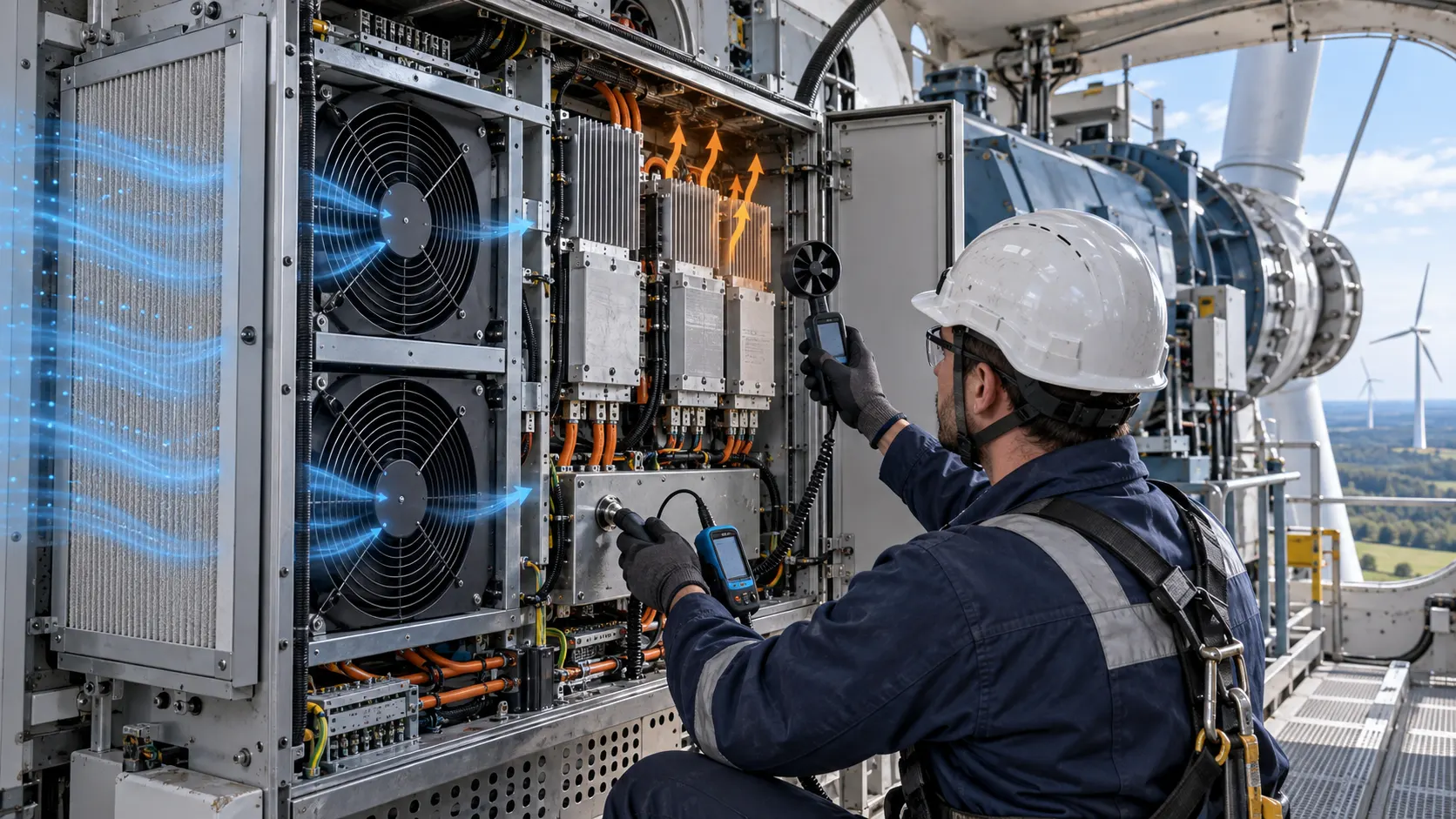
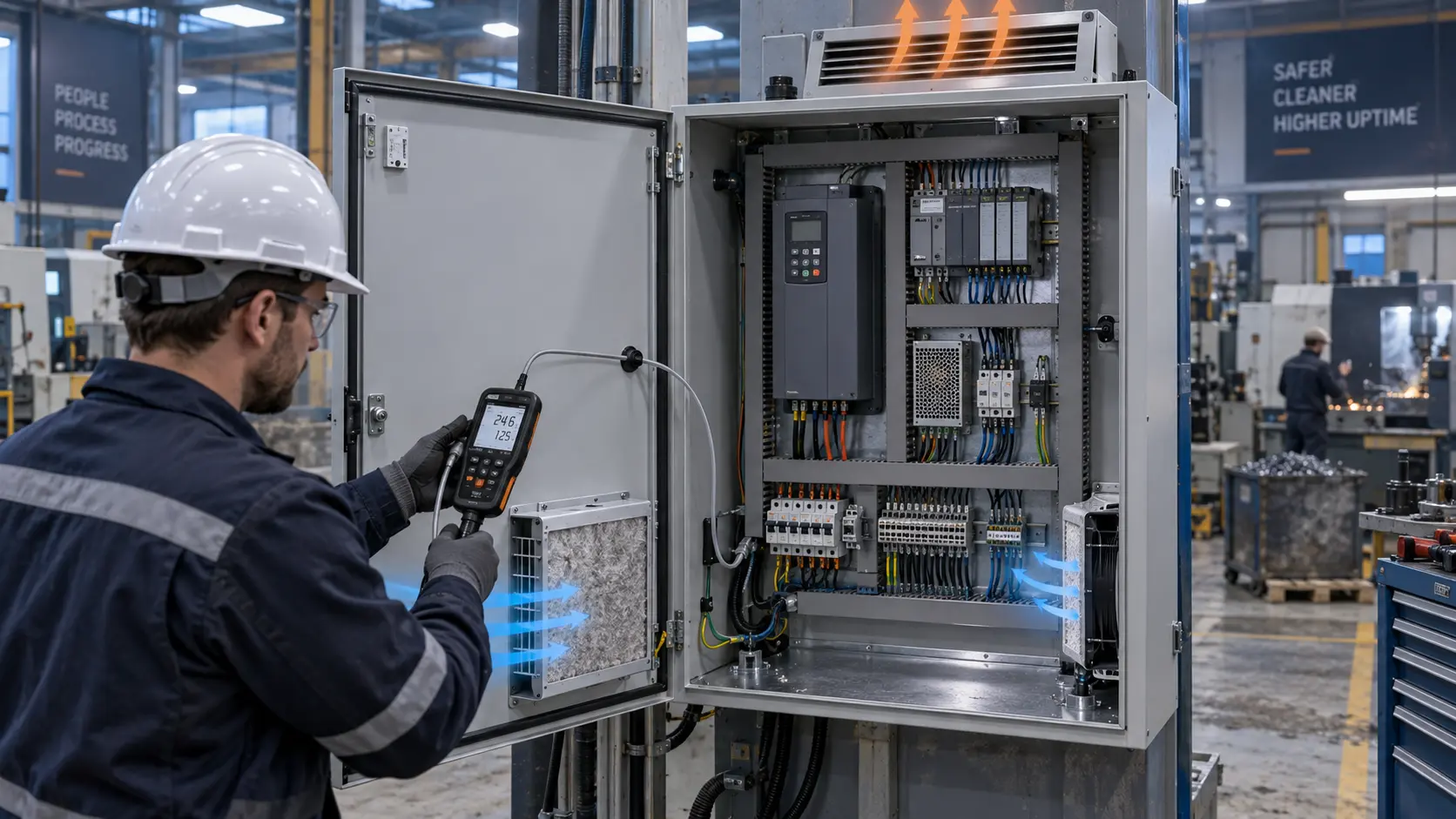
The integrator measured pressure before and after the filter, at the fan inlet, near the drive heatsink and at the exhaust louver. Temperature probes were placed at the drive air inlet, DC-link area, control power supply and cabinet outlet. This showed that a normal RPM signal could coexist with a lower delivered flow when the filter became restrictive.
The negative-pressure prototype also pulled dusty shop air through door seams and cable entries. The sample review compared filtered pressurization with exhaust operation because pressure direction changes contamination risk. A positive-pressure approach can reduce unfiltered ingress when the leakage path is controlled, but it does not remove the need for a suitable filter, outlet and service plan.
The service limit was therefore tied to differential pressure, component temperature and delivered airflow rather than a calendar interval alone. The maintenance team could see when the filter was consuming the fan's available pressure margin.
Interactive: Watch the Cabinet Move From Clean to Loaded Duty
The animated schematic shows why the same PWM command and RPM do not guarantee the same cooling result.
The figure is qualitative, not CFD or a performance curve. In the clean state, the fan has pressure margin. As the filter loads, the system curve rises and the operating point moves to lower airflow. Increasing PWM may recover part of the flow, but the controller must check current, noise, bearing temperature and remaining voltage margin.
The test sequence used clean filter, loaded filter at service limit, reduced fan command, maximum drive duty and restart after a power interruption. Each state recorded fan voltage, current, PWM, RPM or FG, pressure drop, equipment inlet temperature and acoustic behavior. The failure alarm was checked separately from the speed signal.

Sample 01: Match the Replacement to the Installed Pressure
MEGA Tech compared the original fan and candidate samples at the cabinet's real resistance instead of comparing catalogue maximum airflow.
The customer supplied the existing fan model, mounting drawing, connector, wire length, supply tolerance, filter area, louver and available depth. The sample review considered DC axial and compact blower directions, bearing options for horizontal mounting, temperature rating, PWM response, FG feedback and locked-rotor alarm behavior.
A simple pressure example makes the selection issue visible. If the filter, grille and heatsink path create 90 Pa at 70 CFM, the replacement must deliver approximately 70 CFM at 90 Pa. A model advertising 100 CFM at zero pressure may deliver substantially less at that installed point. The actual P-Q curve and assembled test must decide.
The mechanical review also checked connector retention, fan guard, cable routing, vibration transfer, service-panel clearance and whether the fan could be changed without disturbing the VFD or UPS wiring. Same outline dimensions were treated as a starting constraint, not an equivalence claim.
Sample 02: Tune PWM, FG and Thermal Derating
The integrator wanted normal operation to stay quiet and efficient while retaining a controlled response for high drive duty and filter loading.
The control curve used a minimum command for the drive electronics, a normal operating band and a high-temperature response. Hysteresis prevented rapid cycling near the threshold. FG feedback confirmed that the fan was rotating, while differential pressure and the limiting component temperature indicated whether useful flow remained.
The electrical tradeoff was documented. A 24 V fan drawing 0.45 A uses about 10.8 W. At a high-temperature command of 0.75 A, the same fan uses about 18 W. Those are illustrative arithmetic checks; the selected fan's measured current and control response must replace them in the release file.
The replacement sample was compared with the original fan under the same voltage, filter condition and drive load. The team did not accept a lower acoustic result if it came from lower airflow, nor a higher airflow result that exceeded the cabinet power or noise budget.
Sample 03: Validate Dust, Vibration and Long-Duty Reliability
An industrial cabinet fan can fail from contamination, heat, bearing stress or vibration even when its room-temperature airflow looks good.
The test included the cabinet's intended orientation, the hottest expected ambient, repeated motor cycles and the loaded filter state. The fan inlet temperature, electronics temperature and restart behavior were recorded. Where oil mist, coolant or conductive dust was present, the enclosure integrator defined the complete protection and cleaning method rather than treating the fan rating as the whole environmental qualification.
Acoustic testing separated broad airflow noise, motor tone and structure-borne vibration through the cabinet panel. The team checked whether a new fan's blade-pass frequency interacted with the panel or heatsink. Long-duty operation was then used to verify that the control curve did not keep the fan unnecessarily at maximum speed.
For procurement, the useful result was a comparison package: original fan at installed duty, candidate sample at installed duty, current, pressure, temperature, sound, alarm behavior and service assumptions.
Validation Result: A Brand-Alternative Sample Became a Measured Replacement
The final sample preserved the cabinet envelope while making airflow, pressure and maintenance limits visible to the integrator.
The transferable result was not a universal replacement promise. It was a controlled substitution method. The alternative fan had to meet the actual operating point, electrical interface, feedback behavior, mounting and environmental assumptions in the customer's cabinet. The filter service state was included in the comparison.
The release package documented the fan P-Q curve, voltage range, PWM/FG/RD behavior, current, noise test condition, bearing and life assumption, mounting drawing, filter pressure-drop limit and the boundary between fan qualification and cabinet qualification.
This is where a custom supplier can be more useful than a catalogue-only transaction: adjust the fan or motor behavior, build a small sample, test it in the customer's cabinet and only then discuss production replacement quantities.
How MEGA Tech Supports VFD, UPS and Control-Cabinet Fan Customization
MEGA Tech evaluates replacement and custom fan options around the customer's cabinet, pressure target, control interface and service environment.
We can review 12 V, 24 V or 48 V fans, axial or compact blower options, PWM and FG/RD signals, connector and lead-wire details, bearing and life targets, filter pressure drop, high ambient, dust or oil-mist exposure, acoustic limits and small first-build quantities. We can also evaluate alternatives to Sanyo Denki, SUNON, Delta, NMB, ebm-papst and other installed brands when the real operating point is available.
Please provide the cabinet heat load, allowable temperature rise, ambient range, filter and grille pressure drop, fan cut-out, voltage tolerance, control interface, noise target, mounting direction, service interval and quantity. If the data is incomplete, send the current fan part number, cabinet photos and any measured pressure or temperature points.
Our scope is fan and air-path engineering, sample customization and comparative validation. The cabinet builder and drive supplier remain responsible for final electrical safety, EMC, enclosure protection, heat-sink design and machine qualification.
Engineer Questions About This VFD and UPS Case
Use these questions before approving a replacement fan for a drive or UPS cabinet.
Q: Can I replace a fan because the frame and voltage match? A: Not by those two values alone. Confirm airflow at installed pressure, current, control signals, mounting, temperature rating and service condition.
Q: Does RPM prove the fan is cooling the drive? A: No. Filter loading, bypass leakage and poor internal distribution can reduce useful airflow while RPM remains normal.
Q: Should the cabinet use positive pressure? A: It can reduce unfiltered dust ingress when designed with the correct filter and exhaust path, but the enclosure and contamination strategy must be qualified as a complete system.
Q: What should I send for a brand-alternative review? A: Send the current part number, P-Q curve if available, fan size, voltage, PWM/FG/RD requirements, heat load, pressure path, ambient, filter condition, noise target and quantity.
Q: Can MEGA Tech provide a custom specification and sample? A: Yes. We can review the operating point, modify the sample requirements, build a small quantity and compare it in the customer's cabinet before production release.
Need a Replacement Fan or Custom Specification?
Send the current fan model, cabinet heat load, installed pressure path, voltage, control interface, quantity and environmental constraints. MEGA Tech will review the operating point before recommending a sample.
Start with the product information page, or contact a MEGA Tech engineer directly. Include the cabinet drawing, filter data, photos and any clean-filter or loaded-filter measurements. This helps separate a fan replacement issue from a filter, louver, wiring, heatsink or cabinet-layout issue before the production BOM is locked.