The engineering problem
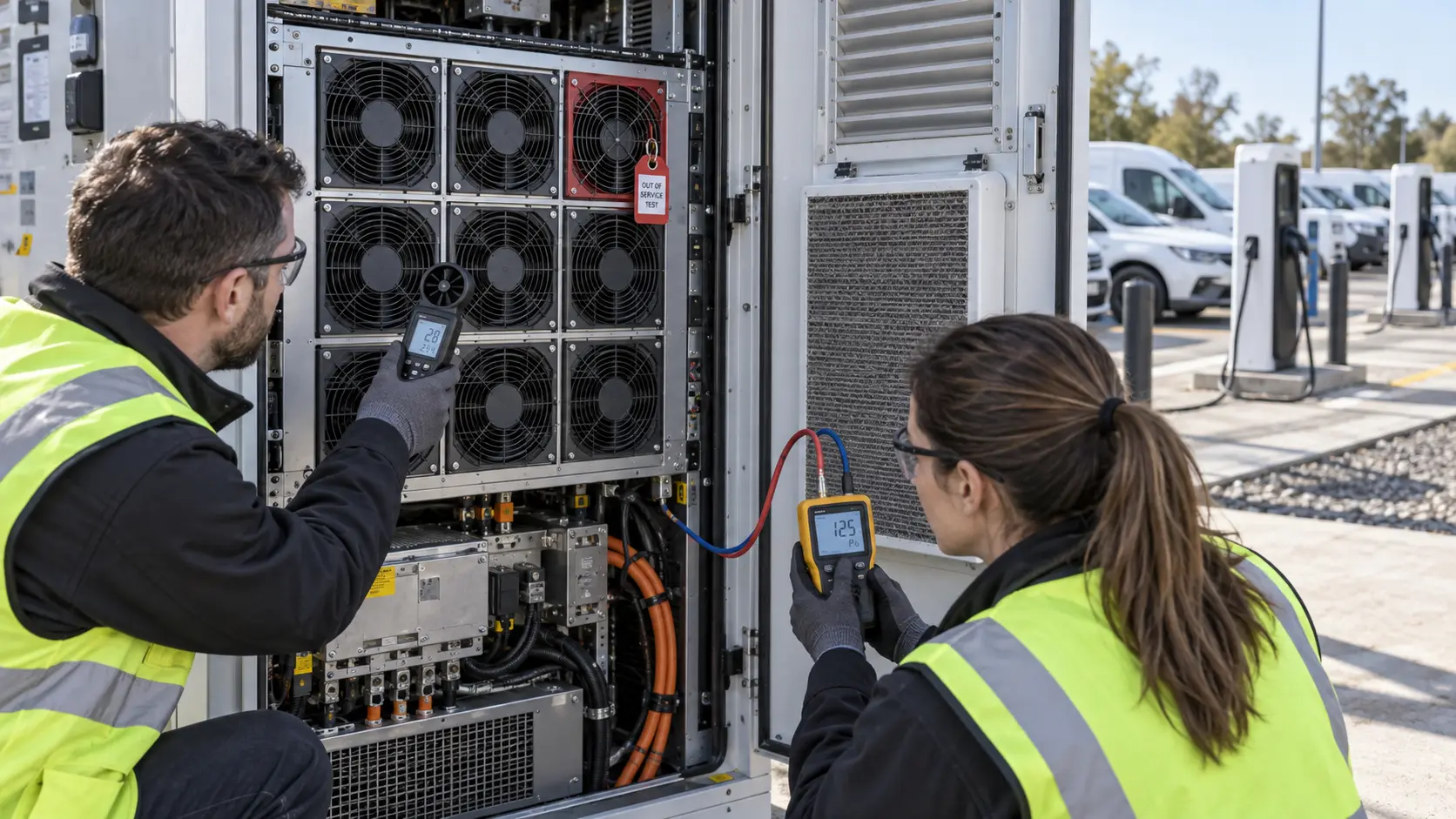
Outdoor EV charging is a thermal and environmental problem together: the fan must move heat while surviving the dust, water, temperature and service conditions around the cabinet.
A charger cabinet sitting by a road faces the full weather cycle: sand and airborne dust in dry seasons, tropical rain and humidity for months at a time, and ambient temperatures that swing from sub-zero start-up conditions to high-load summer operation.
Raise airflow and you solve the thermal peak, but you can also increase contamination exposure and pressure loss across the protective interface. The published deployments treated this as an environmental-adaptation challenge, not a simple more-CFM request: the fan had to deliver useful airflow at the installed resistance and remain controllable after sealing, cabling and material changes.
- Dust exposure in sandstorm conditions.
- Tropical rain and humidity exposure.
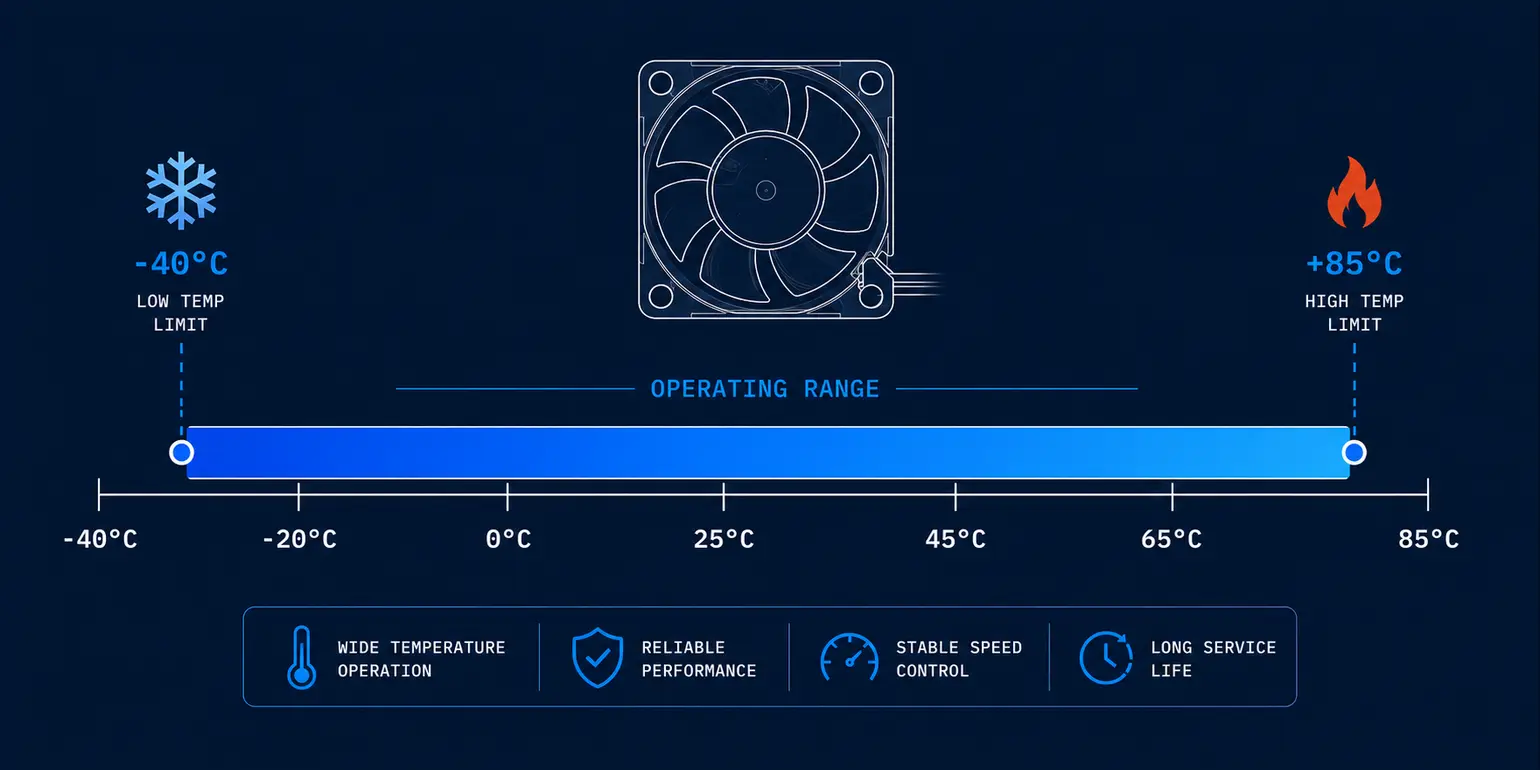
- Low-temperature start-up and high-temperature operation.
Customisation path
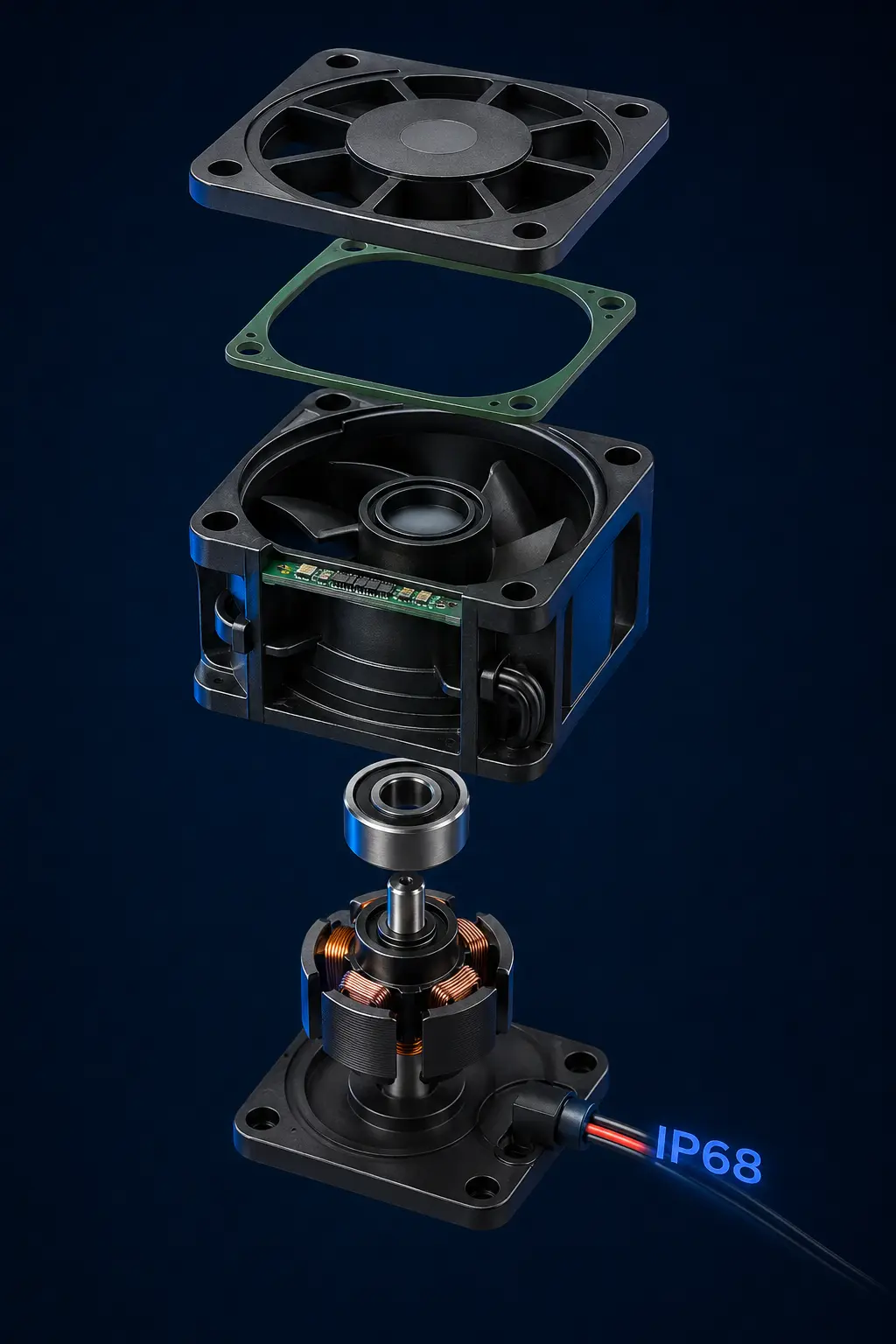
The solution combined an IP68-configured fan assembly with application-specific voltage, cable length and material choices, so a single fan variant could cover multiple installation regions. Under IEC 60529, an IP code classifies the degree of protection provided by an enclosure; the exact tested assembly, mounting interface and test sequence still need to be specified. IP68 was therefore treated as a defined product and test condition, not as a substitute for checking the complete cabinet's airflow and service design.
Each environmental requirement mapped to a concrete configuration option rather than being solved with a generic ruggedised claim. The team also had to confirm that seals, cable exits, bearing choice and materials did not move the fan away from the required pressure and airflow operating point.
| Environmental factor | Adaptation | What it does |
|---|---|---|
| Sand and dust | IP68 seals and sealed bearing | Keeps abrasive particles out of the bearing race |
| Rain and humidity | Waterproof lead and gasket interface | Prevents moisture ingress along the cable and flange |
| Low-temperature start-up | Wide-temperature configuration | Supports sub-zero ambient start-up |
| High-temperature operation | High-temperature material set | Maintains cooling performance at elevated cabinet ambient |
| Regional wiring | Custom voltage and cable length | Fits different 24 V or 48 V bus designs |
- IP68 custom version.
- Wide-temperature configuration from -40 C to +85 C.
- Custom 48 V and cable-length options.
Validation gates before field release
Environmental customisation is only useful when the modified fan is tested at the same thermal and electrical conditions the charger will see in service.
The validation plan should begin with the fan curve at the required voltage and cabinet resistance, then repeat the critical checks after sealing, cable and material changes. Measure airflow, static pressure, current, speed feedback and noise so a ruggedised version is not accepted only because it passes an ingress test.
For a wide-temperature outdoor charger, the sample should demonstrate cold start, high-temperature continuous operation, repeated start-stop cycles, humidity or condensation exposure, water ingress resistance, dust exposure, vibration and connector or cable sealing. IEC 60068 provides environmental-test methods and guidance, but the exact temperature, humidity, vibration, ingress sequence and acceptance levels belong in the customer specification and applicable product standards. The important point is to connect each environmental test to a failure mode and an acceptance result.
The approved sample should then be frozen as a controlled production configuration: named bearing and materials, cable and connector drawing, sealing method, electrical limits, measured operating point, inspection items and replacement requirements. That evidence gives the charger team a repeatable part for regional deployments instead of a one-off prototype.
- Recheck the P-Q operating point after sealing and cable changes.
- Test cold start, hot continuous operation, humidity, water, dust and vibration conditions.
- Record current, speed feedback, noise, airflow and pressure alongside environmental results.
- Freeze the approved sample into a controlled, repeatable production specification.
- Recheck the fan's airflow, pressure and electrical behavior after environmental exposure, not only before the chamber or ingress test.
How it reduced field failures
Because the dominant failure modes in these outdoor cases were moisture and contamination rather than raw airflow, the reliability gain came from sealing and material selection, not from running the fan harder.
The published field outcomes below are migrated as legacy project claims and remain attributed to the original case material. They should be interpreted as project-specific results, not a universal performance guarantee.
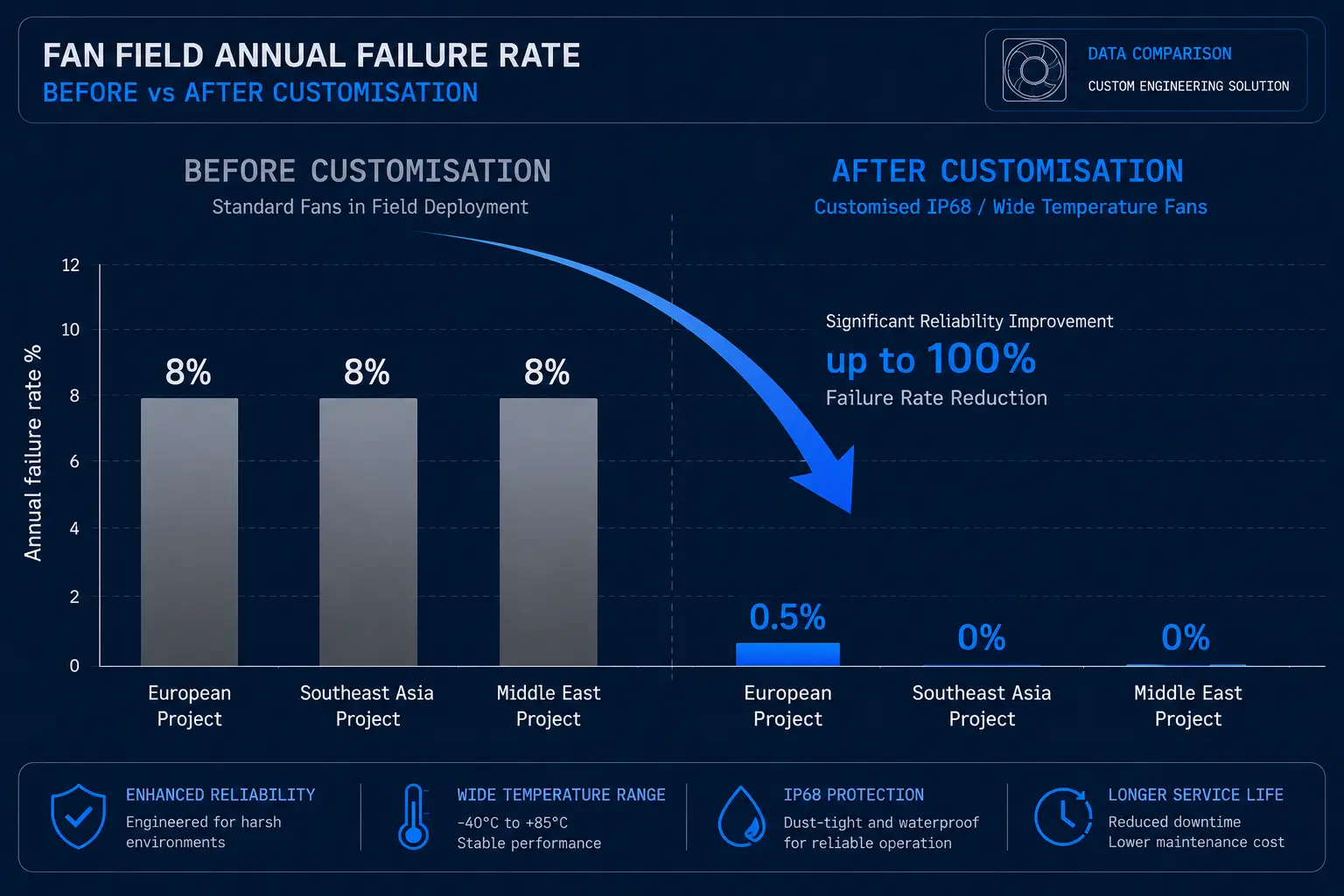
- European charger project: annual field failure rate reported from 8% to 0.5%.
- Southeast Asia rain case: no failures reported during the stated rainy-season period.
- Middle East sandstorm case: no failures reported during the stated sandstorm-season period.
Engineer Questions About This Case
Outdoor charger fan selection has to combine heat rejection with dust, water, temperature, voltage and service conditions.
Q: Why was a standard indoor fan not enough? A: The charger had to start at low temperature, operate at high temperature and tolerate severe outdoor exposure. The thermal and environmental requirements had to be treated as one fan-platform decision.
Q: What requirements were stated for the customized platform? A: The case lists a -40 C start-up target, +85 C high-temperature operation, IP68 protection and a 48 V custom build. These are project requirements, not universal ratings for every MEGA Tech fan.
Q: What did the field data show? A: The case reports an annual field-failure change from 8% to 0.5% in a European charger project, plus zero reported failures in the stated Southeast Asia rainy-season and Middle East sandstorm-season observations. The results remain project- and deployment-specific.
Q: How should environmental fan samples be tested? A: Combine temperature start and operation, voltage behavior, airflow or pressure, ingress or environmental exposure appropriate to the requirement, power, noise, vibration and restart checks.
Q: What must be confirmed before claiming compliance? A: Confirm the exact construction, test method, enclosure interface, environmental condition and certification scope. Do not transfer an IP or temperature statement from one configuration to another without evidence.
- Separate project-reported values from general engineering guidance.
- Record the test condition, mounting, voltage, speed and measurement method with every result.
- Use the case questions to define the next sample or validation step.
Plan an outdoor charger cooling design
For outdoor charging equipment, share the operating environment, enclosure details, required ingress protection, voltage and connector requirements. We can help define a practical fan customisation and validation path before you commit to tooling.