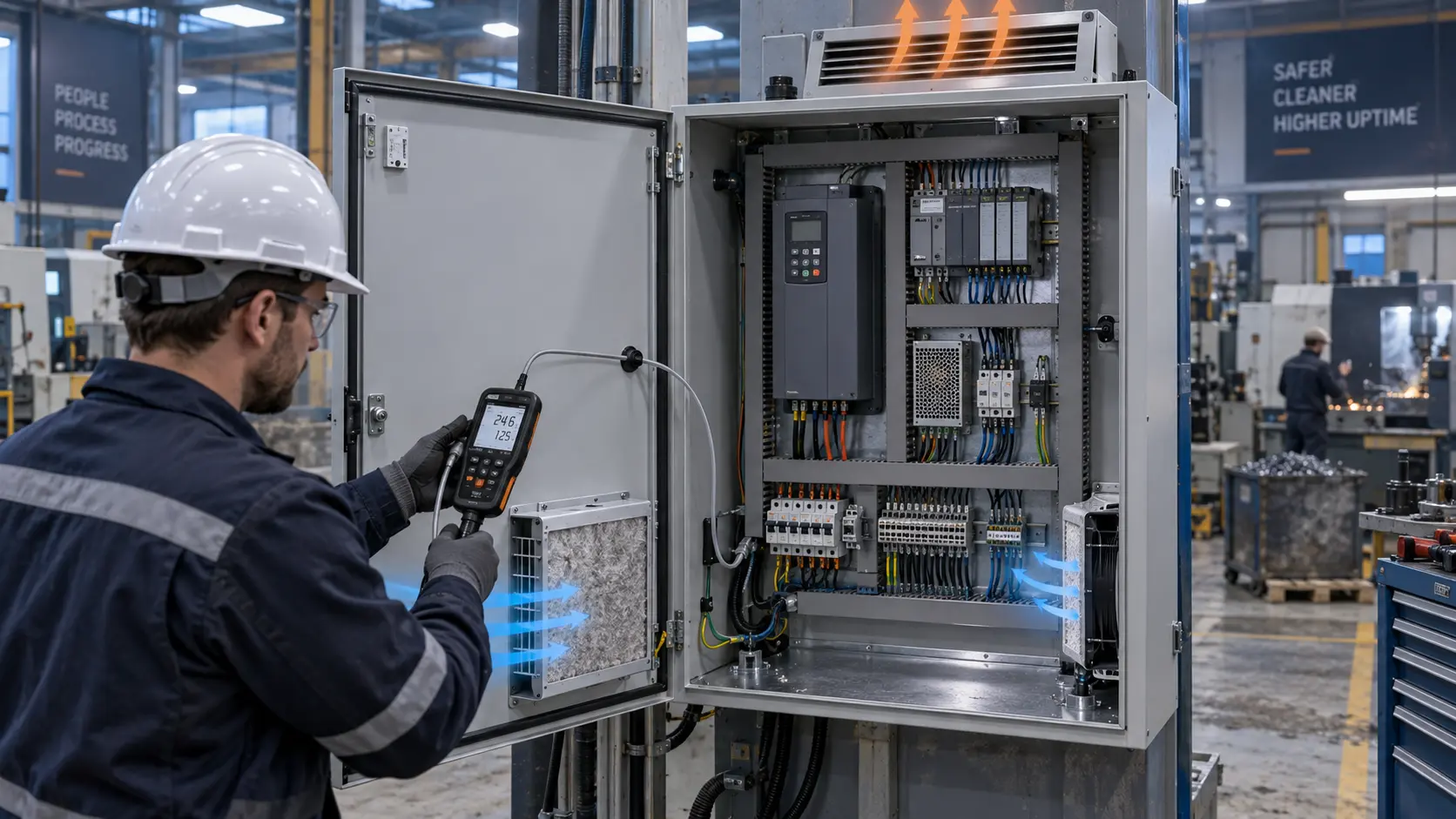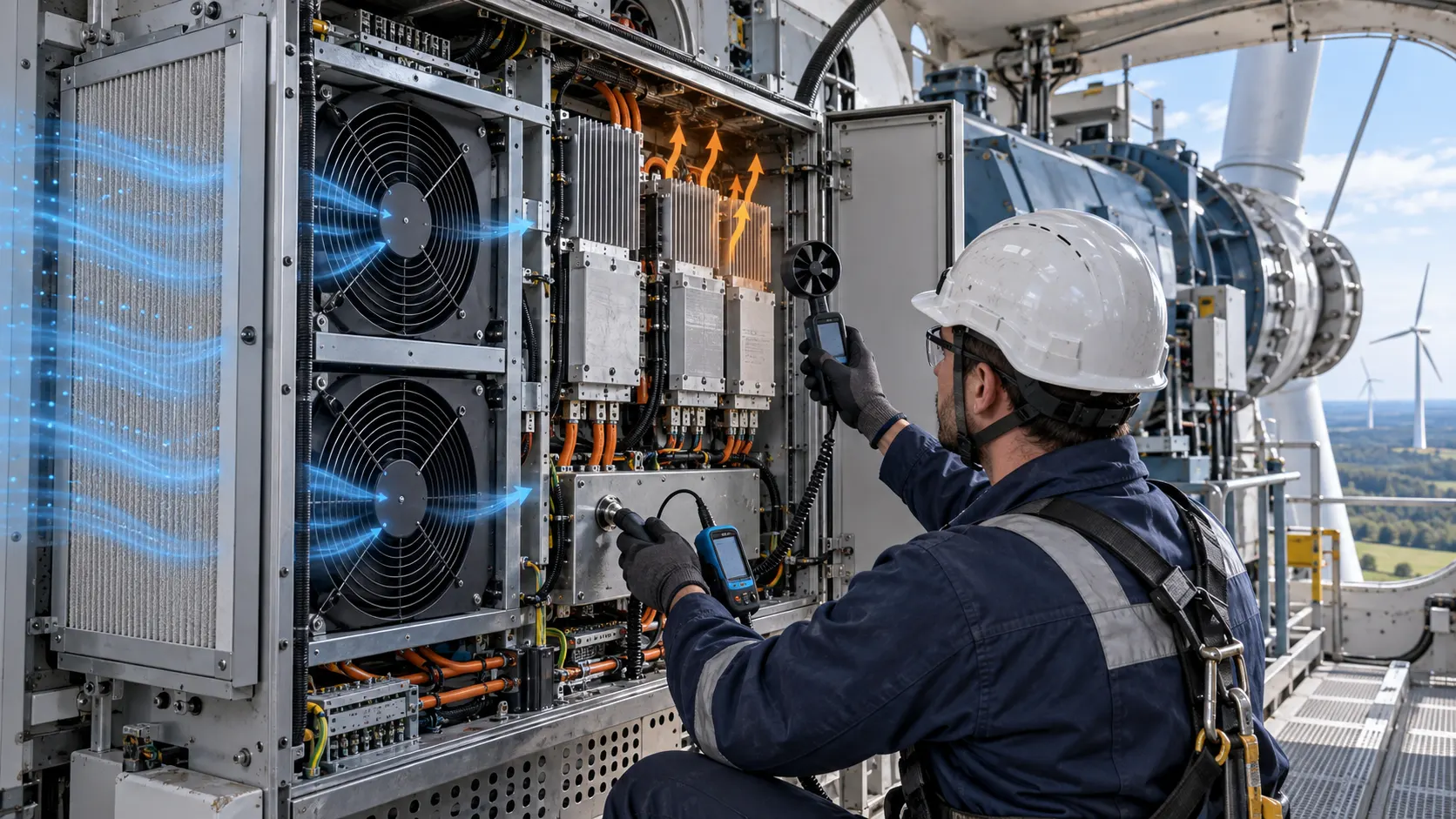
A Customer Who Would Not Accept a Bench Pass
A customer with a demanding product requirement came to us with a condition: no catalogue claims, no golden sample, no reassuring bench run. The cooling fan would earn its place in their product by surviving a full environmental qualification program — and by showing the records.
Their product works in harsh conditions, far from a clean, stable equipment room. In service it heats and cools with the weather and the workload, breathes damp air, and takes knocks in handling, transport and daily use. In that world a cooling fan is a moving part sitting at the front line of every stress the product meets — and a fan that stops is not a graceful degradation. It is the beginning of a failure the customer would own.
So the requirement was set in writing before any sample was discussed: qualify the fan in our quality laboratory, across the stresses the field would apply, measured the same way before and after every stress, with the evidence documented test by test. Whatever the program found, good or bad, would decide whether the fan went forward.
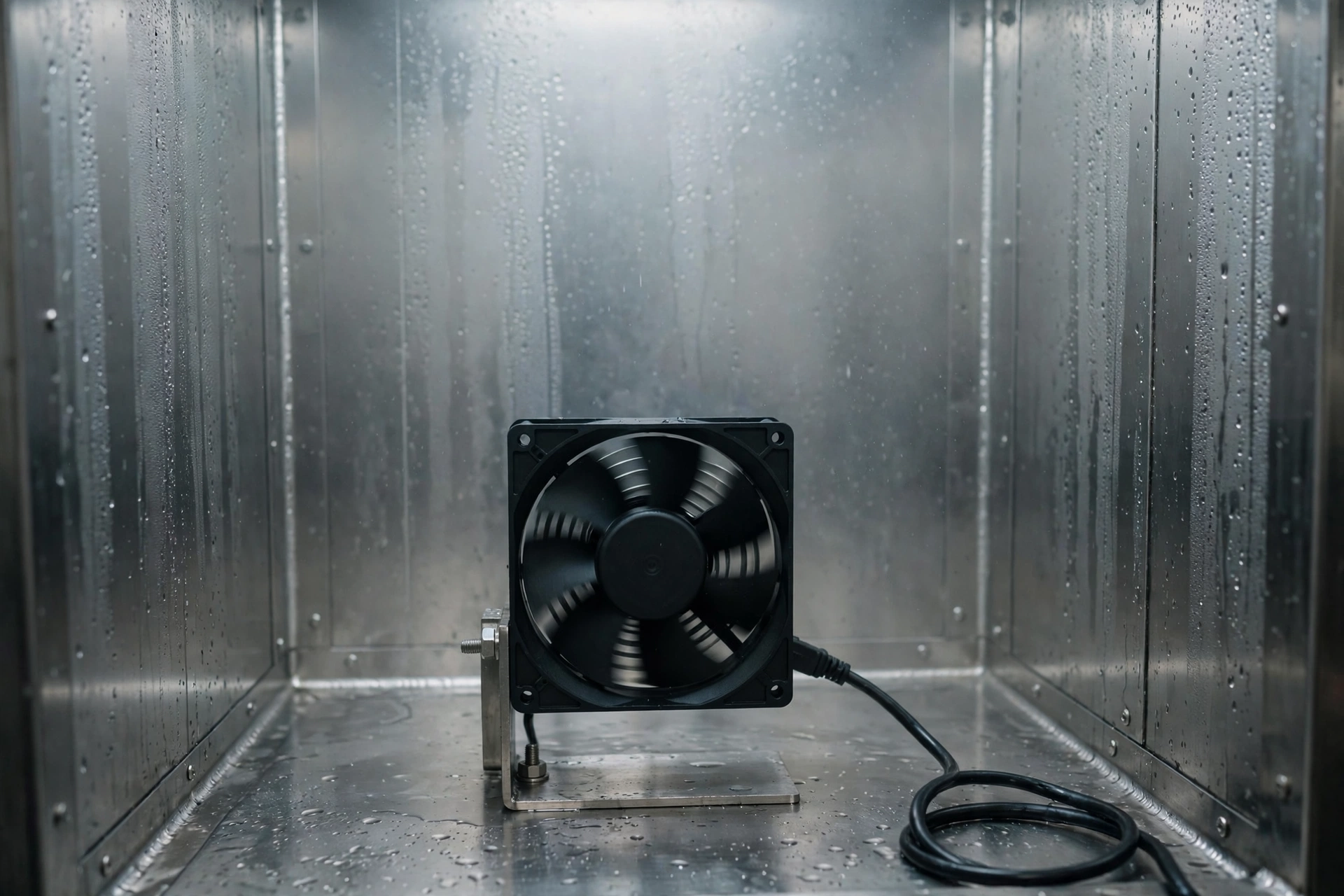
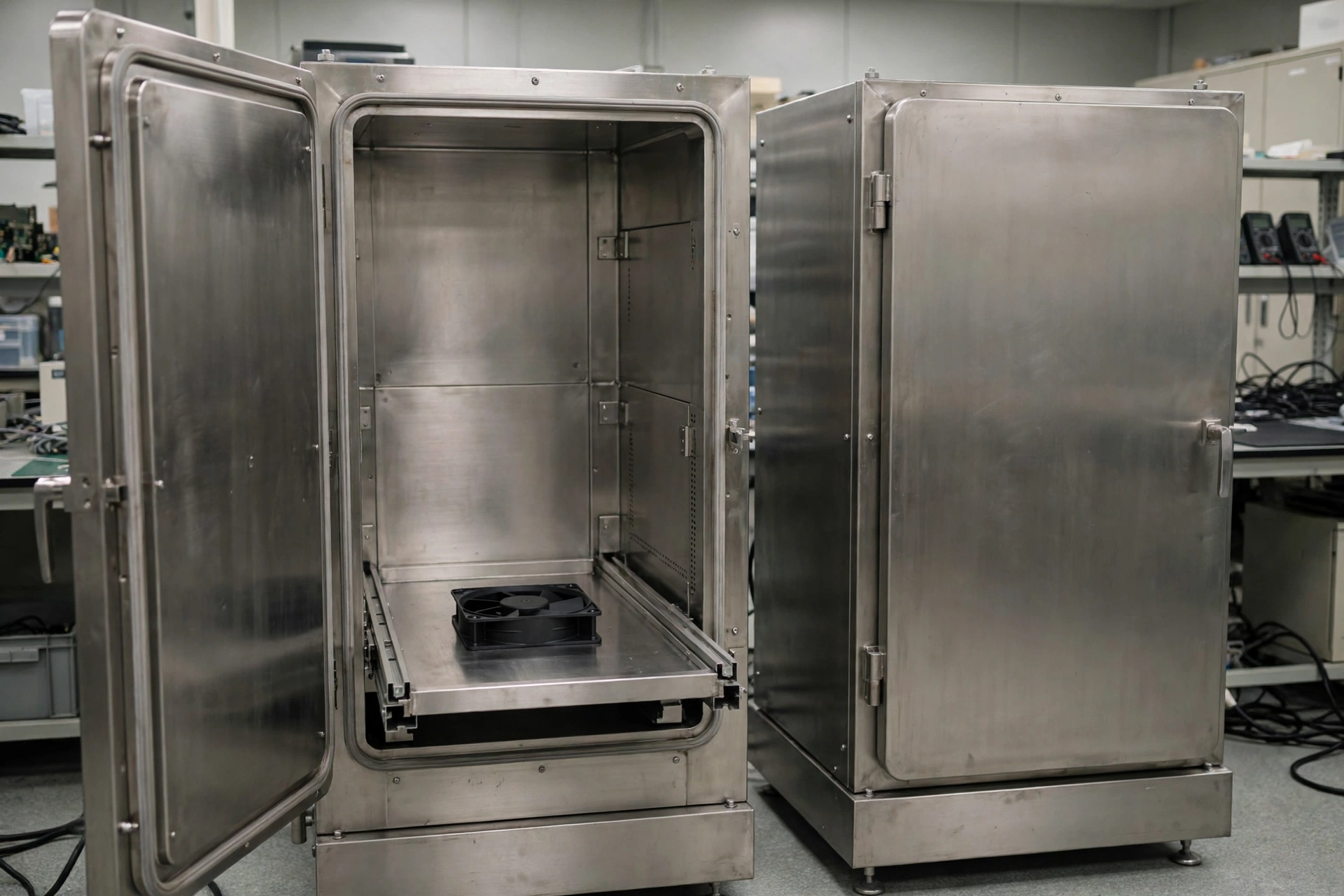
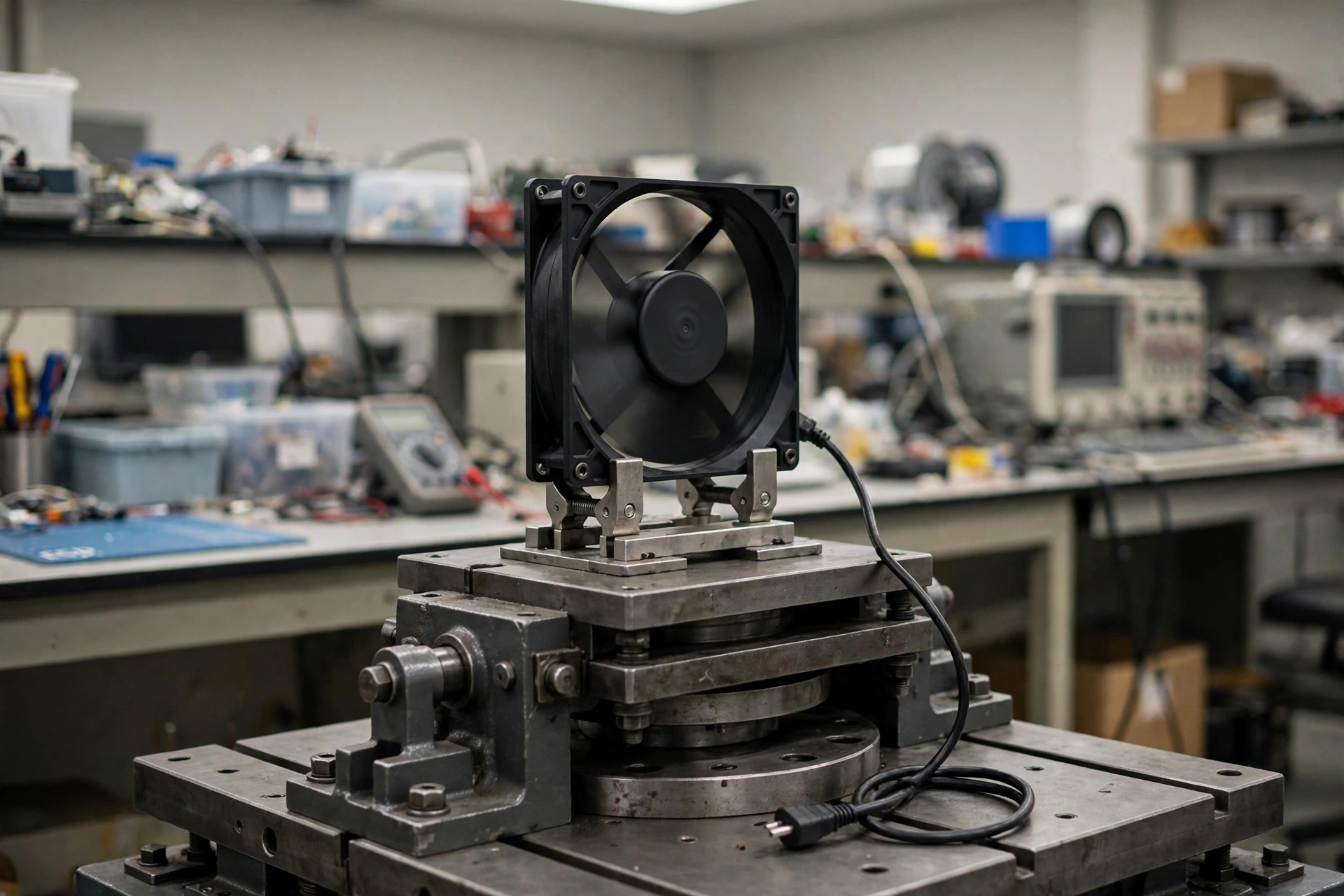
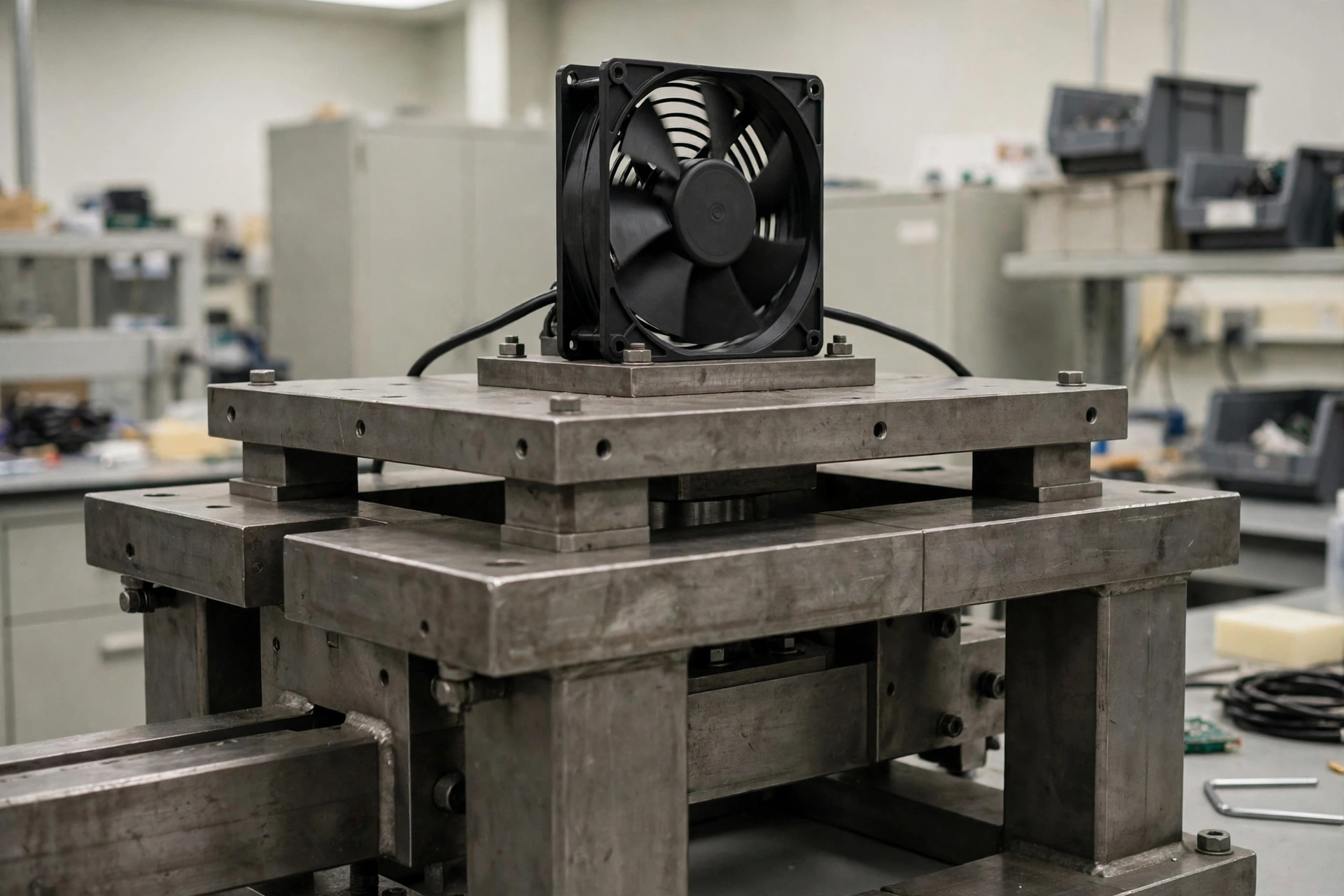
This case describes that program: what it covered, how it was run, and what 'passed' meant. The customer's details and the test data stay with the customer. What can be shared — and what any engineer can reuse — is the method. The scenes pictured along the way are illustrative renderings and schematics, not photographs of the program itself.
What 'Proven' Had to Mean
A qualification program is only worth its cost if the pass bar is agreed before the first test runs. This one had three rules.
Rule one: coverage. Field stresses on a small fan arrive in families — temperature, moisture and mechanical abuse — and each family contains more than one way to fail. A program that tests heat but not cold, or damp but not condensation, proves only that the untested failure modes were never given their chance. The matrix had to cover every family, in depth.
Rule two: honest operating states. Some stresses were applied with the fan running under power, working the way it works in the product. Others were applied with the fan at rest, because real products are also stored, shipped and parked in conditions they must simply endure — and then start, first time, when asked. Testing only a running fan would have qualified half a life.
Rule three: comparison, not impressions. Every sample was measured before its stress and again after it, against the same checks and the same acceptance limits. 'Survived' had to mean 'measures the same as it did before', in writing, sample by sample.
The Temperature Family: Heat, Cold and the Sudden Change
Temperature attacks a fan at two tempos: slowly, through materials that age and creep — and instantly, through shock. The program tested both.
The slow tempo was sustained work at the edges of the operating envelope: the fan running under power in serious heat and in deep cold, long enough for lubricant, plastics, solder joints and drive electronics to stop transitioning and simply live there. Beside it sat unpowered storage at still harsher extremes, because warehouses, freight and parked products never promised to stay inside an operating range.
The transitions came next. Gradual cycling carried the fan between hot and cold while it kept working, again and again, hunting for what expansion and contraction work loose over time: joints between materials that grow at different rates, windings, terminations, the fit of every pressed and bonded part.
Thermal shock removed the gradual part. The sample was transferred between a hot zone and a cold zone almost at once, so the temperature change arrived faster than the materials could relax. Slow cycling forgives interfaces that shock splits open — seals, brittle points, bonded layers. A fan that passes cycling but was never shocked has not met the rudest thing a cold start, a loading dock or a sudden weather front can do to it.

The Humidity Family: The Stress That Waits
Heat announces itself. Moisture does not. Humidity is the stress that gets inside, waits, and fails the fan long after the test that should have caught it.
The steady form of the attack is damp heat that simply stays: warm, saturated air around the fan for an extended soak, testing whether insulation, coatings, connectors and bearing surfaces can live with water permanently trying to get in. It is a patient test, hunting the corrosion and leakage paths that a short exposure never develops.
The cyclic form breathes. As temperature rises and falls, the air inside and around the fan expands and contracts, and the assembly inhales damp air and exhales it — pumping moisture a little further inward with every breath. Cyclic damp heat finds the breathing paths that a steady soak cannot.
Condensation is the family's sharpest weapon. When a cold-soaked fan meets warm, wet air, water forms directly on and inside it — on windings, on electronics, at interfaces. The program included a test profile designed to make condensation happen, not merely to risk it: if liquid water was ever going to form inside this fan in service, it was going to form in the chamber first, under observation.

The Mechanical Family: The Long Shake
Vibration is fatigue delivered wholesale: countless small loads, each one harmless, together enough to undo fasteners, fret contacts and tire lead wires.
The fan was mounted and wired the way it would be installed, then shaken on a vibration table along each of its axes in turn — because a mounting that is stiff in one direction can be a lever in another, and the field never promises to shake along the axis the designer preferred.
Random vibration, rather than a single tidy tone, does the hunting: it excites every resonance the assembly owns, including the ones nobody calculated. What it finds is practical, not theoretical — a connector that walks, a clamp that loosens, a lead wire that work-hardens where it bends, a new rattle that announces itself as abnormal noise.
The point of the long shake is that nothing about it is dramatic. The fan is supposed to come off the table boring: same behaviour, same sound, same measurements as the day it went on.

The Mechanical Family: The Sudden Blow
Mechanical shock tests a different fear: not endurance, but the single worst moment — the drop, the slam, the impact that arrives once and either breaks something or does not.
Where vibration spreads its energy over a long test, shock concentrates it into one sharp pulse, delivered along each axis. The failure modes are equally concentrated: a bearing taking a dent, a shaft shifting, a solder joint cracking, a housing or mounting feature giving way, a connector unseating just enough to become next month's intermittent fault.
Shock is also the test most often argued away — 'the product will never be dropped'. Products are dropped: in production, in freight, in installation, in service. The customer's position was that a fan destined for a harsh-environment product does not get to be fragile in any single moment, and the program treated the argument as settled.
As with every stress in the program, the pulse itself was only half the test. The other half was the full measurement panel afterwards, because a fan that still spins can still have been hurt — and 'still spins' was never the acceptance criterion.

The Discipline: Same Checks, Before and After
Stresses are easy to apply. The value of a qualification program lives in how it measures — and this program measured like a sceptic.
Every sample went through the same panel of checks before and after each stress: its electrical behaviour and running speed against the specification, its sound listened to carefully from all sides, its vibration compared against reference limit samples kept for exactly that purpose, and its body and lead wires inspected for damage. Subjective checks were anchored to physical reference samples, so 'sounds fine' meant 'sounds like the limit sample or better', not 'the inspector was in a good mood'.
The samples went through the program mounted and connected as they would serve — on fixtures, with their connectors and harnesses — because a fan tested loose on a bench is a different, luckier fan than the one that ships.
And the release rule had no partial credit: any sample failing any check after any stress would hold the whole program open. There was no averaging away a bad sample and no retest-until-pass. The bar was the bar.
The Result: A Signature Earned, Not Assumed
The fan completed the full program — every stress family, every check, before and after — and met the customer's requirements.
That sentence is deliberately short, because the evidence behind it is deliberately long: a documented program of environmental stresses with before-and-after measurements on every sample, judged against limits agreed before the work began. The customer received the records, reviewed them, and signed off the fan for design-in on the strength of them.
What the result does and does not claim matters. It claims this fan design, built this way, withstood this qualification program with its measured behaviour unchanged. It does not claim the fan is immortal, and it certifies nothing for anyone else's product: qualification is evidence about a defined design under a defined program — and honest evidence is what makes it valuable to the next engineer.
What to Ask Any Fan Supplier Before You Sign Off
You do not need this customer's product to use this customer's scepticism. These are the questions that separate a qualification program from a reassurance exercise.
| Ask | Why it matters |
|---|---|
| Which stress families does your program cover — temperature, moisture, mechanical — and what sits under each? | Gaps hide in the family nobody tested; a list of tests is not coverage. |
| Which tests run with the fan powered, and which at rest? | Products live both lives; a program that only tests a running fan qualifies half of one. |
| What exactly is measured before and after each stress, and against what limits? | If nothing is measured, nothing was proven. |
| How are sound and vibration judged — against what reference? | Unanchored listening checks pass whatever the listener expected to pass. |
| Is the sample tested as installed — mount, connector, harness? | A loose fan on a bench is a different fan from the one that ships. |
| What happens if one sample fails one check? | The honest answer is 'the program stays open' — anything else is negotiation. |
| Who receives the records, and in what form? | A pass you cannot inspect is a claim, not evidence. |
How MEGA Tech Supports Programs Like This
This program ran the way our sample work is organised to run: the laboratory is not a favour done after the sale, it is part of how a fan earns its way into a product.
MEGA Tech's work covers custom cooling fan development and manufacturing, fan selection, air-path review, sample validation and volume production. The qualification program in this case sits inside sample validation: our quality laboratory runs environmental and mechanical stress testing as a normal stage between 'the sample works on your bench' and 'the design is released', under our ISO 9001 quality system, with CE and RoHS on the product range.
For teams at an earlier stage, the same discipline scales to fit: tell us the environment your product must survive and the evidence your own customer will ask for, and the sample program can be shaped to produce exactly that evidence — no more theatre, no less proof.
Engineer FAQ
Questions engineers ask when a supplier says a fan is 'qualified'.
Q: Is a passed qualification program the same as a certification? A: No. Certification attests a product against a published scheme under a certification body's rules. A qualification program is evidence that a defined design survived a defined set of stresses with its behaviour unchanged — evidence a product team then builds its own qualification on.
Q: Why test a fan unpowered at all? A: Because products are stored, shipped and parked unpowered, often in worse conditions than they work in. The fan that matters is the one that starts afterwards, first time.
Q: Why insist on before-and-after measurement if the fan still runs? A: Because 'still runs' hides drift. A fan can lose margin — speed, sound, vibration — long before it stops, and margin lost in the chamber is a field failure scheduled early.
Q: Which test would you never skip? A: The one the product's environment makes cruellest — and for most enclosed electronics that is a condensation-forming humidity test, because liquid water inside a fan is the failure no bench run rehearses.
Q: Can a small company or a startup get this kind of validation? A: Yes. A shaped sample program is a normal way for us to start: the evidence bar is agreed up front and scaled to the decision it has to support.
Questions for a Qualification Design Review
Bring these to the review before samples are ordered, not after the first field failure.
- Which environments will this product actually meet — in service, in storage, in freight — and who has written them down?
- Which stress families follow from those environments, and which tests represent each family?
- Which stresses apply with the fan running, and which at rest?
- What is the before-and-after measurement panel, and what are its limits?
- How are sound and vibration anchored — what do the reference limit samples sound and feel like?
- Is the sample mounted, connected and harnessed exactly as it will ship?
- What is the release rule when a sample fails — in writing, before the program starts?
- What records will we hold at the end, and will they support our own customer's audit?