Reported test discrepancy
A customer measured a custom bracket axial fan at 4,900 RPM against a 5,300 RPM specification. Internal production testing had already recorded 5,300 RPM, so the investigation focused on the customer test setup.
- Measured by customer: 4,900 RPM.
- Specification and internal test reference: 5,300 RPM.
- Investigation focused on repeatable test conditions.
Why a free-air RPM value can change after installation
RPM is only one part of fan validation. A fan running against an obstruction, grille, duct transition or sealed product interface can experience a different airflow condition from an open free-air test. AMCA guidance describes these installation losses as system effects and recommends comparing the installed arrangement with the test arrangement rather than treating a catalogue headline as the complete product result.
For this case, the fan had been placed flat against a desk, blocking one face, and was measured before the hydraulic bearing had stabilized. The setup therefore changed both the air path and the time at which the reading was taken. That does not by itself prove a hardware defect or define the final in-product performance.
- Keep the inlet and outlet clear for a free-air RPM comparison.
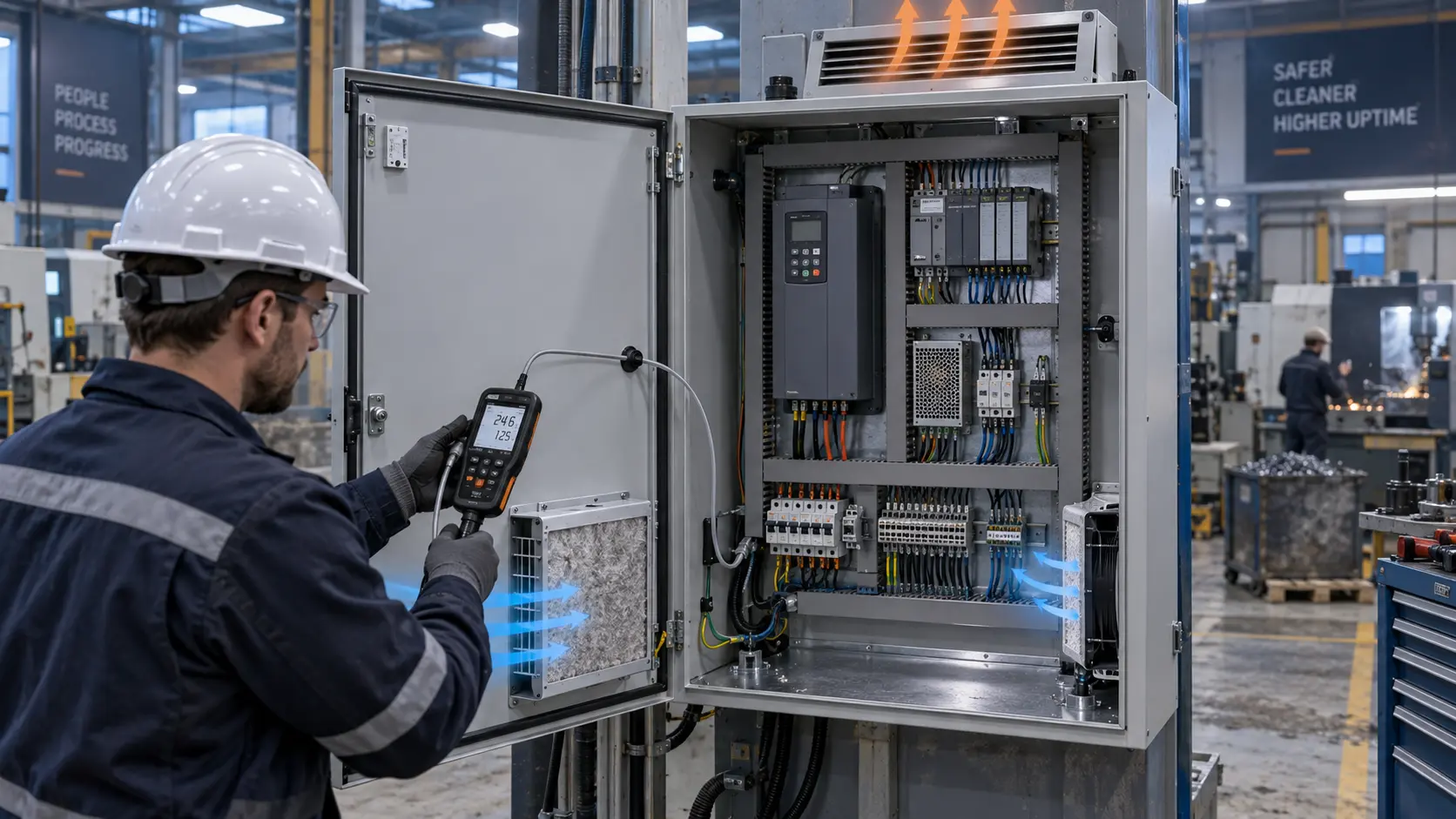
- If the fan is installed in a bracket or enclosure, validate the same bracket, grille, filter and clearance used by the product.
- Record whether the measured value is free-air RPM or RPM at the product operating point.
- Do not use RPM alone to infer airflow, static pressure, noise or thermal performance.
Test-condition review
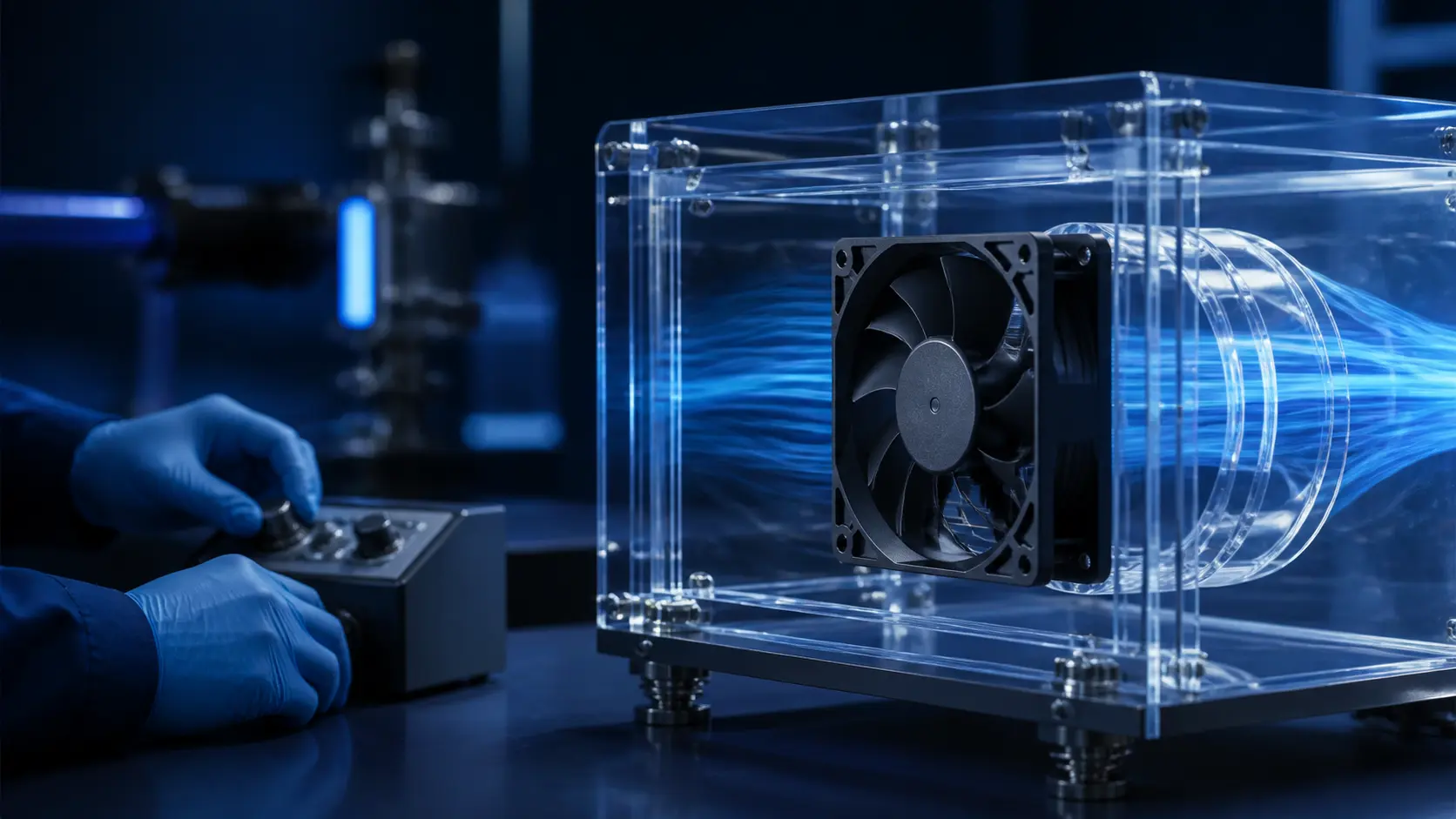
The customer was asked to repeat the measurement after applying the project test protocol: allow the fan to reach the defined stabilized condition and restore open airflow on both sides. A warm-up time is not a universal fan specification; it should be defined for the bearing, motor, controller and application. A controlled engineering check should also record the actual voltage at the fan terminals, instrument model, tachometer target, ambient condition and mounting distance.
For a production or application decision, the same setup should be repeated across more than one sample. A stable RPM result is useful, but the acceptance record should also capture current, airflow or pressure at the required operating point when those values are part of the requirement.
- Use the specified rated voltage and measure voltage at the fan connector.
- Allow the defined warm-up time before recording the result.
- Use a calibrated or verified tachometer and document the reflective mark or optical target used.
- Keep the sensor angle, distance and measurement point consistent.
- Repeat the test on representative samples and record the range, not only one reading.
- For a formal performance comparison, define the measurement uncertainty and check that the speed instrument does not disturb the fan.
- For installed validation, measure the actual operating point rather than substituting free-air RPM.
Validated outcome
After retesting with the fan warmed up and both faces unobstructed, the customer recorded 5,300 RPM, aligned with the specification. The result supported the original fan configuration, but it did not make 5,300 RPM a universal value for every mounting condition. The appropriate conclusion was that the original discrepancy came from a mismatch in test conditions, not from an immediate need to redesign the motor or bracket.
- Retest outcome: 5,300 RPM under the defined comparison setup.
- No hardware defect reported in the published case.
- Free-air specifications should be compared with a free-air test setup.
- Installed product acceptance should use the installed airflow path and the required thermal or acoustic limits.
From a confirmed reading to a production-ready fan
When the fan is part of a new bracket, enclosure or compact product, MEGA Tech can help turn the finding into a controlled sample instead of stopping at a single RPM measurement. We can review the available clearance and pressure loss, adjust the fan configuration or control target, build samples for evaluation, and compare the result at the customer's real operating point.
Before release, the approved sample should have a defined test fixture, input voltage, warm-up time, instrument method, RPM range and any airflow, pressure, noise or temperature acceptance limits. Those conditions can then be transferred into incoming, process or final inspection so the custom fan remains repeatable when the project moves from a small build to volume production.
- Review the customer's bracket, clearance and air-path resistance.
- Build and test a sample under the real product conditions.
- Freeze the approved fan configuration, interface and acceptance method.
- Support repeatable production checks for the approved design.
Engineer Questions About This Case
An RPM discrepancy is a test-condition question before it is a motor redesign decision.
Q: Why did the customer measure 4,900 RPM against a 5,300 RPM specification? A: The fan was placed flat against a desk, blocking one face, and was measured before the hydraulic bearing had stabilized. The setup did not match the open-air production test condition.
Q: Can mounting change RPM? A: It can change the airflow load and system effect seen by the fan, while voltage, instrument method, warm-up time and tachometer interpretation can also change the reading. Compare like-for-like test conditions.
Q: What was the validated result? A: After the fan was warmed up and both faces were unobstructed, the customer recorded 5,300 RPM, aligned with the specification. This does not make 5,300 RPM universal for every mounting condition.
Q: What should be recorded in a repeatable RPM test? A: Record fan-terminal voltage, instrument model, tachometer method, ambient condition, mounting distance, warm-up time and the acceptance RPM range.
Q: Is RPM alone enough for approval? A: No. If the product requirement includes cooling, also verify airflow or pressure at the installed operating point, plus noise and temperature where relevant.
- Separate project-reported values from general engineering guidance.
- Record the test condition, mounting, voltage, speed and measurement method with every result.
- Use the case questions to define the next sample or validation step.
Need help validating a custom fan?
Share the fan model, rated voltage, mounting sketch or photos, warm-up time, tachometer method and the required airflow, pressure, noise or temperature target. These details help distinguish a test-method mismatch from a genuine design gap and give the engineering team a practical starting point for sample development.