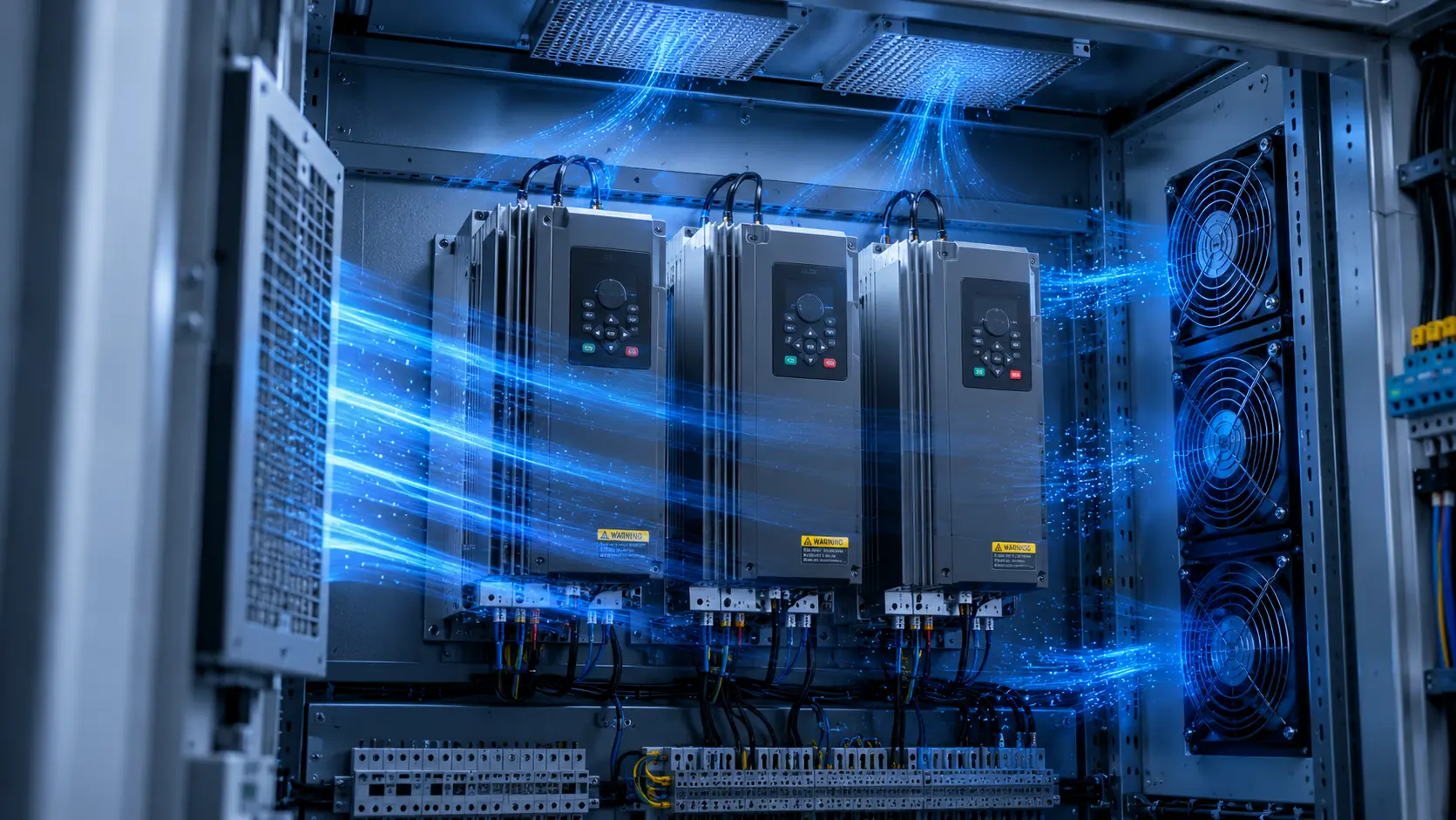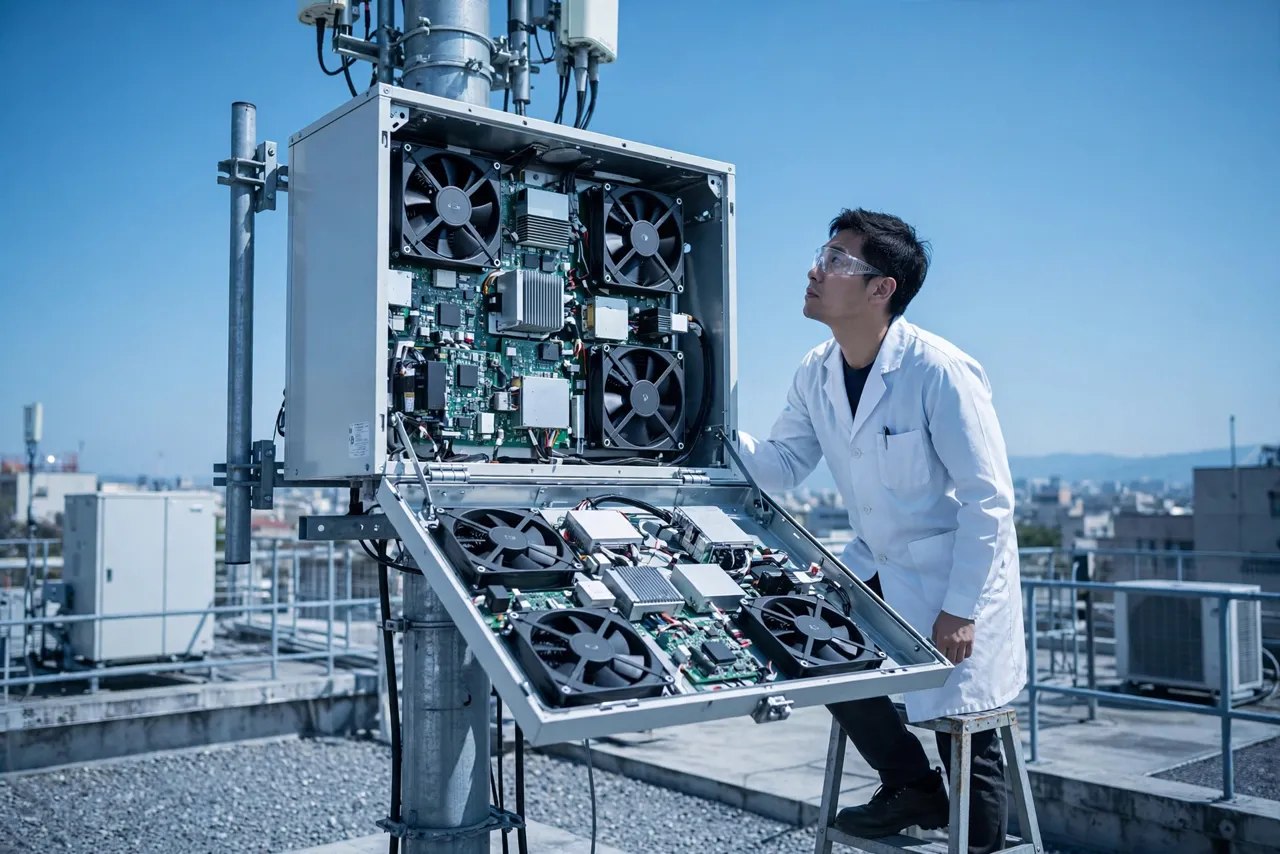
The cell that faded at noon
Two field stories with the same root cause: an antenna treated as a passive box, when it is a high-power-density computer.
A carrier rolls out 5G in a dense urban district. By the second summer, the complaints arrive: throughput drops every hot afternoon, and a handful of sites log thermal alarms. The active antenna units — the AAUs bolted to poles and rooftops — are throttling themselves. Their power amplifiers, pushed past a temperature threshold, back off to protect themselves. The network does not fail; it quietly underdelivers, exactly when traffic peaks.
The slower version is built into the business case: an AAU that derates its transmit power on hot days delivers less coverage and less capacity than the planning tools assumed. Nobody’s fan failed. The thermal design treated the antenna as a passive box, and it is not one anymore.
The active antenna unit is where 5G’s heat problem lives: dozens of power amplifiers packed behind the radiating elements, power density that keeps rising with each generation, and a housing that must survive sun, rain, salt, and wind on a pole — with weight and noise limits that rule out easy answers. This article explains why AAUs run hot, when passive cooling runs out, the temperature-efficiency coupling, site constraints, four misconceptions, and five buyer checkpoints.
Why AAUs run hot
Massive MIMO, inefficient power amplifiers, digital processing — and a housing that fights every thermal requirement.
Massive MIMO multiplies the heat: a 64T64R AAU carries dozens of transmit/receive chains, each with its own power amplifier — the per-chain power is modest, the total packed into a slim housing is not. Power amplifiers are inefficient by physics: PAs convert a fraction of their DC power into RF output and the rest becomes heat — and the fraction shrinks as temperature rises. The PA is both the main heat source and the component most punished by heat.
Digital processing adds its share: beamforming computation, DPD, and control electronics draw real power in the digital board compartment — heat that shares the same housing and the same thermal budget as the PAs. The housing is a thermal bottleneck: it must be slim for wind loading and aesthetics, sealed against weather, and light enough for the pole — slim means small heat-sink area, sealed means the inside air cannot be exchanged freely, light means limited thermal mass. Every mechanical requirement fights the thermal one.
Do the heat budget at the radio’s actual operating point: full transmit power, maximum ambient, peak solar load on the housing. That is the thermal reality the cooling system must handle.
When passive cooling runs out
Passive is the right answer wherever it works — and power density keeps shrinking the places where it does.
Passive cooling is the first choice for good reasons: heat sinks and natural convection have no moving parts, make no noise, draw no power, and never need a service visit. For lower-power AAUs in temperate climates, passive is the right answer — and it stays the right answer wherever it works.
But power density keeps rising: each generation pushes more RF power through a housing that cannot grow much — wind loading, pole limits, and aesthetics cap the size. At some point the heat-sink area and natural convection cannot reject the heat at worst-case ambient, and the design faces a choice: derate the radio, grow the housing, or add active cooling.
Active cooling buys back the thermal margin: fans — usually inside a sealed or semi-sealed housing, circulating air across internal heat exchangers or driving external airflow over enhanced sinks — let a compact AAU hold full power at high ambient. The trade is real: power draw, acoustic noise, and a component with a finite life at the top of a pole.
The honest comparison is total cost of ownership: a passive design that forces PA derating loses capacity revenue; an active design costs fans and maintenance. Compare the derated capacity against the fan cost, the energy, and the service visits — over the site’s real lifetime, not the datasheet’s.
The temperature-efficiency coupling
Heat reduces PA efficiency, lower efficiency generates more heat — the loop that makes AAU thermal design unforgiving.
PA efficiency (PAE) falls as junction temperature rises — a hotter PA converts less of its input to RF and more to heat, which raises its temperature further. In a well-designed thermal system the loop stabilizes at an acceptable operating point; in a marginal one, the loop drives the PA toward its protection threshold, and the radio derates or shuts down transmit chains.
The design point must include the coupling: a heat budget that assumes room-temperature PAE at maximum ambient is optimistic twice over — the ambient is high and the efficiency is low. Size the cooling for the degraded-efficiency worst case, or the radio will find that case on its own.
Derating is the silent failure mode: unlike a thermal shutdown, PA derating does not raise an obvious alarm — the site stays “up” while delivering less than planned. Network KPIs drift, capacity planning assumptions erode, and the root cause hides in a temperature log nobody reads. Monitor PA temperature and transmit power together; divergence between them is the signature.
Thermal headroom is capacity headroom: every degree of thermal margin the cooling system buys is margin the radio can spend on transmit power. In capacity-constrained networks, the cooling system is part of the capacity plan.

Site constraints that shape the cooling
Weight, power, noise, salt, and the most expensive service visit in the series.
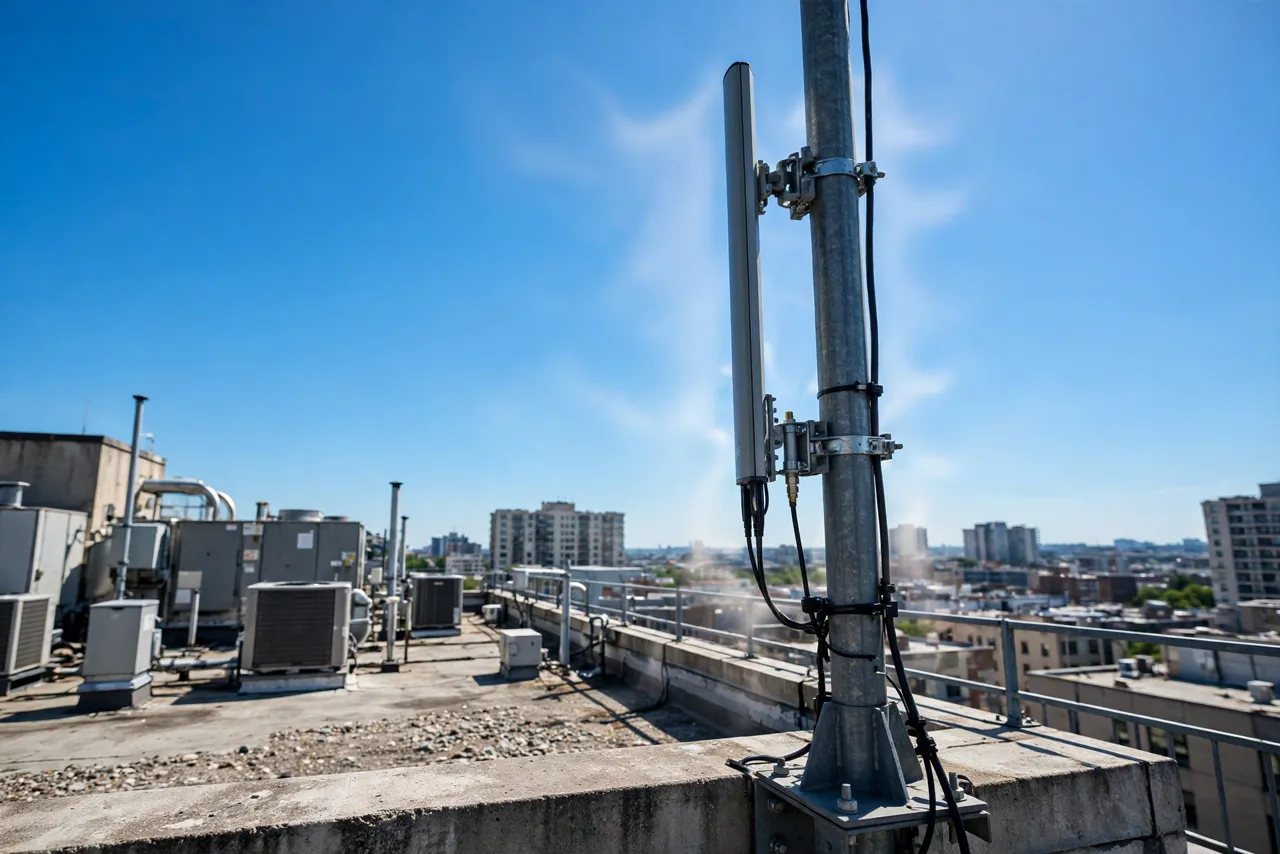
Weight and wind loading: the AAU hangs on a pole or rooftop structure rated for a specific load — every kilogram of heat sink or fan assembly competes with the radio itself. Active cooling must earn its weight: enough thermal benefit per kilogram to justify its place. Power budget: the site’s power feed is sized for the radio, and the cooling system’s draw comes out of the same budget — fan power at full speed on the hottest afternoon is part of the site’s peak load.
Acoustic noise: rooftop and street-level sites sit near people — fan noise that is irrelevant on a highway billboard becomes a complaint on a residential rooftop. Speed control tied to temperature — quiet at night, working hard at noon — is a site-acceptance requirement here, not a luxury. Salt, dust, and rain: coastal and roadside sites punish any air path — sealed housings with internal circulation avoid the exposure but need heat-exchange surfaces; filtered designs need the clogging margin and maintenance plan from the outdoor-display discussion.
Service access: a pole-mounted AAU tens of meters up is the most expensive service visit in this article series — a lift, a crew, sometimes a road closure. Fan life, redundancy, and remote monitoring are not optional extras; they are the difference between a maintenance ticket and a site outage.
Four misconceptions that throttle networks
The four beliefs that survive every design review — and keep networks derating every summer.
Misconception 1: “The heat sink is big enough.” Big enough for what — the lab’s 25 °C, or the rooftop’s 50 °C with full sun and degraded PAE? Passive designs validated at room temperature are the most common source of field derating. Validate at the coupled worst case.
Misconception 2: “Fans are a reliability downgrade.” An uncooled AAU that derates every summer is already unreliable — it just fails gracefully enough to hide. A well-designed active cooling system with monitored, replaceable fans is more reliable in delivered capacity than a passive design running on the edge.
Misconception 3: “Thermal alarms mean the cooling failed.” Alarms that fire on normal hot afternoons mean the thermal design was undersized — the alarm is the design confessing. Protection and alarming are for faults and extremes, not for August.
Misconception 4: “All sites need the same cooling.” A temperate rooftop and a desert pole are different thermal worlds. Cooling designed for the worst site wastes money everywhere else; cooling designed for the average site derates at the worst ones. Segment the thermal design by site class — or pay for it in capacity.
Five buyer checkpoints for AAU cooling
Five questions that turn “outdoor rated” from a slogan into a specification.
Checkpoint 1: demand the coupled heat budget. PA heat at degraded high-temperature efficiency, digital board power, peak solar load, maximum site ambient — in one documented budget. If PAE is assumed at room temperature, the budget is fiction. Checkpoint 2: confirm the passive/active decision. Which site classes are passive, which are active, and what thermal analysis justifies the boundary — ask to see the worst-case numbers for the hottest site class, not the average one.
Checkpoint 3: verify full-power operation at worst case. Full transmit power, peak sun, maximum ambient, end-of-maintenance-interval filter condition where applicable. Derating under these conditions is a failed test wearing a software mask. Checkpoint 4: check the acoustic and power reality. Fan noise at full speed against the site’s noise limits; fan power at full speed against the site’s power budget. A cooling system that violates either will be disabled in the field — and then the radio derates.
Checkpoint 5: require thermal telemetry and fan monitoring. PA temperature, transmit power, fan speed and status — monitored remotely, alarmed on divergence. A site without thermal telemetry is a site whose derating you will discover from customer complaints.
The design details that decide capacity
Internal circulation, redundancy, speed control, vibration — the details that keep the radio at full power.
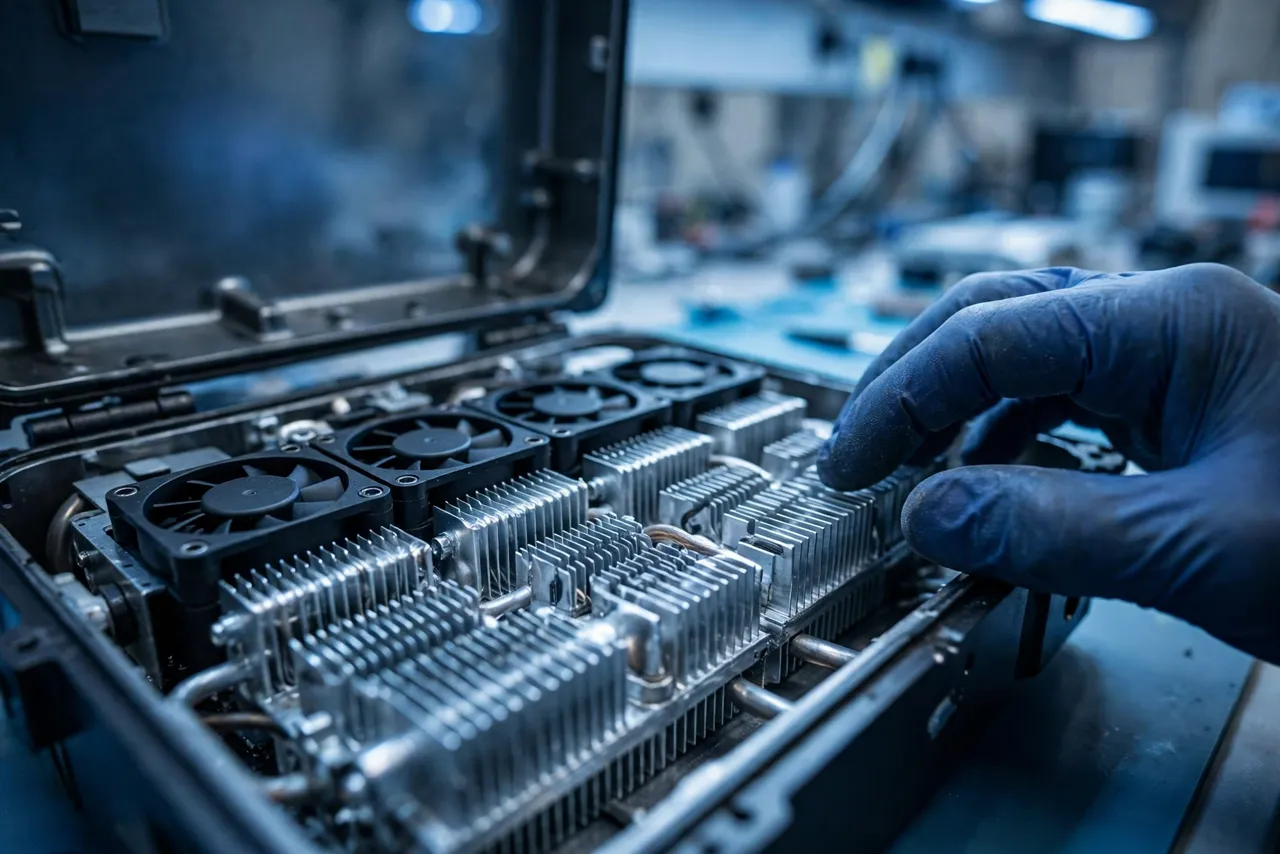
Internal circulation in sealed housings: the common active-cooling architecture — fans circulate internal air across heat-pipe or finned surfaces bonded to the housing, which rejects heat to outside air. No outside air enters — salt and dust stay out, and the fans live in a clean, controlled environment. Fan redundancy and life: pole-top service is the most expensive visit in this series — size for N+1 where the site’s criticality justifies it, specify long-life bearings, and monitor fan status so a failure becomes a scheduled visit, not an emergency.
Temperature-proportional speed control: fans at full speed only when the thermal load demands it — quiet nights, hard-working afternoons. This cuts energy, cuts noise complaints, cuts dust ingestion, and extends fan life — but the control curve must be validated against the coupled worst case. Vibration and structural integration: pole and rooftop structures move in wind; the AAU and its fans must survive the movement without exciting resonances — balanced impellers, isolated mountings, and strain-relieved wiring.
Corrosion protection: coated heat-exchange surfaces, sealed connectors, hardware rated for the site’s exposure class. A fan that survives thermally but corrodes mechanically is still a field failure.
How MEGA Tech supports AAU thermal projects
The winners design the cooling around the site class — not around the catalog.
Telecom sites punish generic fan selection — the winners design the cooling around the site class. MEGA Tech supports AAU thermal projects through its standard five-step engagement: custom cooling fan development and manufacturing, fan selection, airflow path review, sample validation, and mass production.
In practice: selection starts from the coupled heat budget and the site-class constraints (Checkpoints 1–2 and 4), so the fan matches the thermal and acoustic reality; airflow path reviews cover the internal circulation loop and the heat-exchange surfaces, including the degraded-PAE worst case; sample validation tests full-power operation at worst-case conditions; and mass production holds the validated configuration steady with change control.
Engineer FAQ
Short answers to the questions buyers actually ask.
Q: Passive or active cooling — which is right for our AAU? A: It depends on power density and site class: lower-power radios in temperate sites stay passive; high-power massive-MIMO units in hot climates need active cooling to hold full power. The wrong choice is whichever was made without the coupled worst-case analysis. Document the decision per site class.
Q: How do we account for PA efficiency dropping with temperature? A: Build the heat budget with PAE at the maximum expected junction temperature, not at room temperature — then add peak solar load and maximum ambient on top. If the budget cannot hold that point, the radio will derate in the field.
Q: Our sites derate on hot afternoons but stay “up.” Is that acceptable? A: It is common but it erodes the capacity the network was planned around — and it hides in KPIs instead of alarms. Fix the thermal design; do not normalize the derating.
Q: How loud can the fans be? A: It depends on the site: residential rooftops have strict limits, remote poles have none. Specify the acoustic budget per site class and validate fan noise at full speed against it — a cooling system that violates the limit will be disabled in the field.
Q: Do we need redundant fans in an AAU? A: For critical or hard-to-service sites, yes — pole-top service is the most expensive visit in this series, and N+1 turns a fan failure into a scheduled ticket instead of an emergency. Size the survivors to hold safe PA temperatures.
Q: What telemetry should we require? A: PA temperature, transmit power, fan speed and status — monitored remotely with alarms on divergence between temperature and power. That divergence is the signature of thermal derating.
Questions for your next design review
Bring these to the review; leave with a thermal design you can defend.
- Do we have a coupled heat budget — PA heat at degraded PAE, digital power, solar load, max ambient?
- What is the passive/active boundary, and is it justified per site class?
- Can the radio hold full transmit power at peak sun and maximum ambient?
- What are the acoustic and power budgets — and does the cooling system fit both?
- Is there fan redundancy, and can the survivors hold safe PA temperatures?
- What thermal telemetry is monitored, and are there alarms on temperature-power divergence?
- Are the heat-exchange surfaces and hardware rated for the site’s corrosion exposure?
- What does a pole-top fan service visit actually cost — and how does that change the design?