For Engineering Teams

Engineering Resources & Downloads

Specification checklists, an L10 life-estimation worksheet, and conversion tables — enough to size, verify, and compare fans in under 30 minutes, before you commit to a part number.

Sizing & Specification Checklist

Twenty-four checks across six categories, each with a concrete pass criterion, to complete before you freeze a fan spec.

Aerodynamic

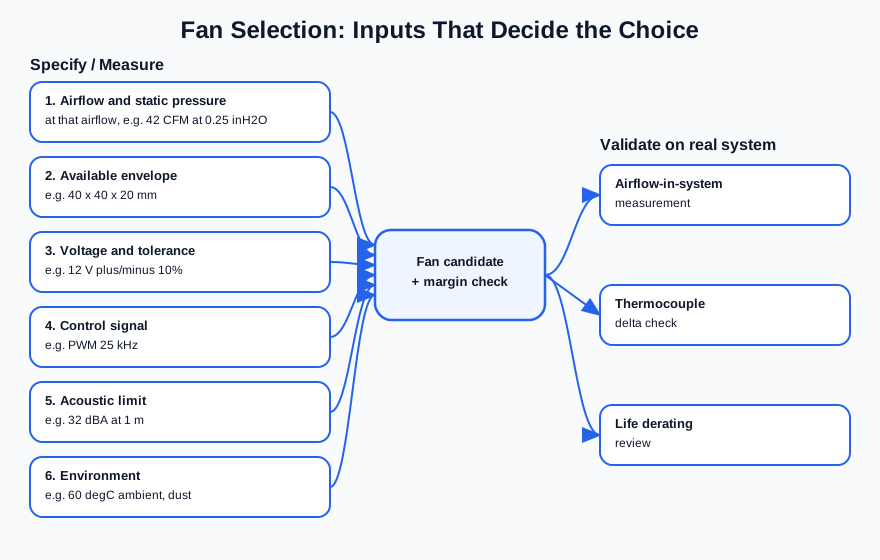
  • Required airflowState target airflow (CFM or m³/h) at worst-case system impedance, e.g. 200 CFM at 120 Pa.
  • Static pressure budgetSum all restrictive elements; add 25-30 % margin for filter and mesh build-up.
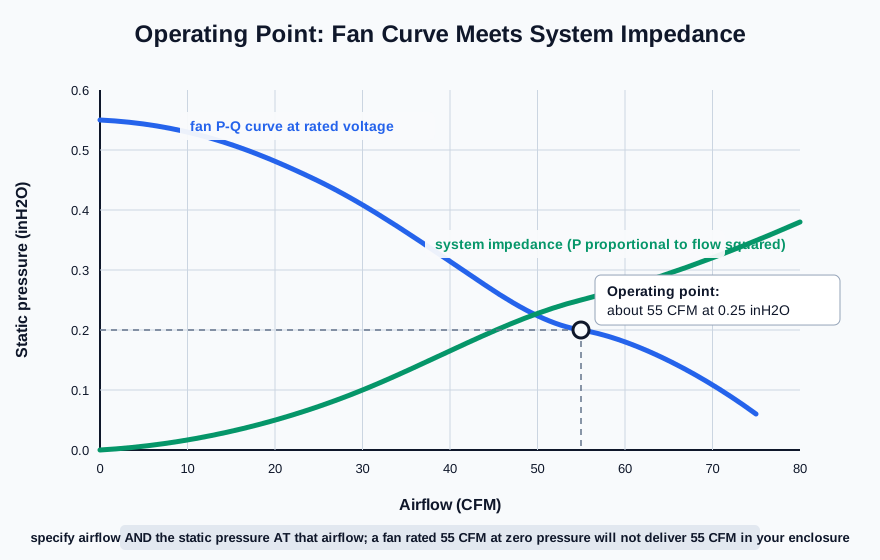
  • Free vs. forced airflowReal-world delivery can drop 40-60 % against impedance; always use P-Q curves, never free-air ratings.
  • Operating pointConfirm the chosen operating point sits outside the unstable stall region across the full PWM range.
Electrical & Control

  • Voltage & toleranceSpecify nominal voltage and band, e.g. 12 VDC ± 10 %, including ripple from the supply.
  • Inrush / start-up currentRecord cold inrush current; it can peak at 2-3x running current for a brief window.
  • PWM control rangeConfirm PWM frequency (e.g. 25 kHz) sits above the audible band, and ask for the duty-cycle-to-RPM curve rather than assuming a linear mapping.
  • Locked-rotor protectionRequire stall detection and auto-restart within 2-5 s so a blocked fan recovers safely.

Environment

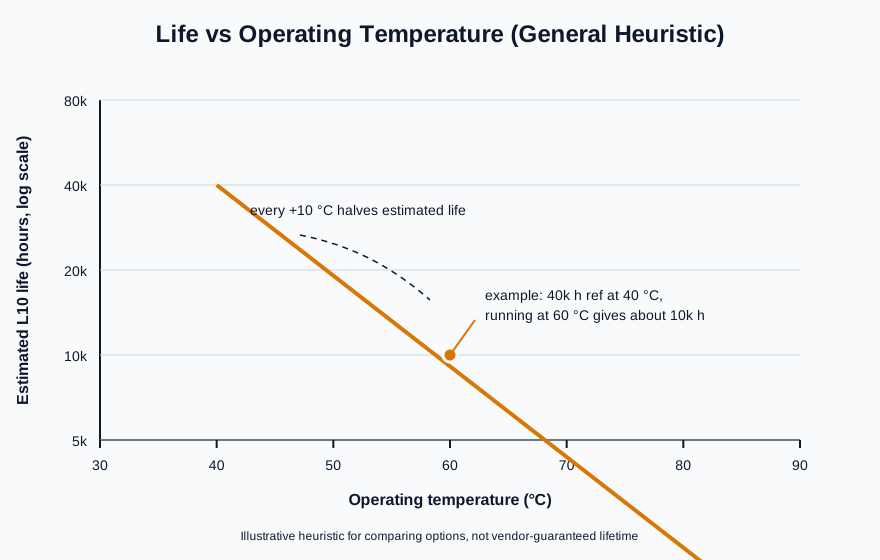
  • Operating temperature rangeAsk for the vendor derating threshold (commonly around 70 °C ambient); bearing life roughly halves for every 10 °C above the rated temperature.
  • Humidity & condensationSpecify conformal coating when RH exceeds ~85 % or under rapid thermal cycling that drives condensation.
  • Ingress protection (IP)Select IP54 or higher for dusty air, IP65+ for washdown or outdoor exposure.
  • Pollutants & vibrationDefine dust load (e.g. ≤ 10 mg/m³), salt-spray duration, and vibration level in G that the fan must survive.

Acoustics

  • Sound pressure level (dBA)Quote at 1 m axial in free field; a 10 dBA rise reads as roughly twice as loud.
  • Loudness (sones)Ask for sones alongside dBA — 1 sone corresponds to 40 phon, and perceived loudness doubles every +10 phon (dBA approximates phon only at mid frequencies).
  • Tonal contentFlag discrete tones (whistling) from blade-pass frequencies; they dominate perception even at low dBA.
  • Measurement conditionsRequire free-field, 1 m, fan-only readings with background noise at least 10 dB below the reported value.

Reliability & Validation

  • L10 bearing lifeAsk which L10 the vendor rates and at what temperature (commonly quoted at 40 °C), then re-derive it at your own ambient before accepting.
  • MTBF figuresConfirm the failure definition (e.g. 10 % of units, electronics vs. mechanics) behind any MTBF claim.
  • Qualification test planRequire 500-1,000 h accelerated run-in plus thermal-shock cycling (-40 °C to +70 °C) on first samples.
  • ESD immunityVerify 4 kV contact / 8 kV air discharge immunity per IEC 61000-4-2 for the control inputs.

Compliance & Documentation

  • Safety certificationsConfirm UL, CE, and UKCA status for the target region with your integrator before design lock.
  • RoHS / REACHRequest current RoHS exemptions and a REACH SVHC declaration of ≤ 0.1 % w/w per substance.
  • IP rating evidenceAsk for the original test-lab report — self-declared IP codes are not proof of sealing.
  • DeliverablesRequire P-Q curves, wiring diagrams, and 2D/3D CAD models with every first article.
Sizing & Specification Checklist

Fan Life Estimation Worksheet (L10)

Estimate bearing life at your temperature and voltage with a 10 °C thermal rule — finished in under a minute from a vendor-supplied rating.

L10_est = L10_ref x 2^((T_ref - T_op) / 10) (valid when the fan runs at rated voltage)

This is a general estimation heuristic for comparing options of equal bearing technology, and it assumes the fan runs at its rated voltage. Voltage affects life mainly through fan speed: if your operating voltage differs materially from rated, use the vendor's speed-life data instead. This estimate is NOT a vendor-guaranteed lifetime and is NOT a substitute for accelerated life testing or the manufacturer's own data.

SymbolFieldUnitExample
L10_refRated L10 life at reference conditionsh40,000
T_refReference ambient temperature for the rating°C40
T_opYour operating ambient temperature°C60
V_ratedRated (reference) voltageV12
V_opYour operating voltageV12
L10_estEstimated L10 life at your conditionsh10,000

Example: L10_ref = 40,000 h at T_ref = 40 °C, fan running at rated voltage. Operating at T_op = 60 °C: L10_est = 40,000 x 2^((40-60)/10) = 40,000 x 2^(-2) = 10,000 h. Same voltage, 20 °C hotter — life drops to one quarter.

Life vs operating temperature heuristic curve

Quick Conversion Tables

Ten unit bridges used most often at the test bench, with factors rounded to three significant figures.

QuantityFromToFactor
AirflowCFMm³/h1 CFM = 1.699 m³/h (multiply by 1.699)
AirflowCFMm³/s1 CFM = 0.000472 m³/s
Airflowm³/hL/s1 m³/h = 0.278 L/s
Static pressurePainH2O1 Pa = 0.00401 inH2O (1 inH2O = 249 Pa)
Static pressurePammH2O1 Pa = 0.102 mmH2O (1 mmH2O = 9.81 Pa)
PressurembarPa1 mbar = 100 Pa
Rotational speedrpmrad/s1 rpm = 0.105 rad/s (multiply by π/30)
Air velocitym/sft/min1 m/s = 197 fpm (196.85)
HeatkWBTU/h1 kW = 3,412 BTU/h
Temperature°C°F°F = 1.8 x °C + 32
Operating point where the fan curve meets system impedance

Downloads

Two printable CSV worksheets you can open in Excel or any spreadsheet: a 24-item sizing and specification checklist, and an L10 life estimation worksheet with the derating arithmetic laid out row by row.

CSVSizing & Specification ChecklistDownload CSV ↓ CSVFan Life Estimation Worksheet (L10)Download CSV ↓ PDFCooling Fan Requirement Checklist (PDF)PDF, English ↓ PDFCooling Fan Sample Validation Record (PDF)PDF, English ↓

Still deciding?

When time is short, skip the guesswork and send us your operating point — airflow in CFM or m³/h, static pressure in Pa, operating voltage, and ambient temperature — and we will propose a shortlist of candidates with data attached. For quick answers on sizing, duty cycle, and control, browse the Engineering FAQ page. Every recommendation we make comes with its P-Q curve and a life estimate, so you can defend the choice in your own review.