
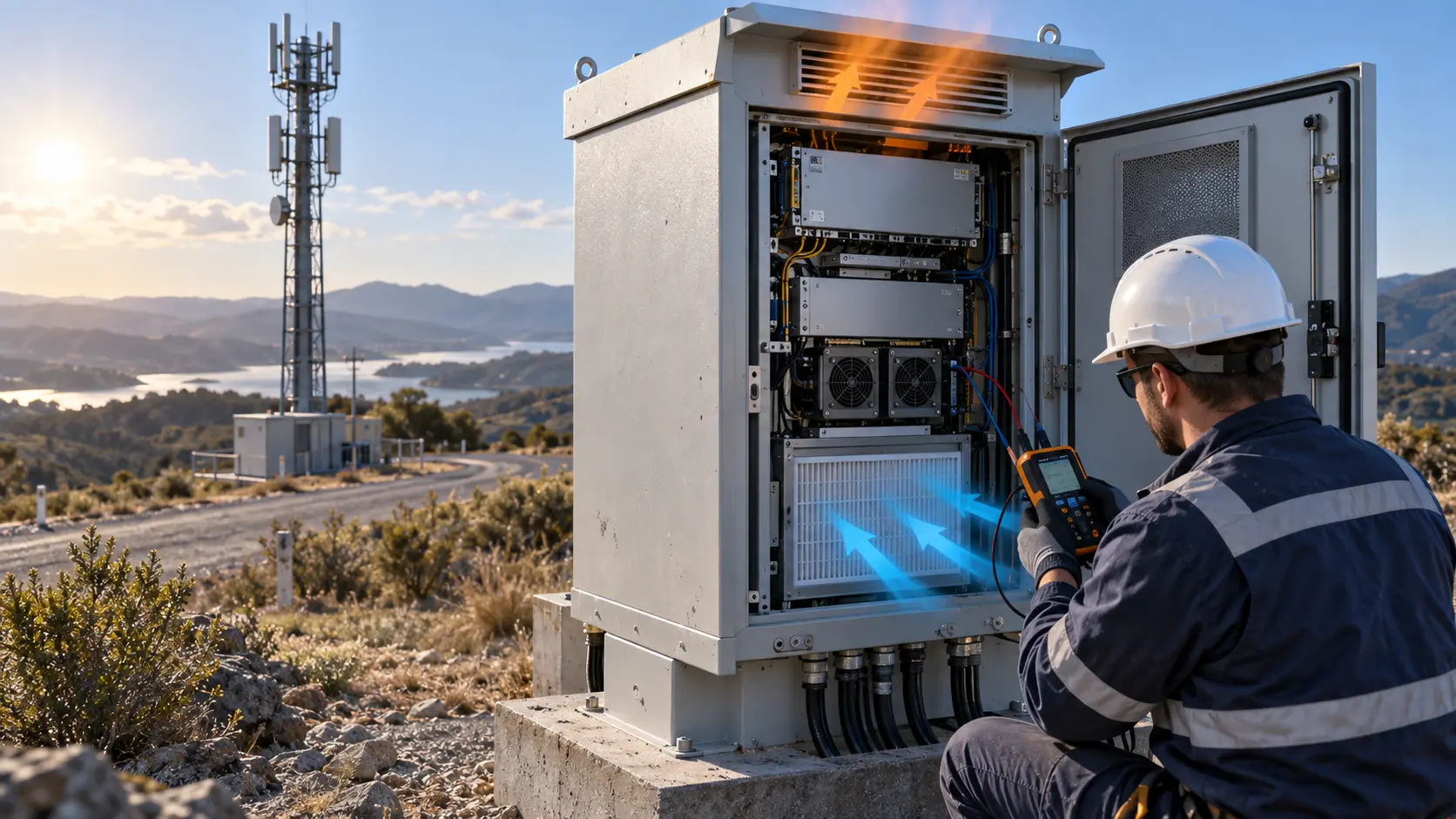
The 5G Cabinet Passed the Bench Test but Lost Thermal Margin Outdoors
An anonymized Middle East telecom integrator needed a 48 V cooling-fan sample for an outdoor radio cabinet exposed to high ambient temperature, dust and long unattended service intervals.
The first fan looked adequate in free air. After the filter, rain hood, grille, cable bundle and internal baffle were installed, delivered airflow dropped and the radio power module became the limiting component. The cabinet also had to keep dust and water ingress within the enclosure strategy, so simply opening a larger vent was not acceptable.
MEGA Tech reviewed the customer's cabinet sample, heat-load list, fan cut-out, filter, voltage, alarm signal, service interval and environmental requirements. The objective was a production-oriented fan and filter sample that could maintain useful airflow at the installed pressure, not a catalogue maximum-airflow claim.
The customer identity and unreleased acceptance limits remain confidential. This case presents the engineering workflow, transparent estimates and validation questions that should be repeated for a real outdoor cabinet.
The Engineering Hook: Outdoor Cooling Is a Thermal and Contamination Decision
A ventilated cabinet must reject heat while accepting only the environmental exposure the equipment and enclosure can tolerate.
ITU guidance describes forced ventilation as a combination of fans and filters that moves outside air while limiting dust, insects and liquid water. In practice, the design also has to consider solar gain, salt, humidity, condensation, altitude, filter fouling and maintenance access. A fan's IP label does not by itself prove that the complete cabinet path meets the required ingress or corrosion strategy.
The integrator needed to decide whether filtered ventilation remained suitable or whether the cabinet would need a heat exchanger or air conditioner. The decision was made from the equipment heat loss and site boundary conditions, not from cabinet volume. The fan sample was developed only for the ventilated configuration and did not replace the cabinet integrator's responsibility for sealing, rain management or condensation control.
This distinction is important for procurement. A higher-pressure fan can recover flow through a loaded filter, but it cannot make an unsuitable open-air architecture safe for salt, water or dew-point conditions.
The Problem in Operation: Filter Loading Moved the Fan to the Wrong Point
The radio cabinet had enough nominal airflow, but the useful operating point shifted as the filter accumulated dust.
The first sample was reviewed at clean-filter condition. When the filter pressure drop increased, the fan moved left on its P-Q curve and the far-side power module received less cooling air. A temperature probe near the fan outlet looked normal, while the component inlet temperature at the end of the internal path continued to rise. The measurement location created a false sense of margin.
The team added pressure taps before and after the filter, at the fan inlet, near the equipment inlet and at the exhaust. They also mapped temperature at the radio module, power supply, battery backup area and cabinet wall. This separated filter loss from bypass leakage and showed whether the internal baffle delivered air to the hot components.
The fan was not judged by the clean-filter number alone. The service limit was defined by differential pressure, delivered airflow, component temperature and the alarm strategy. This allowed the buyer to compare fan options using the same maintenance condition.
Interactive: Watch Filter Loading Change the Installed Duty
The animated schematic shows why the fan command, pressure drop and equipment temperature must be evaluated together.
The figure is qualitative, not CFD or a product curve. In the clean state, the fan has more available pressure margin. In the loaded state, the same command may produce less useful flow. A controller can respond with PWM, but the increased speed must be checked against fan current, noise, bearing life and the cabinet's power budget.
The test plan used clean filter, service-limit filter, reduced fan command and high-ambient states. Each state recorded filter differential pressure, fan voltage and current, PWM command, RPM or FG, equipment inlet temperatures and outlet temperature. If humidity or condensation was a concern, dew point and internal surface temperatures were logged separately.

Sample 01: Start With Heat Load, Solar Exposure and the Real Vent Path
The customer supplied the enclosure and equipment list so the fan sample could be evaluated against the actual cabinet rather than an open test fixture.
The thermal ledger included radio electronics, power conversion, battery or backup equipment, fan input power and an allowance for solar heat. A planning example used 300 W internal heat and a 20 K allowable air rise. The simplified relation Qv = P/(rho x cp x deltaT) gives about 0.0125 m3/s, or roughly 26.5 CFM, before filter margin, leakage, altitude and nonuniformity are considered. This is an estimate for planning, not an acceptance limit.
The cabinet path then added the filter, rain hood, grille, cable openings, shelf and baffles. If those restrictions require 80 Pa at the delivered flow, the selected fan must provide the required flow at 80 Pa, not at zero pressure. The sample was also checked at the available 48 V supply and at the lowest and highest allowed voltage.
The design review included inlet pressurization versus exhaust operation. Positive pressure can help reduce unfiltered dust ingress when the cabinet is opened or leakage exists, but it also requires a controlled exhaust path and a rain-safe filter arrangement. The final architecture remained the integrator's decision.
Sample 02: Tune PWM, FG and the Maintenance Alarm Together
A good outdoor fan sample should tell the controller when cooling capability is being consumed by filter loading or a fan fault.
MEGA Tech compared the customer's PWM command range, FG speed feedback and RD alarm requirement with the candidate fan behavior. The control team set a minimum safe command, a normal thermal curve and a high-temperature response. Hysteresis prevented rapid speed cycling when the cabinet temperature hovered around the threshold.
The filter alarm was treated as a separate signal. A fan spinning at the expected RPM does not prove that the cabinet receives the expected airflow if the filter is blocked or an internal bypass is open. Differential pressure across the filter and temperature at the limiting equipment point provided better maintenance evidence than RPM alone.
The buyer also checked fan current because a higher command during hot weather and filter loading can consume a meaningful part of a remote cabinet's power budget. A 48 V fan drawing 0.8 A uses about 38.4 W; two fans at that condition use about 76.8 W before conversion losses. These are illustrative calculations and must be replaced by the selected fan's actual electrical data.
Sample 03: Validate Dust, Rain, Salt Fog and Service Access
Outdoor reliability is an assembly question: fan, filter, grille, cable gland, coating, connector and cabinet opening must work together.
The sample review checked filter replacement, rain hood geometry, gasket compression, cable routing and connector retention. The fan itself was not presented as a substitute for the cabinet's IP or corrosion qualification. Where salt or corrosive pollution was possible, the integrator defined the material, coating and test method for the complete assembly.
High-ambient operation was tested with the cabinet in its intended orientation and with the solar or external heat assumption stated. The team recorded the fan inlet temperature, winding or electronics limit, component inlet temperature and restart behavior after a thermal shutdown or power interruption.
The acoustic target was also evaluated at the nearest occupied area and during normal and alarm commands. A remote cabinet can be quiet most of the time but become an avoidable noise source when the fan runs at full speed because a filter alarm was ignored.
Validation Result: A Custom Sample Made the Maintenance Limit Measurable
The final sample gave the integrator a clean-filter curve, a loaded-filter operating point and a defined service response instead of a single maximum-CFM number.
The transferable result was a repeatable test method. The fan was evaluated at the actual cabinet pressure, the limiting equipment temperature was measured directly and the filter condition was recorded. The customer could now compare a standard or replacement fan using the same operating states and the same alarm limits.
No universal IP rating, fan life or temperature result is claimed because those values depend on the cabinet, filter, environment, material and test method. The production release package should document P-Q data, voltage range, PWM/FG/RD behavior, current, noise, bearing or life assumption, mounting drawing, filter pressure-drop limit and the complete enclosure qualification boundary.
For procurement, this makes brand substitution more defensible. A replacement fan should match the installed performance envelope and controls, then be validated in the cabinet. Same frame size alone is not proof of equivalence.
How MEGA Tech Supports Outdoor Telecom Fan Customization
MEGA Tech develops custom DC or EC fan samples around the cabinet's real pressure, voltage, environmental and maintenance requirements.
We can review 12 V, 24 V or 48 V requirements, axial or compact blower options, PWM and FG/RD signals, connector and lead-wire details, bearing and life targets, filter pressure drop, dust or salt exposure, temperature range, acoustic limits and small first-build quantities. We can also evaluate replacement options for known brands when the existing operating point and installation are available.
Please provide the cabinet heat load, design ambient, solar exposure, allowable equipment temperature, filter and grille pressure drop, fan cut-out, voltage tolerance, control interface, IP strategy, corrosion environment, service interval and quantity. If data is incomplete, send the current fan part number, cabinet photos and any measured pressure or temperature points.
Our scope is fan and air-path engineering, sample customization and comparative validation. The enclosure maker remains responsible for final IP, rain, condensation, corrosion, EMC, electrical safety and site qualification.
Engineer Questions About This Outdoor 5G Case
Use these questions before approving a ventilated cabinet fan or replacement model.
Q: Is a higher IP-rated fan enough for an outdoor cabinet? A: No. The complete cabinet path, filter, rain management, cable entries, condensation control and corrosion strategy must be qualified together.
Q: Should I select the fan from free-air CFM? A: No. Use delivered airflow at the pressure created by the filter, grille, baffles and exhaust path. Recheck it at the filter service limit.
Q: Can RPM prove that the cabinet still has airflow? A: No. A blocked filter or bypass path can leave RPM normal while useful equipment airflow falls. Measure pressure, airflow or the limiting component temperature.
Q: What should I send for a custom 5G cabinet fan review? A: Send heat load, ambient and solar conditions, allowable temperature, filter curve, pressure target, fan size, voltage, PWM/FG/RD needs, IP and corrosion requirements, noise target and service interval.
Q: Can MEGA Tech provide a custom specification or P-Q curve? A: Yes, after the installed operating point and sample conditions are defined. We can review an existing part number or start from the cabinet drawing and requirements.
Need a 48 V Fan Curve or Custom Specification?
Send the cabinet heat load, design ambient, filter pressure drop, fan size, voltage, control interface, IP strategy, noise limit and service condition. We will review the installed operating point before recommending a sample.
Start with the product information page, or contact a MEGA Tech engineer directly. Include the current fan model, P-Q curve, cabinet photos and any clean-filter or loaded-filter measurements. This helps separate fan capacity from filter, baffle, sealing, rain-path or condensation problems before the production BOM is locked.